

FS-2026-0807 | November 2026
Facilitating Effective Brainstorming with Adult Learners
By Brilliant Asamoah, Graduate Research Assistant, UMD, Xuan Wei, Extension Specialist, UMD, and Colby J. Silvert, Assistant Professor, UMD
Introduction

Practitioners often need effective brainstorming techniques to solve problems or develop action plans using creative approaches. For a vast majority of practitioners (e.g., Extension and outreach professionals), brainstorming approaches can also serve as an essential participatory tool for adults to share ideas, thereby helping sustain their interest in the learning event and promoting lasting knowledge gains (Stofer, 2022). Although brainstorming is often portrayed as a simple process, its facilitation is complex, requiring knowledge of social psychology, motivation, and organizational culture (Wilson, 2013). This publication highlights the principles and best practices that Extension professionals and other adult educators can use in brainstorming activities to achieve desired results.
Brainstorming Principles
Brainstorming is a group creativity technique in which members work to reach a conclusion for a specific problem by spontaneously contributing a list of ideas (Kumar, 2012). Osborn (1953) and Wilson (2013) suggested the following rules or principles that facilitators and participants should adhere to for effective brainstorming:
Encourage all to participate in the session.
Encourage all participants to participate so that diverse perspectives and experiences are represented. Recognize that not everyone is an extrovert or willing to speak up in these settings; use inclusive strategies such as individual idea generation, written responses, and inviting contributions and feedback for a set time period even after the session ends.
Withhold judgment/criticism.
During brainstorming, educators are discouraged from criticizing others’ ideas, either implicitly (through nonverbal cues or facial expressions) or explicitly (through verbal cues). Praising ideas should also be avoided, as participants may interpret unpraised ideas as bad ideas, resulting in a reluctance to share further (Wilson, 2013). Facilitators may encourage participation by celebrating the act and willingness of sharing regardless of the idea’s viability.
Focus on generating a large quantity of ideas.
According to Wilson (2013), the primary criterion for measuring the success of a brainstorming session is the number of ideas generated. The brainstorming session should focus on generating as many ideas as possible, but if prioritizing ideas is part of your objectives, do so at the end of the session. Techniques for prioritizing are discussed later in this publication. Thus, facilitators are encouraged to eliminate anything that limits the number of ideas. For example, a best practice is to designate a member of the facilitating group to take notes on the ideas, rather than have the brainstorming participants take their own notes. However, some constraints help participants focus their thinking and generate more relevant, innovative ideas. Completely removing limits may result in ideas that are unrelated to the problem, unrealistic, and difficult to implement. Additionally, facilitators may face unavoidable constraints such as time, ethical considerations, and learning objectives. Finally, an unconstrained pile of ideas often leads to decision fatigue, where the group or student struggles to transition from divergent brainstorming to convergent decision-making (Habib, 2024).
Encourage new and “wild” ideas.
The purpose of brainstorming is to generate ideas for solving a problem, designing a program, or developing a plan. It is therefore essential to allow participants to free-wheel (i.e., feel comfortable generating ideas without constraints). All ideas should be noted, including “wild” ideas that may not be directly related to the brainstorming topic. However, use different techniques to keep the discussion on the topic, including constantly referring to the main topic or question under discussion. Also note that these “wild” ideas may serve as triggers to foster innovation that seems strange until it becomes mainstream.
Build on others’ ideas.
Educators should ensure that all ideas generated are visible to everyone. This allows participants to identify and build on each other’s ideas. The facilitator or designated note-taker should write ideas on large sheets of paper, such as a flip chart or large sticky notes. For virtual sessions, online whiteboard tools such as Zoom, Teams, or Miro can be used. The ideas should be written in a bold, legible font so everyone in the room can easily read them.
Steps For Planning and Delivering an Effective Brainstorming Session
The purpose of brainstorming is to generate a large quantity of creative ideas (Phillips, 2011; Wilson, 2013). Along with brainstorming, other ways to generate ideas include free listing (see Brewer, 2002 for more), brainwriting (Heslin, 2009), and braindrawing (Collins, 2017). Once you have
decided that brainstorming is a viable method to find solutions or answer your questions, the following steps may be helpful to achieve success:
- Identify your meeting objectives or desired outcomes. You should clearly identify objectives for the meeting, which may include developing a list of ideas or finding a solution to a problem.
- Develop the right question(s) or topic. Asking the right questions will not only help you generate a large number of ideas but also produce highquality ones. The question or topic should neither be overly broad nor so narrow that creativity or exploration is limited. Educators should use “How,” “Why,” and “What” questions, ensuring they focus on a specific problem or need. Facilitators should balance structured questioning with opportunities for participants to freely interact and build on one another’s ideas, including using follow-ups when discussion slows or becomes too narrow, and avoiding having the facilitator respond to every contribution.
- Decide whether participants should do any “pre-learning” before the brainstorming session. For unfamiliar topics, it can be helpful to assign participants “homework” before the session to prepare their minds and encourage more ideas. According to Kelley (2001), participants who engage in prior “homework” generate more and better ideas. To ease the burden on participants, provide a variety of options, including reading, watching, or listening to something on the topic, or a question for the brainstorming session, so participants can choose what fits their learning style.
- Select the right participants and facilitator and determine the group’s size and composition. The simple rule is to select people who can answer the question you will ask (Coyne & Coyne, 2011). If you are not comfortable facilitating a brainstorming session, consider someone with experience conducting similar activities, such as focus groups. It is important to note that some contentious and dominant participants require experienced facilitators who will focus on eliciting as many ideas as possible and on reminding participants of the session’s objectives. If large groups are difficult to manage, consider breaking large groups into smaller subgroups of three to six members and designating a leader for each subgroup. The leader may guide the group discussion, take notes, and share the group’s ideas with the larger session audience.
- Draft an agenda, rules, and introduction for the session. The agenda should outline the time allocated for introductions, discussion of the topic and procedure, warm-up exercise, and the brainstorming session itself. It should also include breaks and any post-brainstorming activities. The introduction should include the facilitator’s role, the session’s goals, timeline, ground rules, process, and the purpose of the data (Wilson, 2013). Ground rules are a set of rules agreed upon beforehand to guide how the participants interact and work together. Ground rules should be tailored to your participants and the session’s objectives, incorporating key principles and best practices that align with these objectives.
- Choose a comfortable location for the session. Consider rooms with limited interruptions and enough space for flipcharts and posting ideas so everyone can see everything. Berkun (2010) proposed using a room other than the one used for everyday meetings and talks. If the session is online, designate a member of the facilitating team to ensure everything works, including screen sharing, muting, or unmuting.
- Utilize a range of techniques to stimulate ideas. Educators are encouraged to explore ways to generate new ideas and build on existing ones. Commonly used techniques include round-robin, in which participants take turns sharing ideas; mind mapping, which organizes ideas visually; stepladder, which builds on ideas by introducing participants one by one; and rapid ideation, which focuses on generating a large number of ideas in a short period of time. Ritter & Mostert (2018) suggest beginning brainstorming in silence, in which participants reflect on the topic and on how to approach the idea-generation process. Other techniques include lines of evolution, which treat topics as biological organisms that adapt, mutate, and branch over time, and random connections, a lateral thinking technique that forces the brain to bridge the gap between the current topic/problem and a completely unrelated, randomly chosen object or concept. Based on the topic and the session’s objectives, facilitators should decide and use the technique that best fits.
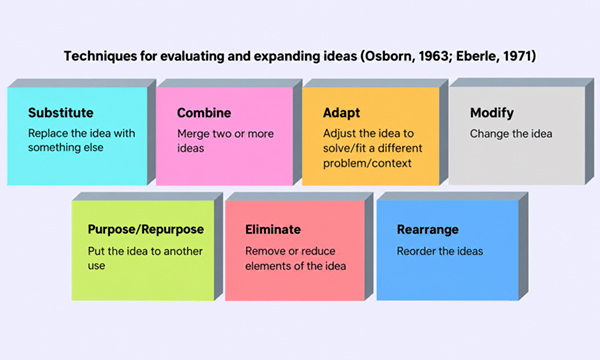
- Evaluate and expand ideas. Based on the session’s goals and if captured in the agenda, engage participants in evaluating the ideas to select the best ones. You may also consider changing and expanding ideas. The goal is to improve the best ideas, so the facilitator must separate the idea from the person and shift the mindset from “grading” to “shaping.” Osborn (1963) and Eberle (1971) proposed the SCAMPER technique: substitute, combine, adapt, modify, purpose/repurpose, eliminate, and rearrange ideas, as explained in Figure 2.
Conclusion
Adult educators are encouraged to use participatory methods, such as brainstorming, in their educational and outreach programs. However, they should recognize that the approach requires strict adherence to principles and best practices to address both the content and process aspects of facilitation. When used appropriately, it fosters collaboration and creativity in a relaxed environment, allowing adults to tap into their prior experience. However, if not managed effectively, the process may lead to disorganized, deviated, extrovert-dominated conversations and eventual groupthink. Participants may prioritize
agreement and conformity over critically examining different perspectives and alternatives. This can suppress dissent, discourage original ideas, and reduce the diversity and quality of ideas generated.
References
Berkun, S. (2010). The myths of innovation. O’Reilly Media, Inc.
Brewer, D. (2002). Supplementary interviewing techniques to maximize output in free listing asks. Field Methods 14(1):108-118. https://doi. org/10.1177/1525822X02014001007
Coyne, K. P., & Coyne, S. T. (2011). Seven steps to better brainstorming. McKinsey Quarterly, (2), 1-8. https://www.mckinsey.com/~/media/McKinsey/ Business%20Functions/Strategy%20and%20 Corporate%20Finance/Our%20Insights/Seven%20 steps%20to%20better%20brainstorming/Seven%20 steps%20to%20better%20brainstorming.pdf
de Bono, E. (1970). Lateral thinking. Penguin Books. Eberle, R. F. (1971).
SCAMPER: Games for imagination development. D.O.K. Publishers.
Edwards, S., & Cooper, N. (2010). Mind mapping as a teaching resource. The Clinical Teacher, 7(4), 236-239. https://doi.org/10.1111/j.1743- 498X.2010.00395.x
Fry, D., Nhenga-Chakarisa, T. C., Izumi, N., & Bernheim, B. (2022). Round robin: A new qualitative methodology for identifying drivers of violence against children. The Qualitative Report, 27(9), 1975-1997. https://doi.org/10.46743/2160-3715/2022.5501
Habib, S., Vogel, T., Anli, X., & Thorne, E. (2024). How does generative artificial intelligence impact student creativity?. Journal of Creativity, 34(1), 100072. https://doi.org/10.1016/j.yjoc.2023.100072
Heslin, P. A. (2009). Better than brainstorming? Potential contextual boundary conditions to brainwriting for idea generation in organizations. Journal of Occupational and Organizational Psychology, 82(1), 129-145. https://doi.org/10.1348/096317908X285642
Kaimal, G., Ayaz, H., Herres, J., Dieterich-Hartwell, R., Makwana, B., Kaiser, D. H., & Nasser, J. A. (2017). Functional near-infrared spectroscopy assessment of reward perception based on visual self-expression: Coloring, doodling, and free drawing. The Arts in Psychotherapy, 55, 85-92. https://doi.org/10.1016/j.aip.2017.05.004
Kelley, T. (2001). The art of innovation: Lessons in creativity from IDEO, America’s Leading Design Firm.
Kumar, V. (2012). 101 design methods: A structured approach for driving innovation in your organization. John Wiley & Sons.
Levine, J.M. & Hogg, M.A. (eds.) (2010). Stepladder technique. Encyclopedia of group processes & intergroup relations (pp. 851-853). SAGE Publications, Inc. https://doi.org/10.4135/9781412972017.n263
Osborn, A. (1963). Applied imagination. Charles Scribner’s Sons.
Osborn, A. (2012). Applied imagination: Principles and procedures of creative writing. Read Books Ltd. Phillips, J. (2011). Relentless innovation: What works, what doesn’t–and what that means for your business. The McGraw-Hill Companies, Inc.
Ritter, M. S. & Mostert, M. N. (2018). How to facilitate a brainstorming session: The effect of idea generation techniques and of group brainstorm after individual brainstorm, Creative Industries Journal, 11:3, 263-277 https://doi. org/10.1080/17510694.2018.1523662
Stofer, K. (2017). Education and Facilitation Methods for Extension: AEC619/WC281, 4/2017. https://doi.org/10.32473/edis-wc281-2017
Stofer, K. A. (2022). Education and Facilitation Methods for Extension: AEC619/WC281, 4/2017. EDIS, 2017(2). https://doi.org/10.32473/edis-wc281-2017
Wilson, C. (2013). Brainstorming and beyond: A user-centered design method. Newness.
Zane, L., & Zimbroff, A. (2021). Ideation techniques and applications to entrepreneurship. Annals of Entrepreneurship Education and Pedagogy. https://www.google.com/books/edition/Annals_of_Entrepreneurship_ Education_and/-rMTEAAAQBAJ?hl=en&gbpv=1&dq=rapid+ideation+techni ques+in+Extension&pg=PA63&printsec=frontcover
Zlotin, B. & Zusman, A. (2006). Patterns of evolution: Recent findings on structure and origin. Ideation International.
BRILLIANT ASAMOAH
basamoa1@umd.edu
XUAN WEI
xuanwei@umd.edu
COLBY J. SILVERT
csilvert@umd.edu
This publication, Facilitating Effective Brainstorming with Adult Learners (FS-2026-0807), is a part of a collection produced by the University of Maryland Extension within the College of Agriculture and Natural Resources.
The information presented has met UME peer-review standards, including internal and external technical review. For help accessing this or any UME publication contact: itaccessibility@umd.edu
For more information on this and other topics, visit the University of Maryland Extension website at extension.umd.edu
University programs, activities, and facilities are available to all without regard to race, color, sex, gender identity or expression, sexual orientation, marital status, age, national origin, political affiliation, physical or mental disability, religion, protected veteran status, genetic information, personal appearance, or any other legally protected class.
When citing this publication, please use the suggested format:<
Asamoah, B., Wei, X., & Silvert, C. J. (2026). Facilitating Effective Brainstorming with Adult Learners (FS-2026-0807). University of Maryland Extension. go.umd.edu/FS-2026-0807.