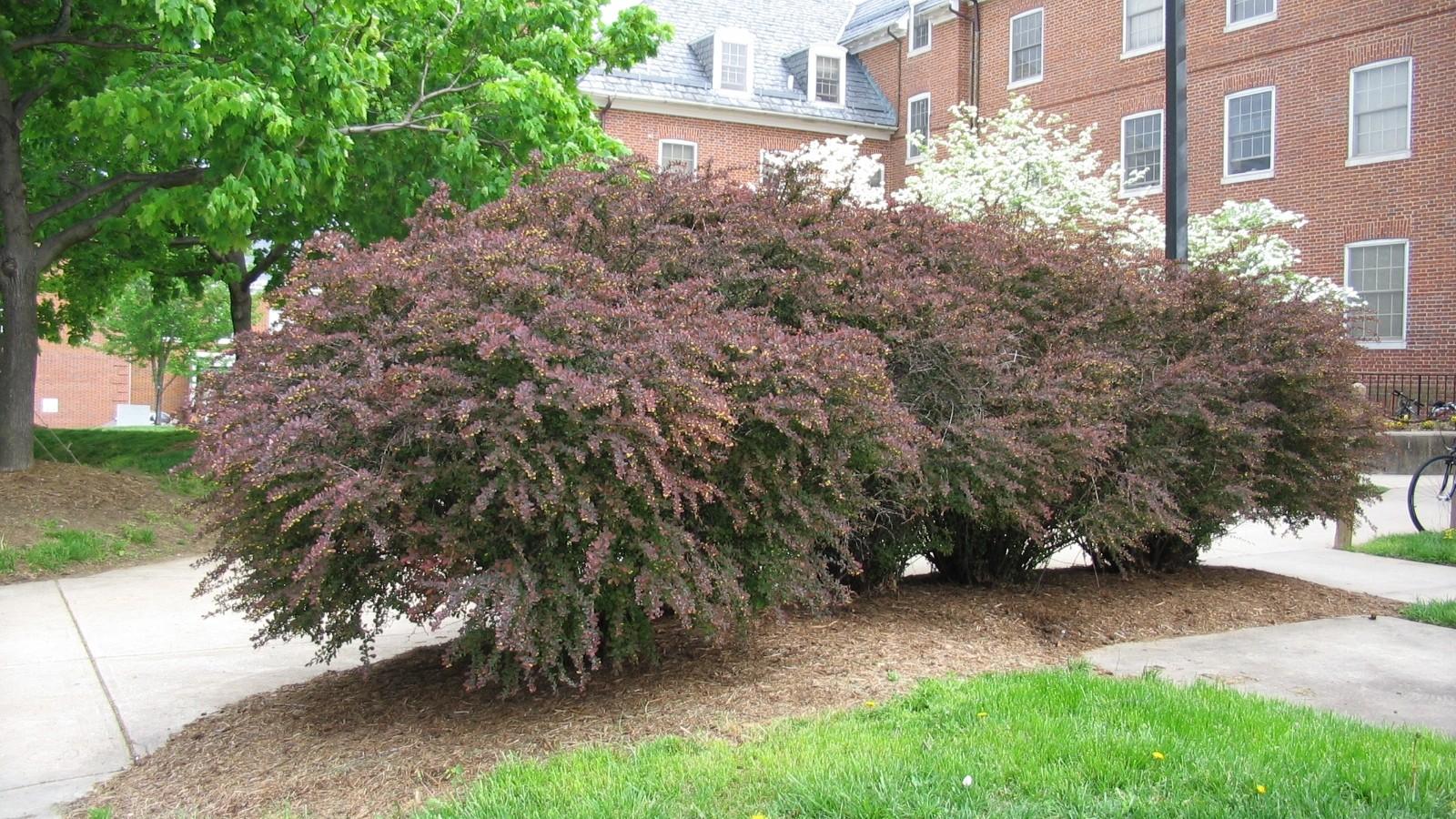
A red-leaved cultivar of Japanese barberry (Berberis thunbergii) grown as an unpruned hedge.
Photo: Miri Talabac, University of Maryland Extension
Updated: April 29, 2026
Japanese barberry (Berberis thunbergii) is a deciduous flowering shrub native to Japan. It was introduced to the U.S. in the mid-1800s. It has become widely in landscaping due to its resistance to deer browsing, easy maintenance, adaptability, and tolerance of dry, poor soils and urban conditions.
European Barberry (Berberis vulgaris) looks similar to Japanese barberry but is rare in Maryland. American/Allegheny barberry (Berberis canadensis) also has similar features; while native to a small portion of the southeastern U.S., it does not grow wild in Maryland.
Physical features of Japanese barberry
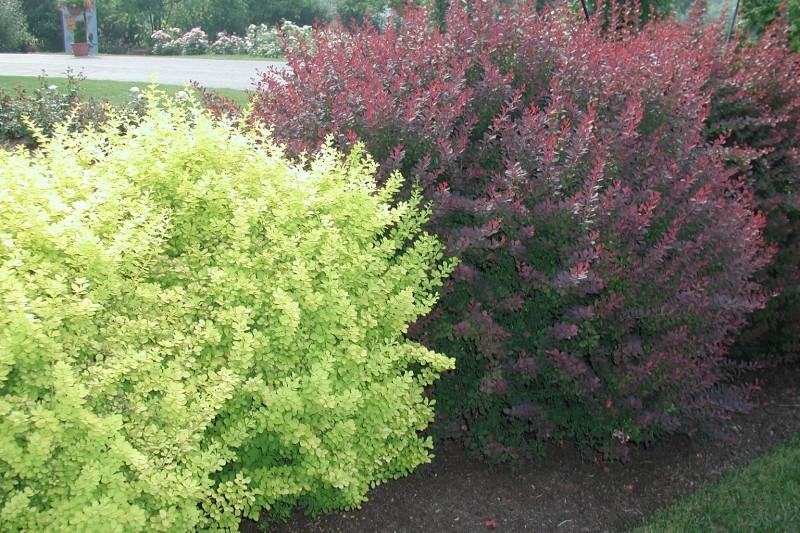
Dozens of cultivars have been developed in recent decades for compact growth habits and a range of foliage colors. In managed landscapes, the leaves are often reddish-purple or yellow-green in color. When seedlings spread into natural areas (especially in woodland shade), they often revert to green leaves and develop a more arching branch structure that forms thickets when the plants take over the understory.
Although not planted for showy blooms, numerous flowers are produced in mid-spring when the shrubs are not regularly pruned (since pruning may remove some flower buds). Pollinated flowers produce berries that ripen in autumn and persist (until eaten by wildlife) into winter. The foliage usually turns red or orange in autumn before shedding.
Growth rate and habit: moderate growth rate (about 1 or 2 feet per year); multi-stemmed, rounded habit, often with arching branches (for plants that are not dwarf or pruned regularly)
Typical mature size: 2 to 8 feet tall and wide, depending on genetics (dwarf varieties grow slowly and stay more compact) and environment (full sun can keep plants more compact than shade)
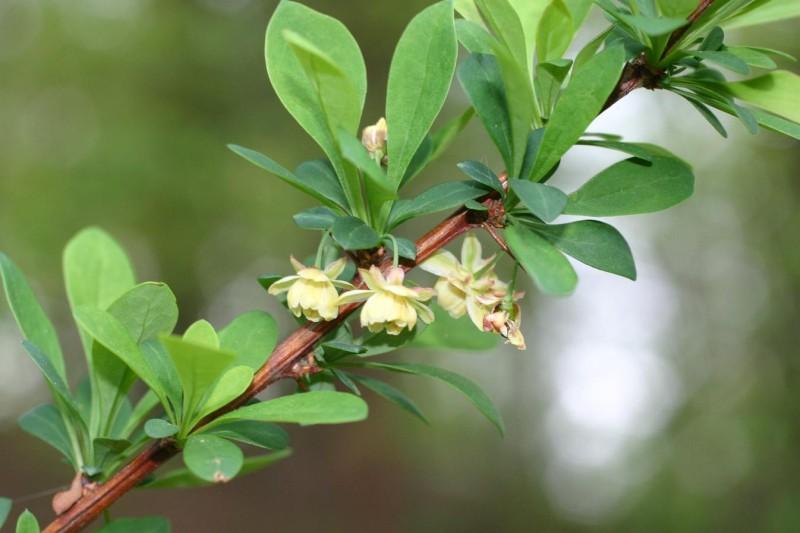
Blooms: small, drooping, pale yellow flowers with multiple petals; on short stalks in small clusters
Leaves: simple (not divided into leaflets) with smooth margins and a tapering, narrow base; alternate arrangement on the stem
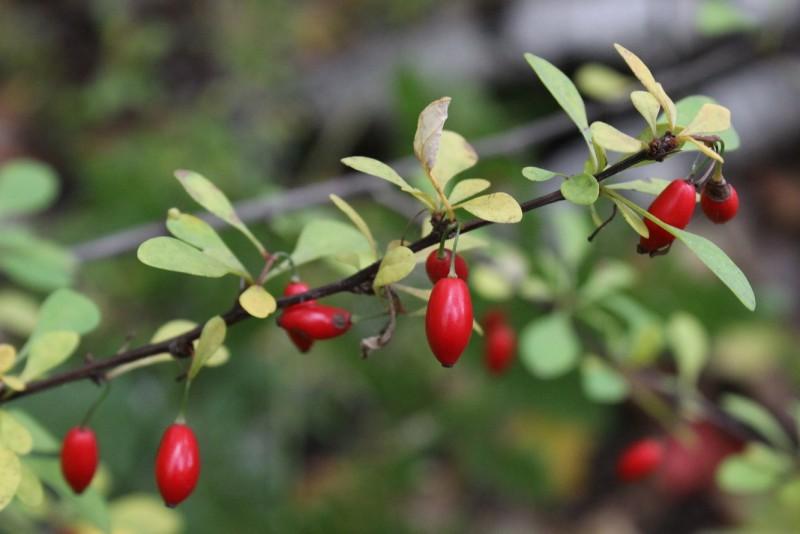
Fruit: bright red glossy berries on short stalks
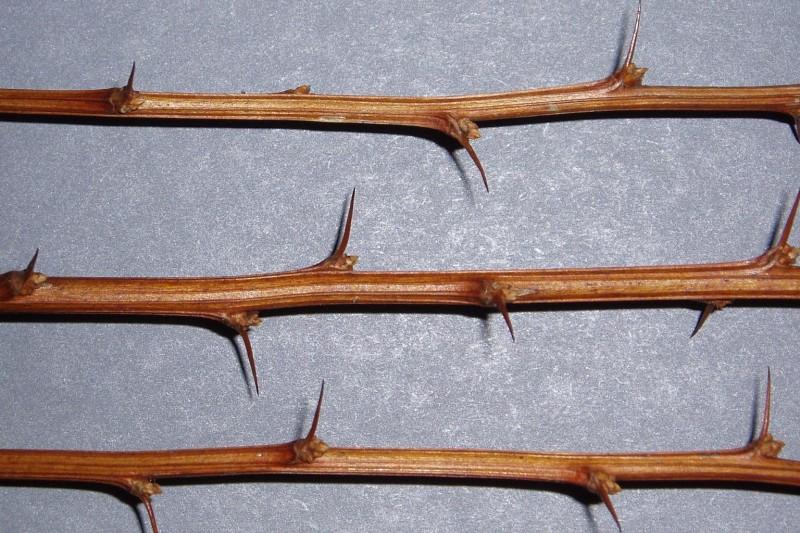
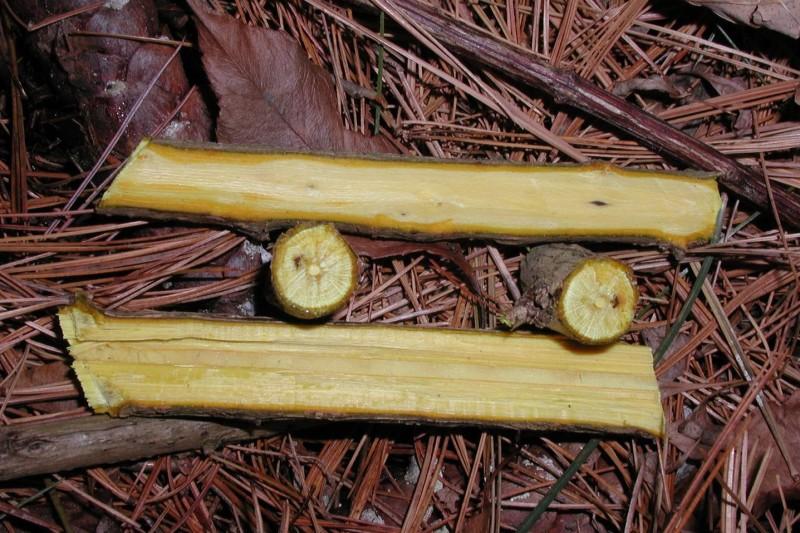
Stems: a slender, sharp spine grows at each node (where a cluster of leaves, flowers, and fruits attach to the stem); the inner wood (under the bark) is yellow, a trait shared with relatives Nandina and Mahonia
Cluster of pale yellow drooping flowers on a Japanese barberry stem. Photo: Leslie J. Mehrhoff, University of Connecticut, Bugwood.org
Glossy red berries hanging from a barberry stem. The foliage is just beginning to change color for autumn. Photo: Chris Evans, University of Illinois, Bugwood.org
Slender spines growing from nodes on the stem, readily visible on leafless branches. Spines are easily felt but hard to see on leafy branches. Photo: Leslie J. Mehrhoff, University of Connecticut, Bugwood.org
Japanese barberry wood is yellow, particularly just under the bark. Photo: Leslie J. Mehrhoff, University of Connecticut, Bugwood.org
Japanese barberry cultivars are commonly yellow-leaved or red/purple-leaved. Photo: Leslie J. Mehrhoff, University of Connecticut, Bugwood.org
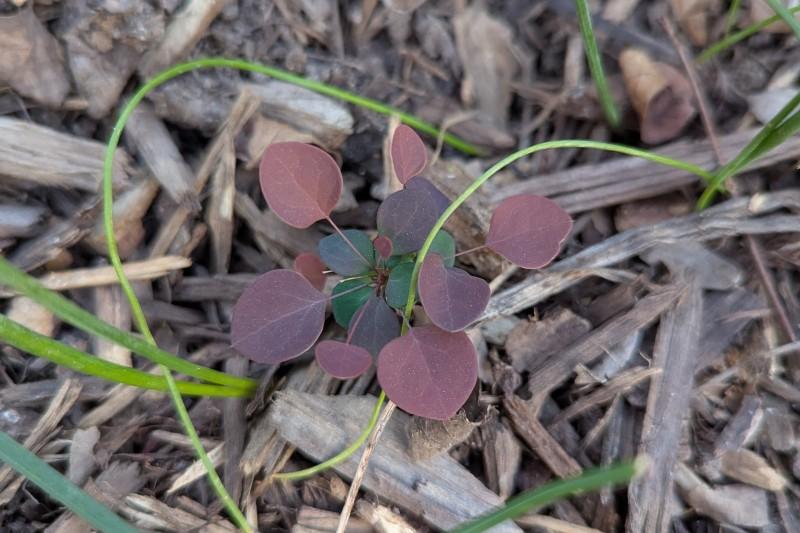
Some red-leaved Japanese barberry cultivars produce seedlings with the same leaf color. These can be hard to spot when surrounded by bark mulch in a garden bed. Photo: Miri Talabac, University of Maryland Extension
Environmental impacts of Japanese barberry
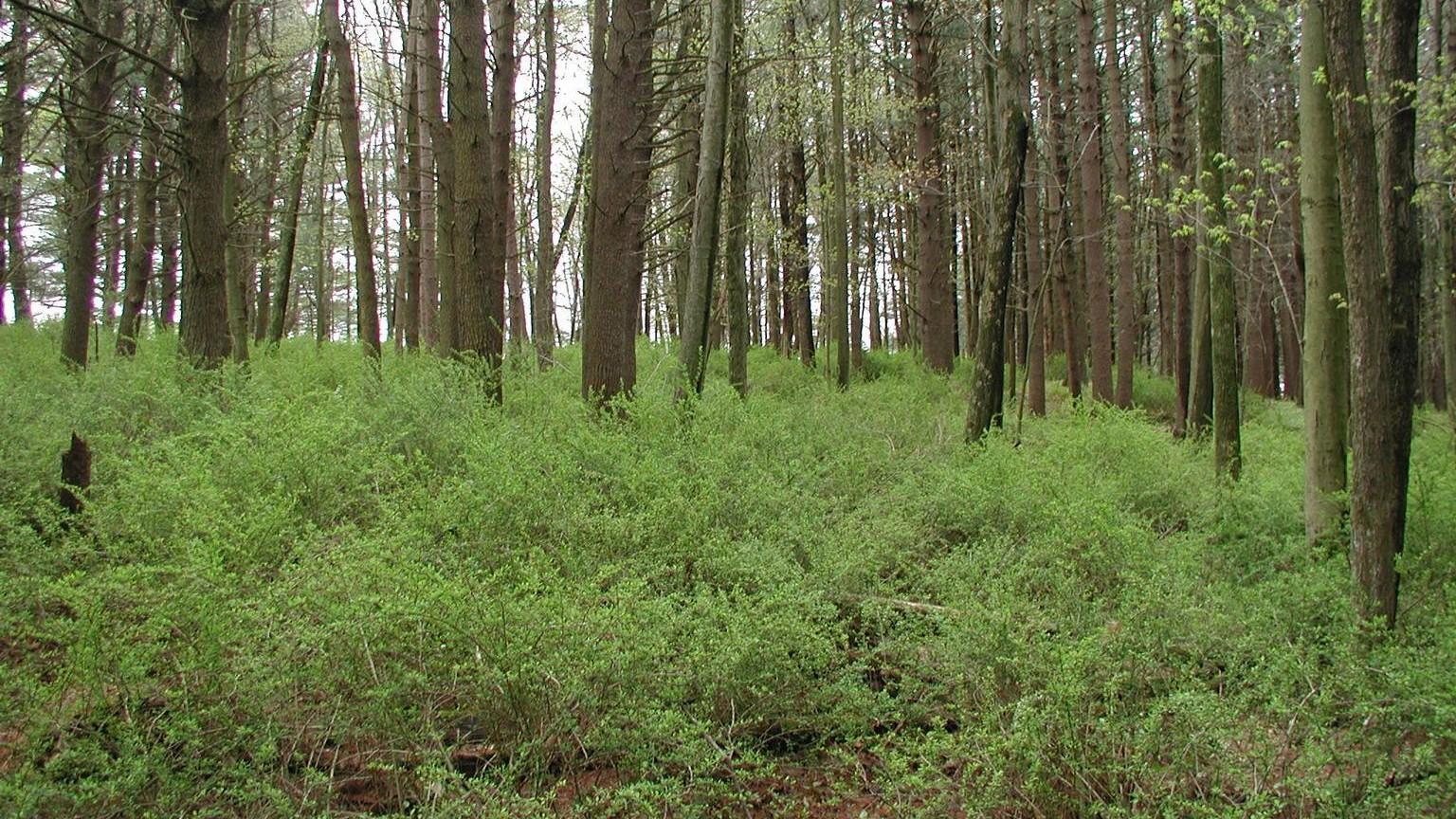
Japanese barberry is an invasive species and spreads by seeds dispersed by birds and small mammals. If branches arch over and touch the ground, they can root; new stems can also arise from rhizomes (spreading roots). A single shrub can form a dense impenetrable mass. White-tailed deer prefer not to eat Japanese barberry, which allows it to spread more easily as native plant competition is browsed.
Japanese barberry that seeds into woodlands often takes over the understory (since deer don't eat it) and bears green leaves. Photo: Leslie J. Mehrhoff, University of Connecticut, Bugwood.org
The shrub's dense foliage and low branching creates an ideal, humid environment for black-legged ticks (deer ticks) which can carry the pathogen that causes Lyme disease.
Conditions that favor growth
Japanese barberry thrives in full sun and tolerates deep shade. It is highly adaptable to many habitats, including forests, wetlands, pastures, and meadows. Colonies of barberry forms dense thickets and displace native species.
Alternatives to Japanese barberry
Do not plant Japanese barberry, and replace existing specimens when possible. The Maryland Department of Agriculture (MDA) regulates the sale of invasive plants, and Japanese barberry is a prohibited species under Maryland law. Refer to the MDA's Maryland Prohibited Invasive Plant Law and Regulations resource page for more information and a list of all other regulated species.
Some cultivars of Japanese barberry are marketed as sterile. Once a species is listed as prohibited, MDA regulations apply to all cultivars of that species unless individual cultivars are later granted an exemption.
Several native or non-invasive shrub species can be grown instead of Japanese barberry. Some have comparable features of low deer palatability, drought tolerance, or ease of pruning. Cultivars of some native or non-invasive shrub and perennial species have showy summer foliage colors comparable to those of barberry cultivars, such as reddish-plum, bronze-orange, and yellow-green. For best wildlife value, avoid cultivars with reddish-purple leaves, which could negatively affect leaf-feeding native insects, or plant them sparingly.
Kaufman, Sylvan Ramsey & Wallace Kaufman. 2007. Invasive Plants: Guide to Identification and the Impacts and Control of Common North American Species
Swearingen J., K. Reshetiloff, B. Slattery, and S. Zwicker. 2002. Plant Invaders of Mid-Atlantic Natural Areas. National Park Service and U.S. Fish & Wildlife Service, Washington, DC.