
Ten Years of Managing Grower-Friendly Apple Trees Created at the Maryland Research and Education Center in Keedysville, Maryland
By Christopher Walsh1, Carol Allen1, Julia Harshman1, Kathleen Hunt1, and Douglas A. Price2
1 Department of Plant Science and Landscape Architecture, University of Maryland, College Park, Maryland.
2 Western Maryland Research and Education Center, Maryland Agricultural Experiment Station, Keedysville, Maryland.
During the past winter we interviewed more than 100 people in the apple business ecosystem. When we asked them what their most important problem is. Their answer was “labor”. This is not only a problem for American apple growers. It was a top problem mentioned by fruit growers in the Republic of South Africa and by fruit growers in Chile, Peru and Mexico.
To address the labor issue, we began an apple breeding project in the 1990s. Our goal was to create grower-friendly apple trees with reduced susceptibility to fire blight, were scion-dwarfed to reduce pruning labor, and produced quality apples under Maryland's hot, humid growing seasons.
To test the tree size, vigor and management needs of our apple trees, we planted a series of our "Elite Selections" a decade ago at Keedysville. Each selection was grafted onto a clonal semi-dwarf rootstock. Merton-Malling 111 (M,111) is a vigorous semi-dwarf stock that produces trees that are about 70 percent of standard size. Trees were planted at a 9 by16 foot spacing (302 trees per acre) in four randomized blocks. Each replicated plot in this planting consisted of three trees of the same scion-rootstock combination. The trees were left unpruned for a decade to observe their natural size, architecture, and fruit quality.
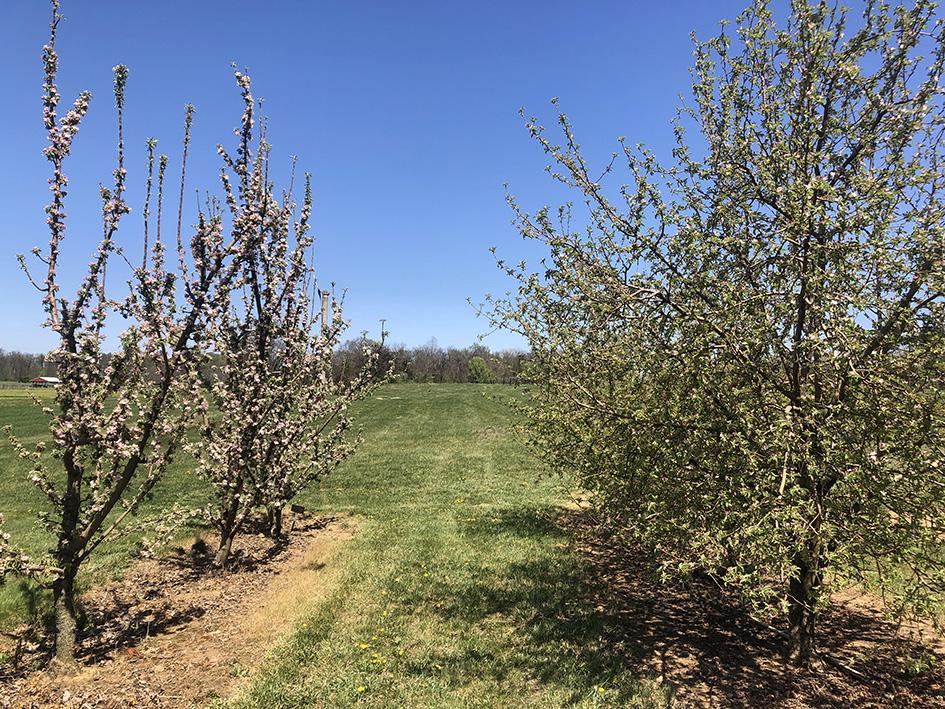
After ten years of unpruned growth, these elite trees had outgrown their initial spacing and were difficult to manage (Figure 1). During this past winter, two of the three trees in each replicated plot were removed. The remaining trees were lightly pruned in March, 2026. Pruning cuts were made prior to budbreak using a lightweight chainsaw on a pruning pole. The time needed to make the necessary thinning-out cuts was recorded as minutes per tree. To make the pruning times meaningful, time per tree was multiplied by 302 to give an estimated pruning time required per acre.
In the text below we list a few attributes of the elite trees evaluated in this planting.
CGM-1W (An unpatented seedling thought to be McIntosh Wijcik pollinated by Gala)
- Trunk cross-sectional area 15.2 cm2
- Upright spur-type tree with short, stiff branches and short internodes
- Produces large, yellow apples that ripen in early September
- Pruning time estimated as 10.1 hours per acre.
MD-TAP1 (A patented, novel seedling of Goldrush apple tree)
- Trunk cross-sectional area 20.4 cm2
- Upright spur-type apple tree with some pliable branches and short internodes
- Produces yellow apples that ripen in early September
- Pruning time estimated as 10.1 hours per acre.
MD/TAP2 (A patented, novel seedling of Fuji apple tree)
- Trunk cross-sectional area 23.9 cm2
- Upright spur-type tree with still branches and short internodes
- Red apples that ripen in mid-September to mid-October
- Pruning time estimated as 22.6 hours per acre.
F610 (An unpatented, vigorous Fuji seedling apple tree)
- Trunk cross-sectional area 23.0 cm2
- Upright tree with a strong central leader and good branch angles)
- Yellow apples that ripen in late September
- Pruning time estimated as 51.3 hours per acre.
CP101 (A patented, Cripps Pink seedling apple tree marketed as Antietam Blush)
- Trunk cross-sectional area 35.2 cm2
- “Umbrella-type” tree with thin branches that fruit on lateral and terminal buds
- Produces red apples that ripen in mid-to-late October
- Pruning time estimated as 65.4 hours per acre.
The architecture of these seedling trees varied considerably. Figure 1 shows the dramatically larger canopy volume between CP101 and MD-TAP1 trees budded on M.111 rootstock. We also noted an increase in pruning time with an increase in trunk cross-sectional area (TCA). This is logical, as the TCA is correlated with the dry weight of wood measured in an unpruned apple tree.
Once we saw that it was possible to develop a much smaller tree on M.111 rootstock, we began trials with MD-TAP1 and MD-TAP2 budded on G.890 rootstock. Geneva 890 is a precocious, semi-dwarf rootstock recently released by the USDA/Cornell University apple-rootstock breeding program. Our goal with these plantings was to test whether the scion dwarfing in the MD-TAP patented trees budded onto a semi-dwarfing rootstock could create a manageable pedestrian orchard.
To maximize early production, no pruning was made on the G.890 planting until the summer of the third leaf.That pruning merely isolated the central leader. At the beginning of the fourth leaf, rootstock suckers were removed and the central leader was headed at about eight feet (See Figure 2). No additional heading cuts were made in the scaffold limbs to keep them pliable. This dormant pruning was completed quickly; it required about 30 seconds per tree. With fewer simple tasks, we believe these trees sill recuce hand labor, and could be easier to handle using mechanized, robotic pruning.
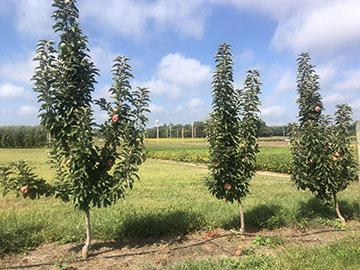
We began planting MD-TAP1 and MD-TAP2 trees on G.890 rootstocks at Keedysville in 2023 using a six-foot in-row spacing. Since that worked well, we planted rows of this same scion-rootstock combination at 40, 60 and 80 inch in-row spacings in 2025. In that 2025 planting we hope to train the trees to be ‘robot-ready’.
While the University of Maryland does not propagate trees for sale, we are working closely with commercial fruit-tree nurseries to evaluate this budwood. Once nurseries begin commercial propagation, growers should be able to plant orchards that require less labor. These trees could also eliminate the need for trellising for a manageable pedestrian orchard. Obviating the need for trellises will save growers thousands of dollars per acre in new plantings.
This article appears in July 2026, Volume 17, Issue 6 of the Vegetable and Fruit News