
When Saltwater Reaches the Field: What Crops Still Work?
February 2026 | Written by: Jarrod Miller, Patricia Ramalho de Barros, Alison Schulenburg, and Katherine Tully
Coastal Fields Are Changing
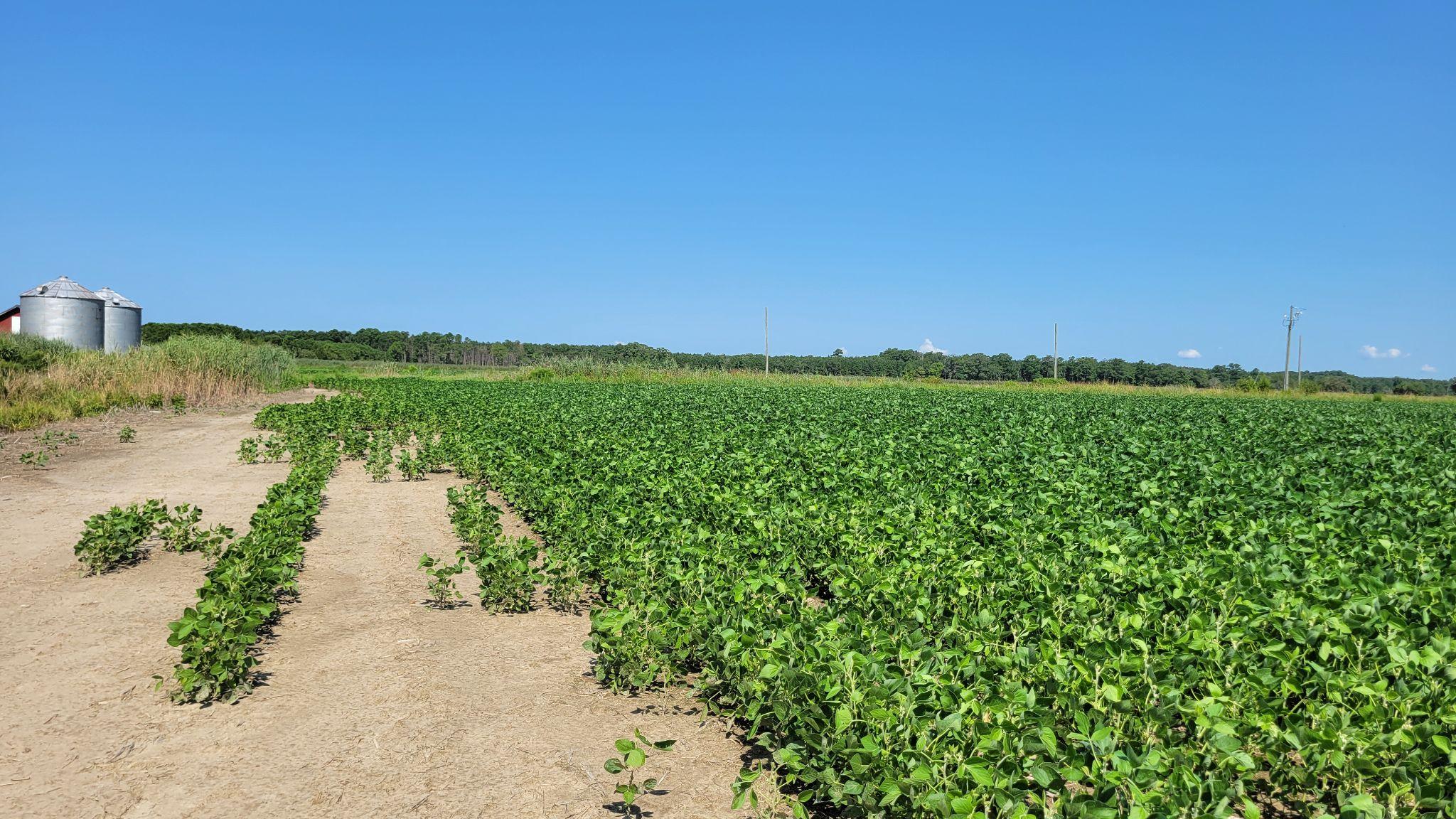
Coastal cropland across Delmarva is facing a growing challenge — saltwater intrusion and inundation (SWI). Tidal flooding and storm surges are pushing salty water onto field edges (inundation), while rising groundwater brings salt up from below (intrusion). Together, these processes increase soil salinity and reduce crop establishment and yield potential. Saltwater does not stay at the shoreline. It often moves inland through drainage ditches connected to tidal creeks, allowing affected areas to expand over time and placing entire fields at risk (Figure 1).

Crops Respond Different to Salinity
Crops vary widely in how much salt they can tolerate. As soil salinity increases, sensitive crops lose yield first, while more tolerant crops may continue to produce. For example, corn can begin losing yield at relatively low salt levels, while small grains such as barley tolerate much higher concentrations before major losses occur. Salinity tolerance has been evaluated for many grain and vegetable crops. For specific tolerance levels in our region, see the University of Delaware factsheet Salt Effects on Crops of the Delmarva Peninsula
Examining Grain Crop Tolerances to Salinity
To understand how crops perform under real coastal conditions, we monitored grain production in working farm fields affected by saltwater intrusion on Maryland’s Lower Eastern Shore. Fields bordered tidal creeks and wetlands and included both actively farmed areas and portions previously abandoned because crops could no longer survive.
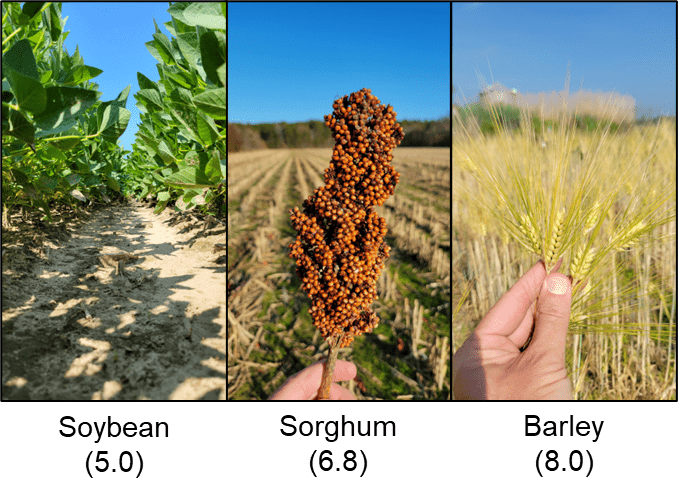
We grew a rotation of sorghum, soybean, and barley across natural elevation changes from the field edge to the interior (Figure 2). These crops represent common regional grain options and differ in salt tolerance (barley > sorghum > soybean).
Small Elevation Changes Strongly Affect Yield
Crop performance closely followed elevation in the landscape (Figure 3). As elevation decreased, soil salinity increased rapidly. In our observations, a practical threshold emerged — once areas dropped below 2 feet above tides, soil salt levels rose sharply and crop success became unreliable. Even very small differences in elevation — just a few inches — could determine whether a crop survived or failed.
Crop Responses in Our Study
Sorghum was the most reliable option where other crops struggled. It tolerated moderate salinity, early-season drought, and deer feeding, though bird foraging affected small plots.
Soybean showed inconsistent performance. It produced well only in low-stress areas with timely rainfall and minimal deer pressure.
Barley, while the most salt-tolerant crop in the rotation, performed poorly when soils were saturated in the winter. In these low-elevation areas, wet soil conditions were often more limiting to growth than salinity
Key Takeaways
Saltwater intrusion is increasingly affecting low-lying coastal fields, and even small differences in elevation — just a few inches — can determine whether crops survive. Sorghum proved to be the most reliable option under these conditions, while soybean and barley were more sensitive to combined stresses like wet soils, salinity, and wildlife pressure. Understanding field elevation and salinity patterns can help farmers match crops to the right spots, protect yields, and make informed decisions about which areas may no longer be suitable for production. Other strategies for marginal areas include planting more salt-tolerant perennial grasses, such as switchgrass or Spartina patens, or considering conservation easements to protect vulnerable land.
For more information see our paper published in Discover Agriculture below.
This outreach was supported by USDA-NIFA: 2018-68002-27915.
References
Miller, J.O., de Barros, P.R., Schulenburg, A.N., Tully, K.L. 2025. Coastal stressors reduce crop yields and alter soil nutrient dynamics in low-elevation farmlands. Discov Agric 3, 119. https://doi.org/10.1007/s44279-025-00303-7