

FS-2025-0766 | June 2026
Growing Blueberries in the Mid-Atlantic
By Haley Sater, Ph.D., Agriculture Educator, University of Maryland Extension, Wicomico County, and Bryan Butler, Agriculture Educator, Carroll County
Introduction
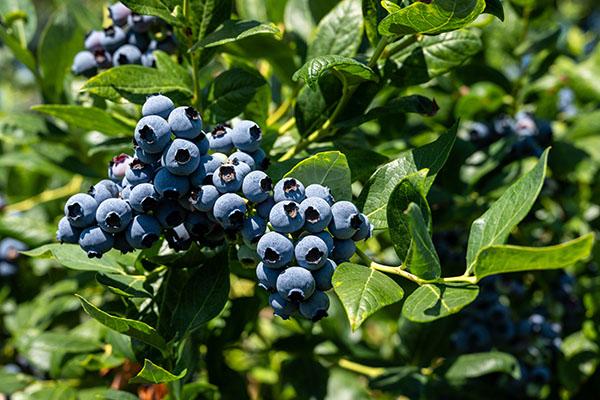
Blueberries are a high-value crop that can thrive in the Mid-Atlantic region with proper site selection, soil preparation, and management. This factsheet provides an overview of best practices for growing blueberries in this region, including information on soil and pH requirements, planting and pruning techniques, irrigation, fertilization, and common weeds and pests. Whether you’re a backyard gardener or a commercial grower, this guide offers regionally relevant insights to support healthy, productive blueberry plants.
Blueberries in America
The blueberry plant is native to North America. Wild blueberries were growing in Maryland when the first European settlers arrived. According to Maryland’s Biodiversity project there are seven native species of blueberries in the state (Maryland Biodiversity Project, n.d.). They’re generally confined to high organic matter soils at the edge of hardwood forests but can also be found in exposed rocky mountain slopes. The need acid soil usually coupled with high organic matter, which limits the range of habitats where blueberries can grow successfully. Plants take several years to bear fruit, but once established, can live for 30 years or more if maintained properly.
Nearly all blueberries grown commercially, known as “highbush” cultivars, are related to the wild species Vaccinium corymbosum commonly found in the Mid-Atlantic and first cultivated for production in New Jersey in the early 1900s. The primary commercial species grown in the U.S. are Northern and Southern Highbush. The rabbiteye (Vaccinium virgatum) species is grown commercially mostly in Georgia, a few parts of Florida, and South Carolina. However, most production in the southern US is now Southern Highbush. Additionally, the “lowbush” blueberry (Vaccinium angustifolium) grows wild in New England and Eastern Canada over large acreages and is harvested commercially.
Considerations Before Planting
Blueberries are not an easy crop to grow. Besides having specific soil needs, blueberry plants attract feeding birds and fruit production is not recommended during the first years after planting. In addition, blueberries are a soft fruit, which must be marketed soon after harvest. Before you decide to grow blueberries, consider your soil’s suitability, your access to irrigation, if labor is available during harvest, and if markets are close by. In addition, blueberries are sensitive to drought. Because rainfall during the summer in Maryland can be sporadic, don’t grow this crop without irrigation.
Site Selection and Preparation
Blueberries do best in soil where crops have never or seldom been grown. Land newly cleared of woods is best because the soil is generally rich in decomposed leaves. Blueberry plants prefer well drained soils and usually don’t perform well in heavy, clay soil. Always have your soil tested for pH, nutrient levels, and organic matter content before planting. Your county Extension educator can assist you with these tests and recommend how to improve your soil before planting.
To grow blueberries, ensure your soil has at least 4% organic matter; closer to 8% is ideal. You can raise the organic matter content by growing cover crops and turning them under. Organic matter can also be added in the form of composted sawdust, wood chips, leaves, or a similar material. The ideal organic amendment for growing blueberries is pine bark mulch, pine fines or pine needles. Pine bark has a pH of 4-5, making it an ideal substrate for blueberries. Peat moss is another effective low-pH organic amendment that may become too expensive when added to a large area. Standard commercial compost is not a suitable soil amendment for blueberries because the pH of this material is too high.
An ideal pH range for blueberries is 4.5 to 5.3. If blueberries are planted into soil with a pH higher than 5.5, they will be stunted and grow slowly. Additionally, you will begin to see symptoms of nutrient deficiency in the plants, such as interveinal chlorosis, where the areas in between the veins of the leaves turn yellow. This is often the first symptom that iron is unavailable to the plant, which is caused by high soil pH.
When soil pH is too high for blueberries, add and incorporate elemental sulfur (S) to lower soil pH. Table 1 gives the amount of sulfur needed to lower soil pH to 4.5. It will take 2 to 3 months or more during the growing season for sulfur to be converted by soil microbes into an acid that lowers soil pH. Replacing sulfur with iron sulfate or mixing the two together can speed up the process. However, do not use aluminum sulfate because aluminum, at high concentrations, is toxic to plants. The amount of sulfur needed to lower soil pH depends primarily on the texture of the soil and the Cation Exchange Capacity (CEC) of the soil. Sandy texture soils require the least sulfur to affect pH whereas heavier clay soils require the most sulfur to reduce pH. Soils with higher CEC require more sulfur to lower pH because CEC buffers soil pH (Longstroth, 2015). If you are unsure of the texture, but your soil analysis report included CEC, you can use CEC as an approximation for soil texture where sandy texture: < 8 meq/100 g, loamy texture: 9-12 meq/100 g, and clay texture: 12-17 meg/100 g (Longstroth, 2015).
| current pH | lb for sandy soil | lb for loamy soil | lb for clay loam soil |
|---|---|---|---|
| 7.0 | 1.75 | 7.5 | 8 |
| 6.5 | 1.5 | 6 | 6.5 |
| 6.0 | 1 | 4.5 | 5 |
| 5.5 | .75 | 3.0 | 3.5 |
| 5.0 | .5 | 1.5 | 2 |
Planting Density and Topography
Blueberry plantings are usually established in rows having a within row spacing of 4-6 ft, and between row spacing of 10 to 12 feet. Blueberries can be planted as close as 8 ft between rows to achieve more plants per acre; however, this can make it harder to bring equipment such as vehicles between rows which should be considered before planting. A typical 1-acre planting may have between 605 plants per acre(using 6 ft in row spacing and 12 ft between rows)and 1,089 plants per acre (using 4 ft in row spacing and 10 ft between rows).
Blueberries should not be planted in low lying areas of fields which are prone to flooding. Blueberries are prone to root rot diseases which are enabled by wet soil conditions. Growers who have poorly draining fields or low areas in their fields would benefit by planting into raised beds to improve gravitational drainage in blueberry fields.
Irrigation
Blueberries require at least 1 inch of water per week from rainfall or irrigation, with consistent moisture especially critical during fruit development and ripening. Trickle irrigation is recommended as the primary system for blueberry production in the Mid-Atlantic. Drip lines should be installed at or before planting to ensure adequate moisture during establishment and eliminate the risk of drought stress following transplanting. Overhead sprinkler systems are occasionally used but are not recommended as a primary irrigation method because they are less water-efficient and leave foliage wet, which can increase disease risk.
Pruning, Planting and Establishment
While there are a large number of blueberry plant cultivars on the market, first time growers might consider looking for ‘Bluecrop,’ an older reliable variety which is widely planted and adapts well to a variety of soils. Consult the University of Maryland Extension publication Blueberry Cultivars for Maryland and the Greater Mid-Atlantic Region for other cultivar recommendations for Maryland. Try to order plants that are two to three years old. Plants younger than this often lack the root system to survive the shock of transplanting. When plants arrive, keep them cool and moist until planting time. Just before planting in the field, “butterfly” the root ball of each plant to generate root growth out and away from the original shape of the container. To butterfly the root ball, remove the pot, lay the plant on its side, and cut through the roots lengthwise with a knife. Set plants in the ground at their original depth, with the top of the root ball level with the ground. More blueberry plantings fail from being buried too deeply when they’re transplanted than from most other causes (except perhaps lack of water). Blueberry is a shallow-rooted plant, and putting the roots too deeply in the soil will cause problems. Tamp soil lightly around the roots on all sides and water. For the first two years, remove flowers when they appear. This allows the plant to establish a good root system before it has to support any fruit.
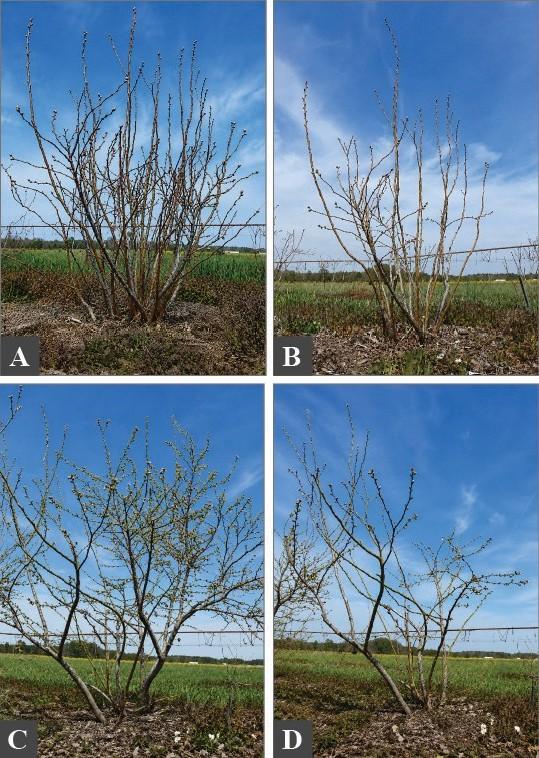
Little or no pruning is needed in the first three years of blueberry establishment. After that, remove some of the older canes each year. The goal is to have new, vigorous canes grow from the base every year. Don’t remove cane tips. An individual cane will remain productive for about six to seven years.
It may become difficult to determine which canes to remove. Older canes will appear light in color and often have loose or peeling bark. Prune the canes at the base. This type of pruning opens the plant canopy to light, which stimulates fruit bud and growth, invigorates the plant and encourages growth from the crown. Remove short canes that are small in diameter and that don’t grow more than 18 inches in their first growing season as they are not very productive. When pruning healthy mature plants, take out one of every six canes, selecting the oldest for removal. Plants should produce at least two to three new canes per year. Be aware that different varieties have different growth habits and may require more or less pruning depending on plant vigor. Some plants will grow tall, and others short and squatty. Some varieties produce a few robust, woody canes and others produce many thin canes. To keep canes from bending over, you may need to stake the taller varieties once the berries have set.
Fertilizing
Choosing the right fertilizer is essential for blueberries. Nitrogen (N), which is the most important macronutrient for plants, is best taken up by blueberries in certain forms. Use either ammonium sulfate or urea to fertilize, but not ammonium nitrate. Generally, it’s best to use urea when your soil pH is at or below 5 and ammonium sulfate if your soil pH is above 5 because ammonium sulfate lowers soil pH. Blueberries can only take up small amounts of nitrate forms of N and the conventional wisdom within the industry has been to avoid nitrate-based fertilizers. However, modern research has suggested that a ratio of 2:1 ammonium nitrogen to nitrate nitrogen could be beneficial for blueberry growth compared to only fertilizing with ammonium nitrogen at the same rate. (Xu, et al., 2021). If you are fertilizing with a single source of N, use ammonium.
After planting, don’t fertilize young blueberry plants. If you planted new plants in the spring and have had a second flush of growth in the summer, you may add 100 pounds of 10-10-10 fertilizer per acre within blueberry rows. When using blended 10-10-10, check the guaranteed analysis. Many formulations supply nitrogen largely as ammonium and urea, which are acceptable for blueberries, but the potassium is commonly provided as potassium chloride (KCl). Blueberries are sensitive to chloride injury, so products that supply potassium as potassium sulfate (K₂SO₄) are preferred. If your fertilizer contains KCl, consider choosing a sulfate-based product or adjusting your potassium source accordingly. During the plant’s second year, apply a split application of N in two equal parts within planted rows. Use ammonium sulfate or urea at 10 lb. N per acre just after bloom followed by a second application 6 weeks later for a total of 20 lb. If you are using ammonium sulfate, apply 48 lb. per acre, or 22 lb. of urea per acre. For each additional year increase the amount of N per acre by 10 lb. until year 8 when 80 lb. N is applied. These are general recommendations, and the individual nitrogen needs for your planting may differ based on your soil type, cultivar, or a myriad of other factors. The best way to confirm that your planting has adequate nitrogen and other nutrients is to take leaf tissue samples in early summer (June or July) of the most recent fully mature leaves and have them analyzed by a professional lab for percent nutrient content.
If you have less than an acre of blueberries or would like to fertilize individual plants, the following are application rates of ammonium sulfate (given in ounces per plant per year):
- Year 2 = 4 ounces
- Year 3 = 5 ounces
- Year 4 = 6 ounces
- Year 5 = 7 ounces
- Year 6 = 8 ounces
- Year 7 and up = 8 ounces
Because blueberry plants are sensitive to pH, have the soil tested every year and adjust using sulfur to lower pH if your pH rises above 5.3. However, it’s possible to make the soil pH too acidic. If your soil pH falls below 4.3 you will need to apply lime to prevent aluminum toxicity and other nutrient imbalances.
Harvesting and Storage
Early-bearing varieties of blueberries ripen in late June; late-bearing varieties continue to ripen through August. Berries will turn blue several days before they’re ripe. When a reddish color remains on the side of the berry near the stem, the berry is not quite ripe. Blueberries are not climacteric fruit and will not continue to ripen once they have been harvested. During the harvest season, berries will need to be picked once a week. Each plant will yield about 6 to 10 pounds of fruit. Store harvested berries at 32° F and 95-percent humidity. Cover berries in containers with cellophane to prevent shriveling caused by moisture loss.
Weed Management
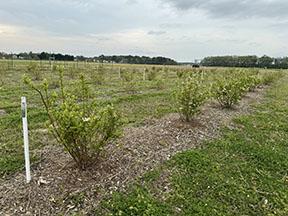
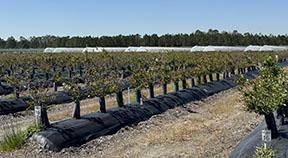
Weed management is particularly important in the establishment years of a blueberry planting. Because blueberries grow slowly the first several years, managing and preventing weeds from becoming established in rows is imperative. If you planted blueberries in rows, it is customary to either mulch the tops of the row for a 3–4-foot swath on either side of the plant (Figure 2). Other common weed control measures are the use of woven plastic landscape fabric in rows (as shown in Figure 3). If you plant blueberries and allow grass to become established, it is necessary to weed or cut the grass within the row several times during the growing season to prevent blueberry plants from being outcompeted by weeds. Several pre-emergence and postemergence herbicides are labeled for use in blueberries, although many of them are labeled for plantings older than one year (Besancon, et al., 2024). Check the labels of each product before you purchase. For more information about what herbicide and other chemical control product can be used in a blueberry planting check Commercial Blueberry Pest Control Recommendations for New Jersey, which is updated every two years (https://njaes.rutgers.edu/pubs/publication.php?pid=e265).
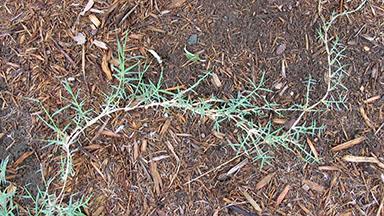
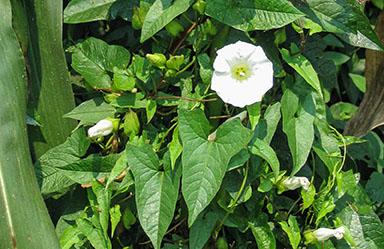
Be vigilant about preventing the establishment of perennial weeds in your blueberry planting. Particularly problematic weeds in blueberry plantings include Bermuda grass (Figure 4), milkweed, nutsedge, mulberry, Virginia creeper, bindweed (Figure 5), and Canada thistle.
Pests
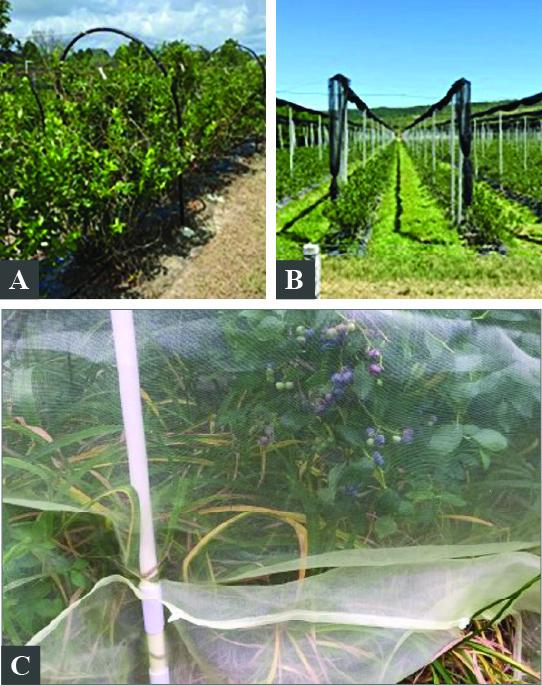
The greatest pest problem for blueberries is feeding birds. Just as the berries begin to color, birds will roost in nearby trees and fly into the bushes, devouring large quantities of fruit. Growers have devised a few techniques to deter birds. Balloons, Mylar tape, noisemakers, and recorded distress calls have all proved somewhat effective. A chemical extract from grapes, methyl anthranilate, has also been used with limited success. However, after berries are treated, they may have a bitter, grapelike residue. For small scale growers, it may be necessary to put nets over the plants to harvest the crop (Figure 6); bird netting is the most effective way to prevent birds from feeding and can be purchased in a range of mesh netting sizes from 1 inch to ¼ inch or finer. Finer mesh or shade cloth (20% or less) can also be used for bird exclusion and tangles less than netting.
Insect pests can affect your blueberry harvest as well. Spotted wing drosophila (SWD) is a new invasive fruit fly that lays eggs inside of the blueberry fruit. After the eggs have hatched, the larvae begin to feed on the fruit and the berries shrivel and collapse on the inside, making the fruit unmarketable. The primary way growers control this pest is with insecticidal sprays; however, Cornell University researchers have tested some fine netting material to see if spotted wing drosophila can be excluded from plantings. The researchers found that 80-gram netting (mesh size 1.0 x 0.6 mm) effectively and repeatedly excluded SWD over multiple seasons of trials (McDermott & Nickerson, 2014).
Although other pests, such as blueberry maggot, have been reported in large blueberry plantings, this particular pest has never been a serious problem in Maryland. To prevent mummy berry disease, use fungicide sprays from bloom and maintain good sanitation practices (such as prompt removal of ripe or diseased fruit and wood). Follow a spray schedule recommended for commercial small fruit production such as the Spray Program for Multi-Small Fruit Plantings found at https://extension.umd.edu/resource/spray-program-multi-small-fruit-plantings/ (Myers, 2024), which contains a complete spray schedule and listing of chemicals for commercial production.
Conclusion
Blueberries can diversify farm income, enhance pick-your-own operations, or provide fruit for home use. To benefit from this long-term fruit crop, growers must select an appropriate site, prepare the soil properly, and provide ongoing care. Successful production requires a thorough understanding of the crop’s needs, especially low soil pH, high organic matter, consistent irrigation, and timely pruning and fertilization. New farmers and small-scale growers can succeed with blueberries if they invest time upfront in soil improvement and plant establishment. Commercial growers who have access to markets and harvest labor can also take advantage of this high-value crop. With good planning and careful management, growers can rely on blueberries to produce for decades.
References
Besancon, B., Oudemans, P., Pavlis, G., Polk, D., Rodriguez-Saona, C.& Ward, D. (2024). 2024 Commercial Blueberry Pest Control Recommendations for New Jersey. Publication E265.
Longstroth, M. (2015). Lowering the soil pH with sulfur. Michigan State University Extension Service. https://www.canr.msu.edu/uploads/files/Lowering_Soil_pH_with_Sulfur.pdf
McDermott, L. & Nickerson L. (2014). Evaluation Of Insect Exclusion and Mass Trapping As Cultural Controls of Spotted Wing Drosophila in Organic Blueberry Production. NY Fruit Quarterly, Vol. 22, pp.25-28.
Maryland Biodiversity Project. (n.d.). Checklist – Genus Vaccinium. Retrieved November 21, 2025, from https://www.marylandbiodiversity.com/checklist/?genus=Vaccinium
Myers, D. (2024). Spray Program for Multi-Small Fruit Planting. University of Maryland Extension, College Park, MD. https://extension.umd.edu/resource/spray-program-multi-small-fruit-plantings/
Xu, J., Fang, Y., Tavakkoli, E., Pan, X., Liao, F., Chen, W. & Guo, W. (2021). Preferential ammonium: nitrate ratio of blueberry is regulated by nitrogen transport and reduction systems. Scientia Horticulturae, 288, p.110345.
HALEY SATER
hsater@umd.edu
BRYAN BUTLER
bbutlers@umd.edu
This publication, Growing Blueberries in the Mid-Atlantic (FS-2025-0766), is a part of a collection produced by the University of Maryland Extension within the College of Agriculture and Natural Resources.
The information presented has met UME peer-review standards, including internal and external technical review. For help accessing this or any UME publication contact: itaccessibility@umd.edu
For more information on this and other topics, visit the University of Maryland Extension website at extension.umd.edu
University programs, activities, and facilities are available to all without regard to race, color, sex, gender identity or expression, sexual orientation, marital status, age, national origin, political affiliation, physical or mental disability, religion, protected veteran status, genetic information, personal appearance, or any other legally protected class.
When citing this publication, please use the suggested format:
Sater, H., & Butler, B. (2003, updated 2026). Growing Blueberries in the Mid-Atlantic (FS-2025-0766). University of Maryland Extension. go.umd.edu/EBR-2025-0766.
Additional Resources on Growing Blueberries
-
Blueberry Cultivars for Maryland and the Greater Mid-Atlantic Region (FS-2025-0777) >
Blueberry Cultivars for Maryland and the Greater Mid-Atlantic Region (FS-2025-0777) > -
Spray Program for Multi-Small Fruit Plantings >
Spray Program for Multi-Small Fruit Plantings >