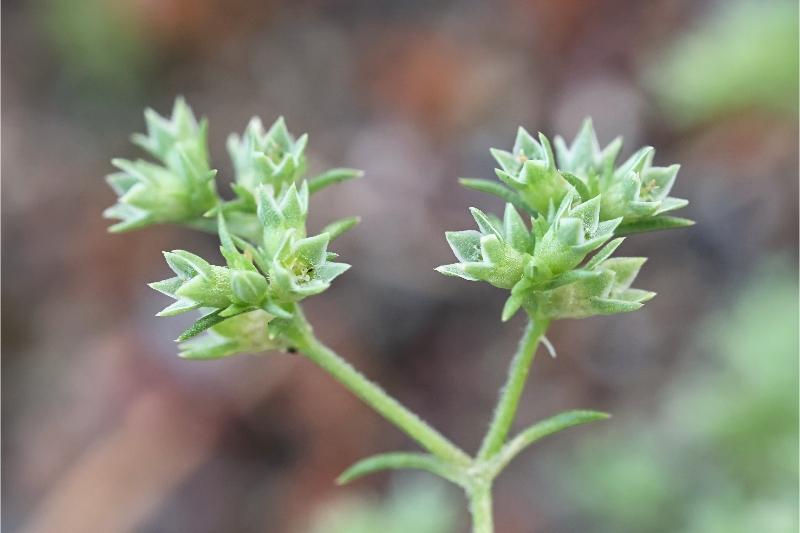
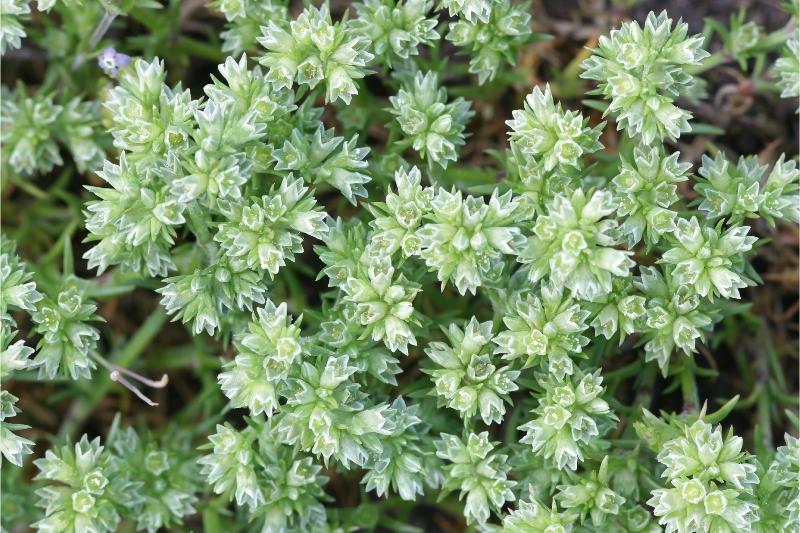
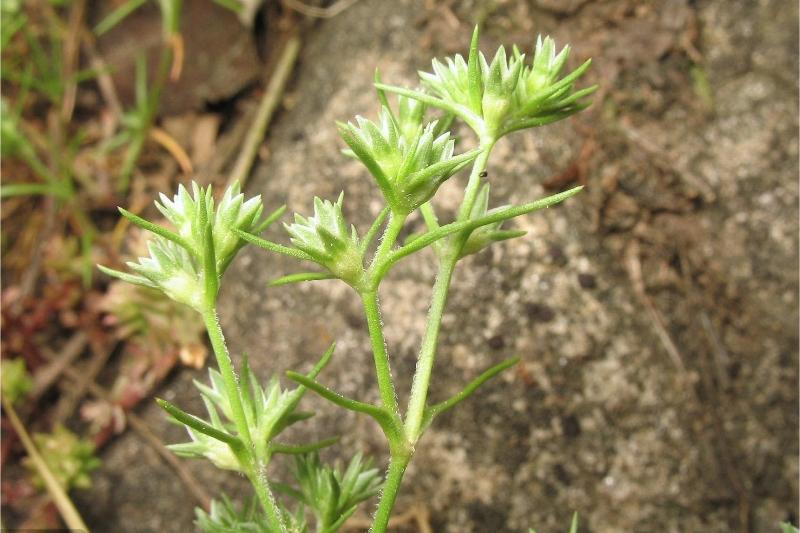
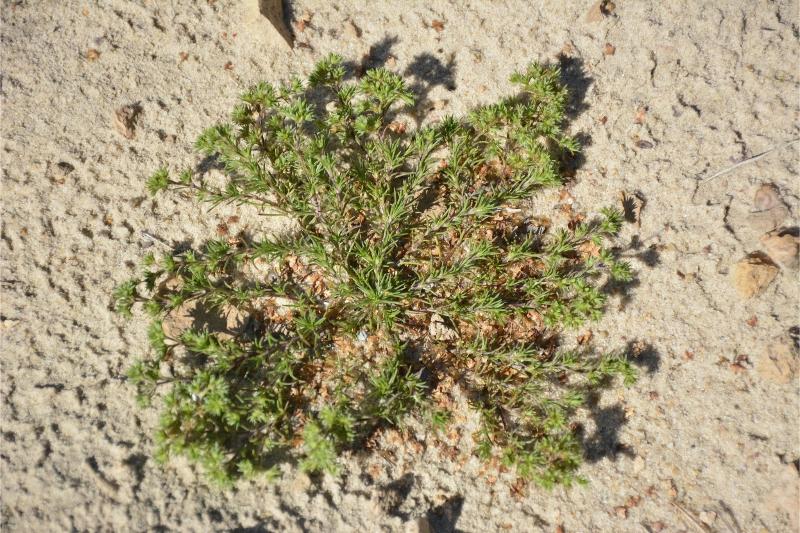
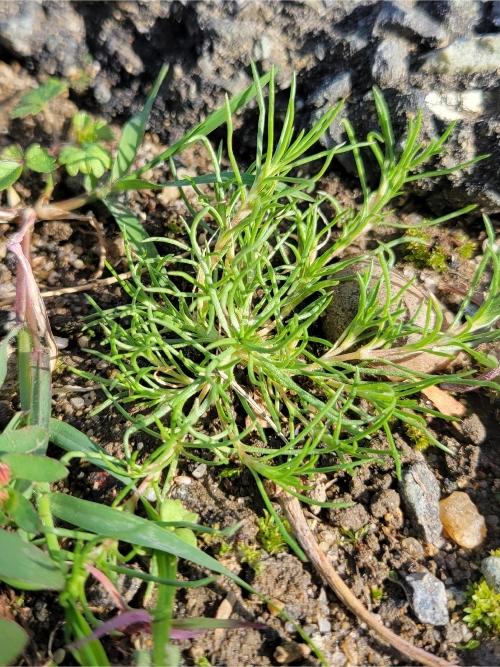
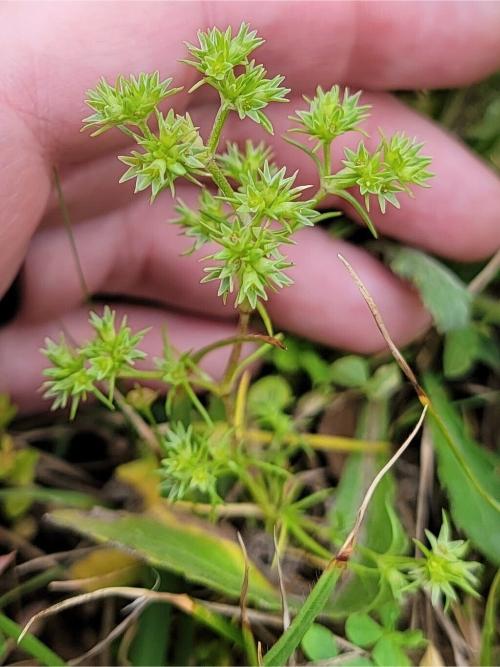
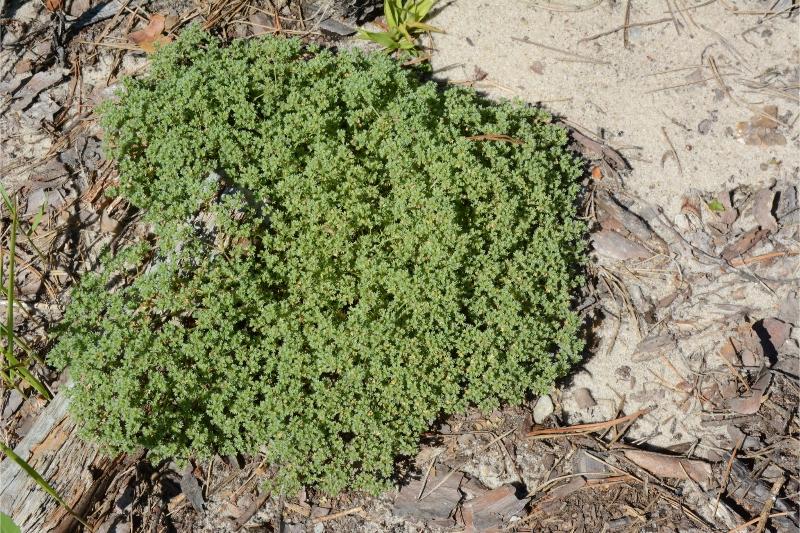
A low clumping plant with clusters of pale green flowers on short stalks, growing near sparse grass and bare, sandy soil.

The growth habit of a flowering perennial knawel plant (Scleranthus perennis), a very similar-looking species to annual knawel. Photo via Adobe Stock.

Updated: November 4, 2026

Knawel (Scleranthus annuus) is a non-native species that is widespread in Maryland. It is a member of the carnation family (Caryophyllaceae).

The knawel common name is derived from the German word knäuel, which refers to a tangle or knot (for example, of yarn). Its somewhat grassy or moss-like appearance from a distance may also explain the common name German moss and the alternative names of German knotgrass, German knotweed, or German knotwort. (The plant is native to more than just Germany and grows wild in many parts of Eurasia and Northern Africa.)

Identification

  • Growth habit: prostrate, with branching stems forming a mat around 4 inches high; may spread to 1 foot or more wide
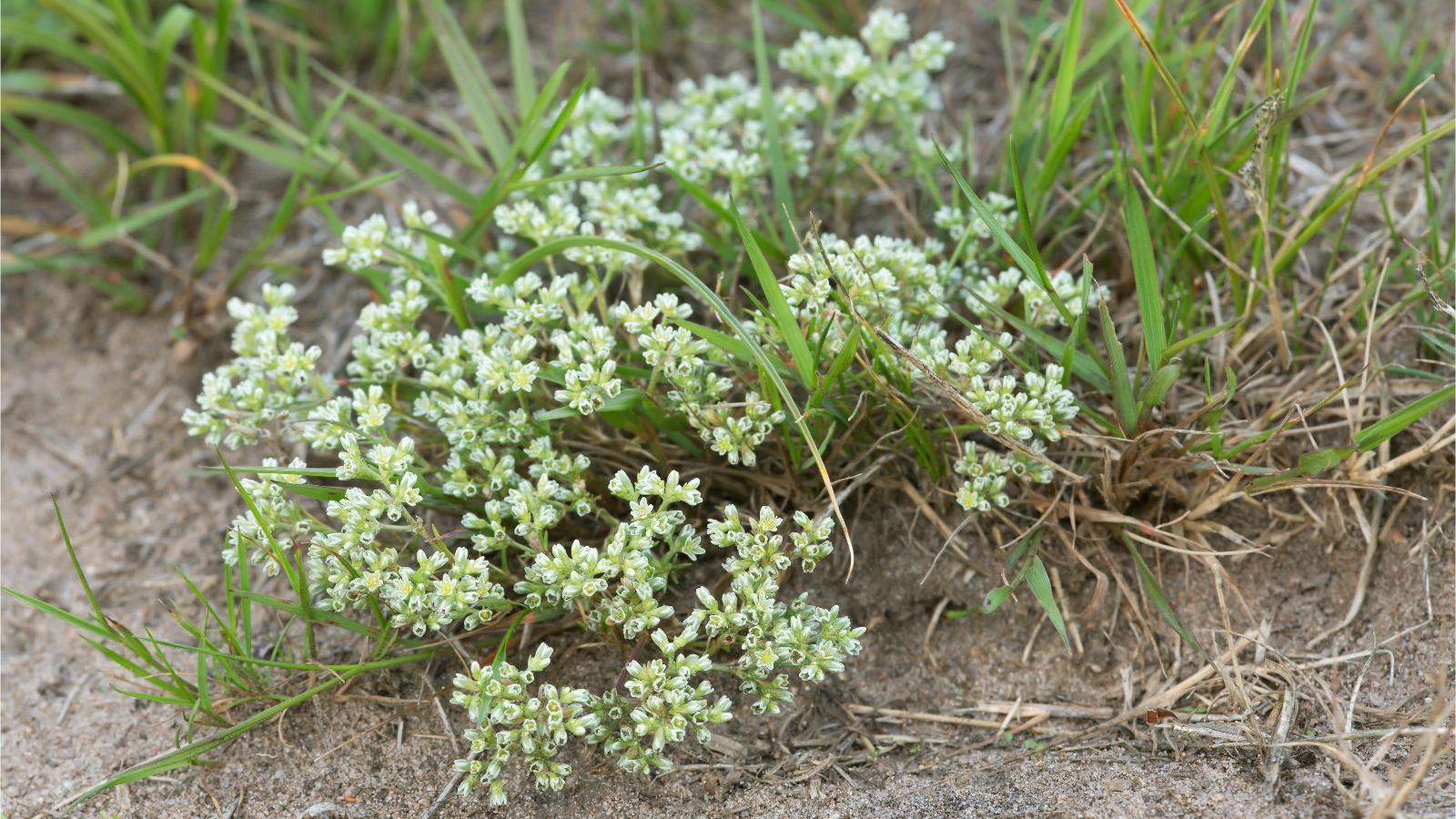
  • Flowers: green with pale margins, with 5 petal-like sepals forming a starlike shape; less than ¼ inch wide; sessile (stalkless)
  • Leaves: linear and narrow, with a pointed tip and sparse hairs along the margins closer to the stem end of the leaf; less than ¾ inch long
    • sessile (no petiole)
    • opposite leaf arrangement
  • Stems: smooth or slightly fuzzy; often brown-tinged

Life cycle and reproduction

Knawel is capable of being a summer annual (seeds germinate in spring, the plants grow and bloom in summer, and ripen seeds prior to dying by autumn) or a winter annual (seeds germinate in late summer or autumn, the plants overwinter and mature in spring, when they flower and ripen seeds before dying by summer).

The overall flowering period may span about March to October, but in Maryland, flowering seems to peak in April and May.

This species spreads by seed, with germination occurring primarily in spring when soil temperatures reach about 65 to 70°F.

Conditions that favor growth

Knawel prefers acidic soil and grows well in dry, sandy, low-fertility sites. The plant grows best in full sun, but will tolerate partial shade. It is very tolerant of salt (such as from ice-melting products), and tends to grow in compacted, dry locations like the edges of a lawn alongside pavement.

Knawel management in lawns

General lawn care practices that discourage weeds

Maintain healthy, dense turf that can compete with weeds and prevent weed germination and establishment. Fertilize the lawn as recommended (based on season and turf type), mow high, and overseed cool-season lawns each autumn to keep the lawn dense and better able to crowd-out seedling weeds. Core-aerate to reduce soil compaction. Learn about fertilizing, mowing, overseeding, and aeration in the resource: Maintaining an Established Lawn.

Lawn care and maintenance

Mechanical management

Remove knawel plants (including the short but tough taproot) by hand or with a manual weeding tool. Doing this when the soil is moist makes the task easier. Pulling up or digging out individual plants is a viable option at the beginning of an infestation (when the plants are not yet abundant) and for young knawel plants.

Manage Weeds Without Chemicals

Chemical management

Herbicide use should always be a last resort when managing weeds. Check for any local pesticide restrictions before buying and applying a product. For example, the Montgomery County pesticide law does not allow most synthetic pesticides (which includes herbicides) to be used on lawns. The active ingredient glyphosate is also prohibited on lawns in Baltimore City.

Learn about herbicide classifications and terminology:

Herbicide Options for Managing Common Lawn Weeds

Pre-emergent herbicide

A pre-emergent applied in either early spring or in late summer or early autumn can prevent knawel from sprouting during its primary seasons for germination. However, when applied to a lawn, you may not be able to sow cool-season grass seed like fescue around the same time.

Post-emergent herbicide

Spot-treat individual, actively-growing knawel plants or infested areas with a liquid broadleaf herbicide in early spring before it goes to seed. Look for a product with one or more of the following active ingredients: 2,4-D, MCPP (mecoprop), dicamba, or triclopyr. An application of non-selective herbicide may work, but would also damage any turfgrass exposed to the herbicide.

CAUTION: Do not spray herbicides containing dicamba over the root zone of desirable trees and shrubs. Roots or leaves may absorb this ingredient and be substantially damaged. Refer to the product label for other precautions.

References

Del Tredici, P. (2010). Wild Urban Plants of the Northeast: A Field Guide. Comstock Publishing Associates.

Neal, J.C., Uva, R.H., et. al. (2023). Weeds of the Northeast. (Second edition.) Comstock Publishing Associates.

Royer, F., and Dickinson, R. (1999). Weeds of the Northern U.S. and Canada. The University of Alberta Press.

Still have a question? Contact us at Ask Extension.