

FS-2025-0793 | August 2026
Letter to a New 4-H Educator: Tips and Strategies for Launching a Successful 4-H Program
By Anna Glenn, 4-H Educator; Vernelle Mitchell-Hawkins, 4-H Educator; Thomas Hutson, 4-H Educator; and Amy Lang, 4-H Educator
Dear New 4-H Educator/Agent,
Welcome to a career where you will never be bored! The world of Extension and 4-H Positive Youth Development is ever-evolving to keep pace with changing community needs and priorities. This publication includes insights from a team of 4-H educators, with over 40 years of combined experience. Our intent is to help you successfully begin your journey into the world of 4-H program planning. Below, you will find tips that may be helpful to new 4-H educators.
Introduction and Purpose
It is helpful to understand the organization for which we work. 4-H is part of the Cooperative Extension system. Extension offices are in every state, in every U.S. territory, and in 80 other countries around the globe. This worldwide program has a rich history spanning over 100 years (Brinn, 2020). Becoming familiar with the historical origin of 4-H can help you understand your role as a new educator in this amazing program.
The Land Grant University System was established by the Morrill Act of 1862, which granted each state federal lands for the establishment of “landgrant” colleges to expand access to higher education (Bickell, 2022). Signed into legislation by Abraham Lincoln, these schools were designed to provide “agriculture, mechanics, and military tactics” in all states in the country by teaching practical agricultural and engineering knowledge and skills (University of Maryland, n.d.). The Hatch Act of 1887 established Agricultural Experiment Stations, research facilities that enabled scientists to conduct practical research in agricultural and applied sciences with the support of off-site facilities. The Second Morrill Act of 1890 expanded the land-grant system by ensuring that all people, regardless of race, had equal access without discrimination to these institutions of higher education. The new act required states to either open their existing land-grant colleges or to provide separate, equal facilities. This act led to the creation of many new universities, which joined a group of already established land-grant colleges, which today are collectively referred to as HBCUs (Historically Black Colleges and Universities) (National Archives, n.d.). In 1994, the Equity in Educational Land-Grant Status Act of 1994 expanded accessibility to include tribal colleges and universities (Bickell, 2022).
During the late 1800s, researchers at land-grant institutions recognized that young people were often eager to explore and apply new agricultural practices developed through experiment station research. Educators saw an opportunity to engage youth in hands-on learning experiences that would help prepare the next generation of farmers and agricultural leaders while also encouraging the sharing of current agricultural knowledge within families and communities. In 1902, the first 4-H youth clubs were founded to support this approach to agricultural and youth education with a focus on life skills development. The 4-H clover emblem emerged in 1910 and was commonly adopted by 1912, with the four Hs standing for Head, Heart, Hands, and Health (National 4-H History Preservation Program, n.d.). The 4-H Pledge was developed in 1927 at the first National 4-H Camp in Washington DC. The pledge, which is recited aloud at nearly every 4-H program and club meeting and program across the country, reads:
I pledge my head to clearer thinking, my heart to greater loyalty, my hands to larger service, and my health to better living, for my club, my community, my country and my world.
In 1914, the Smith-Lever Act established a partnership between the USDA and land-grant institutions to form the Cooperative Extension Service and along with it, the national 4-H program (Bickell, 2022). To this day, extension is tasked with “extending” the research of universities and colleges into communities for local benefit.
Today, national 4-H priority areas are determined by the United States Department of Agriculture National Institute of Food and Agriculture (NIFA) (USDA NIFA, 2017). NIFA “invests in and advances agricultural research, education, and extension and seeks to make transformative discoveries that solve societal challenges” (USDA NIFA, 2017). As a 4-H educator, you are responsible for staying up to date with national priorities and current research. Local 4-H educators tailor their club and community programs to meet local needs aligned with state and national 4-H priorities.
The mission of 4-H is “to provide a supportive setting for all youth to reach their fullest potential by teaching them beneficial life skills and fostering civic engagement, health, and science literacy through research-based, hands-on, experiential programs in a diverse society” (Maryland 4-H, n.d.). Your particular mission is to develop innovative, youth friendly programs that share helpful information and enable youth to learn essential life skills and practical knowledge. Both 4-H professionals and volunteers are constantly seeking opportunities to promote positive youth development through experiential learning activities in a variety of settings, including community clubs, project clubs, in-school and after-school programs, camps, fairs, and contests. It is up to you to determine the format of your 4-H program that will best meet the needs of local communities. It is an exciting and vital role.
Positive Youth Development is the Foundation of 4-H
Positive Youth Development, or PYD, is the foundation of 4-H programming. Youth development efforts were originally viewed as an effort to help youth avoid negative behaviors; however, in the 1990s, researchers began to view youth development through an asset lens, seeing them as individuals with assets instead of as having issues needing to be solved (Lerner, 2017). Today, 4-H professionals work to nurture the assets of youth participants, thereby helping them become capable, confident, citizenship-minded adults.
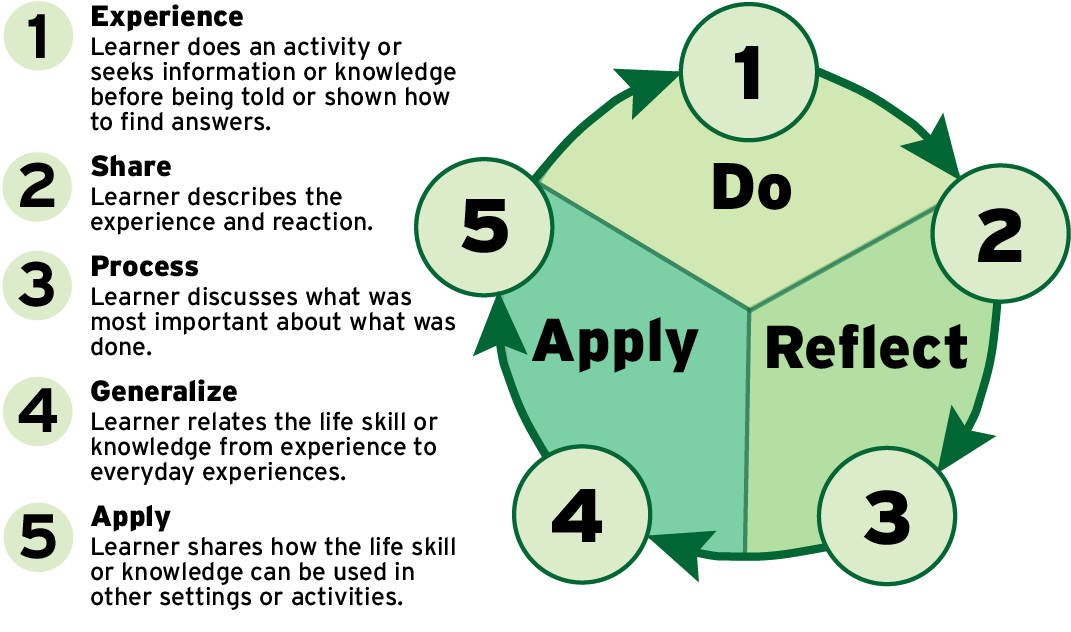
4-H educators incorporate the Experiential Learning Model, shown in Figure 1, into our programs. Experiential learning consists of three main phases: Do, Reflect, and Apply. Youth first Do as they experience an interactive activity. Then they Reflect by sharing their observations/reactions and processing the information. Finally, they Apply what they have learned as they generalize by connecting to real-world examples and applying their knowledge to new situations (Kolb et al., 1974 and 1985).
As a new educator, you may be wondering how you can ensure that PYD is happening in your programs. The 4-H Thriving Model, shown in Figure 2, can help. It was developed by Mary Arnold at Oregon State University (Arnold & Gagnon, 2018) to explain the elements that are critical to PYD and the outcomes and impacts that result from successful PYD programs. The model identifies four critical factors in positive youth development–Sparks, Belonging, Relationships, and Engagement–that are described as the “fertile soil” from which PYD programs can grow. Youth development professionals incorporate these factors into programs to support thriving youth who will display PYD outcomes as indicated by the blossoming flower in the image.
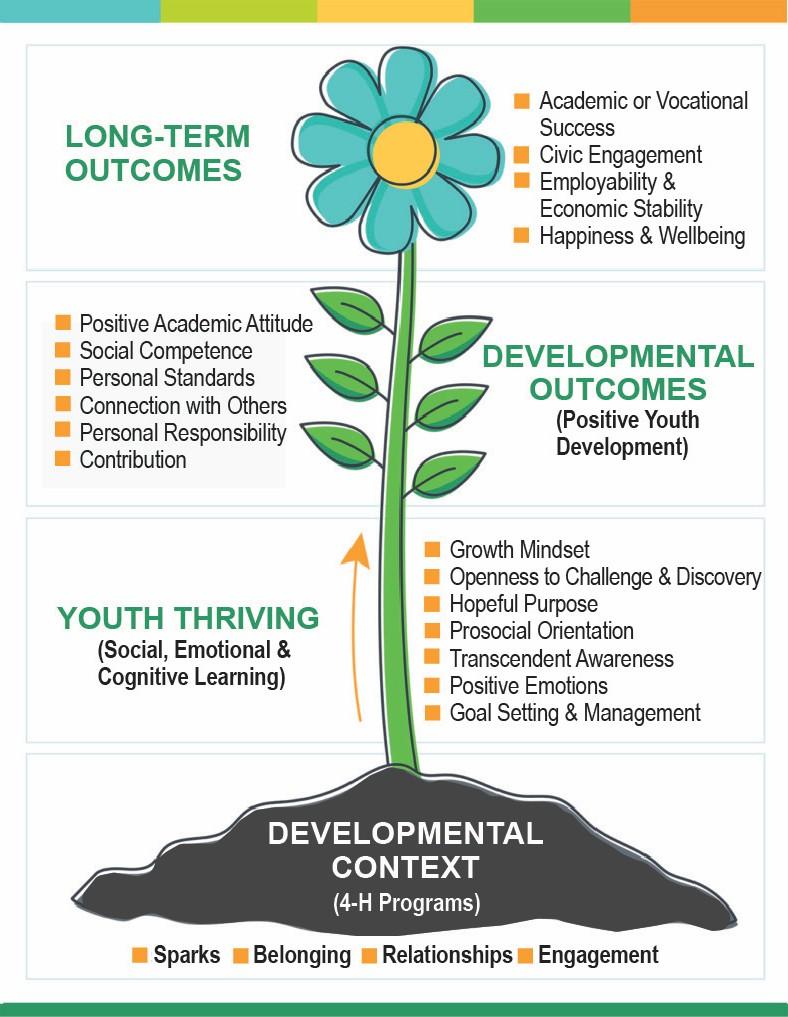
High-quality 4-H programs offer a variety of content topics with a goal of tapping into the sparks of all youth. Sparks are the topic areas that youth are passionate about and will be eager to pursue at a deeper level. High-quality programs also ensure that youth experience a sense of belonging and opportunities to develop strong developmental relationships with adult mentors and peers. Only when youth feel safe, welcome, respected, and valued are they able to blossom and thrive. The final element in the fertile soil of a high-quality 4-H youth program is engagement. Research tells us that higher levels of engagement result in greater impacts for youth.
A few helpful resources that support the 4-H Thriving Model are shared in the reference section below. They include a “Signs of a Great 4-H Program” observation/planning tool (Lang, 2026). Every state has 4-H Thriving Champions whose task is to help peers and colleagues through professional development. Check with your program leader or a colleague to learn more. Recently, the National 4-H Council launched the Beyond Ready Initiative to help educators leverage the 4-H Thriving Model with an intentional focus on life and career skills. The Beyond Ready Program Checklist helps both professionals and volunteers reflect on the goals and outcomes of their programs.
Tips for Implementing a Thriving 4-H Program
As a new 4-H educator, one of your most important tasks will be planning and implementing a comprehensive 4-H program that yields both positive outcomes and long-term benefits for youth. Effective educational programs help youth acquire beneficial life skills and content knowledge through various venues, including the club program and community outreach. Below are some tips from experienced educators.
- Get to know your community. Make as many connections as possible with experienced volunteers, 4-H families, stakeholders, and colleagues who can help you better understand the local youth population. Attend club meetings, county and/or state fair board meetings, school functions, and community events to network with others and expand your knowledge base.
- Conduct a community needs assessment. To develop locally relevant educational programs, you must first collect data to understand the needs and interests of local youth. One of the most effective data-gathering techniques is needs assessment. Formal methods include administering structured surveys/interviews or analyzing existing data on needs from partner organizations, such as schools and Social Services. Informal methods include discussions and meetings with volunteers, parents, youth, and representatives of youth-serving organizations. Data analysis will help you identify key areas of focus for your educational programs.
- Conduct a program assessment. To ensure a strong local 4-H club and community outreach program, it is essential to thoroughly understand the existing program structure and determine its strengths and weaknesses. Review the annual program timeline, including activities and events, as well as aspects of the program that volunteers and families like or think could be improved. Don’t just dive into implementing new programs; instead, take time to learn how your efforts can enhance existing programs and strategically extend program reach to new and underserved audiences in a targeted way.
- Take time to focus on program quality. Many new 4-H educators say yes to every potential opportunity that comes along. However, this approach often leads to becoming overextended and lacking the time to develop high-quality programs. Take time to carefully design programs that address crucial youth needs and lead to positive community impact. It usually takes a year or more to truly understand the intricacies of the local program and its timeline: Don’t implement major changes too quickly, or you may unintentionally harm the existing program.
- Draw on the wisdom of experienced co-workers. Instead of trying to learn everything about the 4-H educational framework, policies, procedures, and strategies through trial and error, it is wise to gain insight from others. Colleagues in your office and those in neighboring counties or districts can provide general guidance on various program aspects. Their institutional knowledge can be invaluable. State 4-H specialists can also provide support related to more complex needs and issues.
- Don’t compare yourself to other 4-H educators. As you learn more about your colleagues and their programs from around the state, it can be nearly impossible not to compare yourself and your programs to theirs. As natural as this is, keep in mind how different our counties and communities are. Resist the urge to compare your work and progress to that of others. Each community is unique, and what works in one geographic area may not be effective in another. Stay focused on goals that will help you develop a thriving local 4-H program with maximum benefits for the youth in your area.
- Allow the local 4-H program to change based on changing youth needs. The local program should be structured differently from the way it was structured 50 years ago, or even 10 years ago. If you grew up in 4-H or volunteered in another county, realize that each county is unique. What was appropriate long ago may not work well at the present time. Be comfortable designing a unique program based on stakeholder input and needs assessment data.
Parting Words
Working as a 4-H educator can be a unique and rewarding experience for you, youth participants, parents, and volunteers. The work is challenging and exciting. There may be some days when you feel overwhelmed by program demands and other days when you enthusiastically embrace new opportunities. These ebbs and flows are natural parts of the work as you proceed on your journey through the world of 4-H. Give yourself grace and try to start each day with optimism. Take care of yourself as you get to work developing programs that support local, state, and national 4-H goals! The short-term and long-term impact your programs have on the youth you work with will help to energize you and keep you excited about the future.
Sincerely,
Your 4-H Educator Colleagues
References:
Bickell, E.G. (2022, September 9). The U.S. land grant university system: Overview and role in Agricultural Research | congress.gov | Library of Congress. Congress.gov. https://www.congress.gov/crs-product/R45897
Brinn, J. (2020, May 15). 4-H around the World: Africa. 4-H Global & Cultural Education. https://www.canr.msu.edu/news/4_h_around_the_world_ africa#:~:text=4%2DH%20has%20spre ad%20 around,it%20is%20called%204%2DK.
Kolb, D. (1974). Experiential Learning Model. Organizational Psychology. Englewood Cliffs, MF: Prentice-Hall. Adapted by Pfeiffer, J. W., & Jones, J. E., Eds. (1985). Reference guide to handbooks and annuals (revised). San Diego: University Associates Publishers.
Lang, A. (2026). 4-H Thriving Model – Signs of a Great 4-H Program (EBR-2025-0761). University of Maryland Extension. go.umd.edu/EBR-2025-0761.
Lerner, R.M. (2017). Commentary: Studying and testing the Positive Youth Development Model: A Tale of Two Approaches. Child Development, 88(4), 1183–1185. https://doi.org/10.1111/cdev.12875
National Archives. (n.d.). Morrill Act (1862). National Archives. https://www.archives.gov/milestone-documents/morrill-act
National 4-H Council. (2025). Beyond Ready Program Checklist. https://helping-youth-thrive.extension.org/wp-content/uploads/2025/04/250423- Beyond-Ready-Checklist-Print.pdf
National 4-H Council. (n.d.). What is PYD? The Science of Success. 4-H. https://4-h.org/about/whatis-pyd/
National 4-H History Preservation Program. (n.d.). National 4-H history. National 4-H History Preservation Program. https://4-hhistorypreservation.com/History/Hist_Nat/
University of Maryland. (n.d.). AGNR history. College of Agriculture & Natural Resources at UMD. https://agnr.umd.edu/about/agnr-history/
University of Maryland. (n.d.). Mission, vision. University of Maryland Extension/4-H. https:// extension.umd.edu/programs/4-h-youth-development/ what-4-h/mission-vision/
ANNA GLENN
amglenn@umd.edu
VERNELLE MITCHELL-HAWKINS
vmh@umd.edu
THOMAS HUTSON
thutson@umd.edu
AMY LANG
amlang@umd.edu
This publication, Letter to a New 4-H Educator: Tips and Strategies for Launching a Successful 4-H Program (FS-2025-0793), is a part of a collection produced by the University of Maryland Extension within the College of Agriculture and Natural Resources.
The information presented has met UME peer-review standards, including internal and external technical review. For help accessing this or any UME publication contact: itaccessibility@umd.edu
For more information on this and other topics, visit the University of Maryland Extension website at extension.umd.edu
University programs, activities, and facilities are available to all without regard to race, color, sex, gender identity or expression, sexual orientation, marital status, age, national origin, political affiliation, physical or mental disability, religion, protected veteran status, genetic information, personal appearance, or any other legally protected class.
When citing this publication, please use the suggested format:
Glenn, A., Mitchell-Hawkins, V., Hutson, T., & Lang, A. (2026). Letter to a New 4-H Educator:Tips and Strategies for Launching a Successful 4-H Program (FS-2025-0793). University of Maryland Extension. go.umd.edu/FS-2025-0793.
-
4-H Thriving Model – Signs of a Great 4-H Program (EBR-2025-0761) >
4-H Thriving Model – Signs of a Great 4-H Program (EBR-2025-0761) > -
The 4-H Journey: Empowering Youth to Thrive in a World Full of Possibilities (EBR-2025-0763) >
The 4-H Journey: Empowering Youth to Thrive in a World Full of Possibilities (EBR-2025-0763) > -
Putting the 4-H Thriving Model into Practice (EBR-2025-0762) >
Putting the 4-H Thriving Model into Practice (EBR-2025-0762) >