
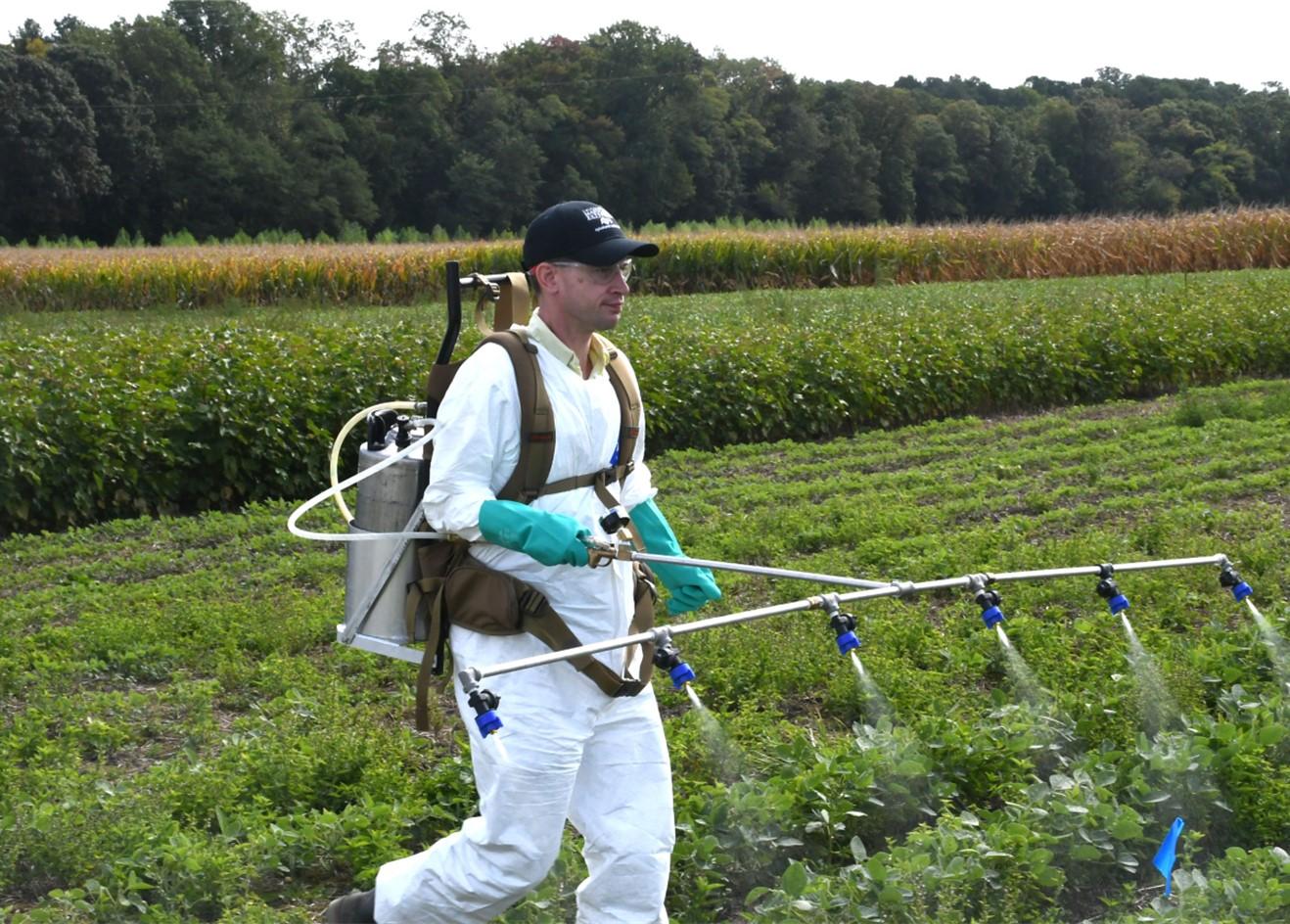
Pesticide Safety and Training
The University of Maryland Pesticide Safety and Training program was created to assist agricultural producers and businesses with timely information regarding pesticide use and recommendations. Farms use Integrated Pest Management (IPM) to solve pest problems while minimizing risks to people and the environment.
Maryland pesticide applicators are licensed through the Maryland Department of Agriculture (MDA) as:
- Private Pesticide Applicators or;
- Private Applicator Certification - An optional training is offered in-person on a regular basis. You can contact your local extension office to get the dates.
- Private Applicator Exam - Exams are offered in counties through the winter months or when there are a number of individuals interested an exam can be scheduled. Contact your Extension office for dates. The Department of Agriculture in Annapolis has testing on a monthly basis.
- Commercial Pesticide Applicators
- Commercial Applicators - Commercial applicators should contact the Maryland Department of Agriculture for information regarding examinations and licensing. This certification requires an annual update for credit hours. Some UME classes are approved for commercial credits.
Pesticide Private Applicator Recertification
The University of Maryland Extension (UME) provides recertification training opportunities for Maryland Private Pesticide Applicators. Private Applicators must complete recertification training during the final year of their current three-year certification cycle. This training provides updated information on pest management, pesticide safety, environmental and health considerations, emerging technologies, and changes in pesticide laws and regulations to help applicators continue using pesticides safely and effectively.
To meet recertification requirements, applicators must earn a minimum of four credits (one credit equals 30 minutes of training), which is equivalent to two hours of approved pest or pesticide-related instruction as determined by the Maryland Department of Agriculture (MDA) and UME. Attendance at approved courses is reported to MDA, which updates each applicator's training records. MDA sends license renewal notices by email in late November to applicators who have met the training requirements and whose certificates are nearing expiration.
Private Applicators can earn recertification credits by attending in-person training programs offered throughout the year. For information on upcoming courses and registration, contact your local Extension office. You can also stay informed through UME newsletters, including Maryland Agronomy News and Fruit and Vegetable News. Additional information is available on the Pesticide Certifications webpage and the University of Maryland Extension Events Calendar.
*Remember that all renewals are done online. MDA will not be mailing pesticide renewals unless specifically requested from MDA. You will not have renewed your license until you complete the renewal forms and pay MDA $7. https://egov.maryland.gov/mda/pesticides. Online tutorials on how to renew your license and print your license are available on our YouTube channel.
Private Pesticide Optional Exam Training
This is an optional training to prepare for the Private Pesticide Applicator exam. It is an optional training that includes a review of the Core Manual (PDF).
Study manuals can be found online on the Maryland Department of Agriculture's website: MD Core Manual or obtained from your county Extension Office for a Fee.
Exam
This exam is for those who wish to obtain a pesticide private applicator license. There is an optional training which includes a review of the Core Manual (PDF).
Study manuals can be found online on the Maryland Department of Agriculture's website: MD Core Manual (PDF) or obtained from your county Extension Office for a Fee.
Recertification
This training will meet the requirements for the Maryland Department of Agriculture Pesticide Private Applicator ReCertification Credits
Licensing
Maryland Department of Agriculture - Pesticide Regulation
50 Harry S. Truman Parkway
Annapolis, MD 21401
Telephone: (410) 841-5710
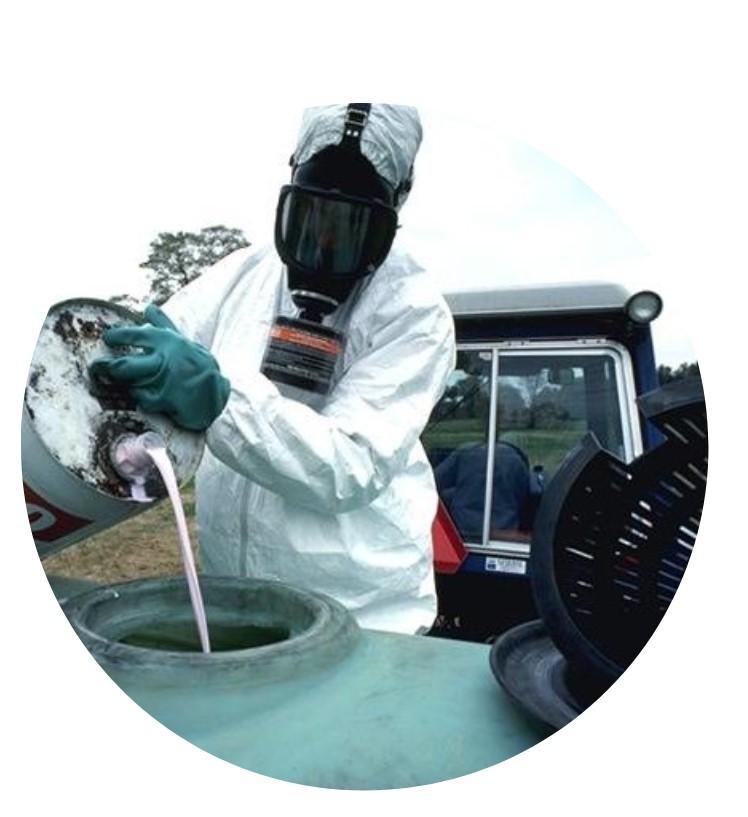
Pesticide Education and Safety

Upcoming Events


Pesticide Recommendations
Field Crops
- The Penn State Agronomy Guide (AGRS-026G)
The Penn State Agronomy Guide is designed as a quick reference for information on crop and soil management, including varieties, nutritional requirements, establishment, and harvesting; storing seed and grain; and farm management and budgeting. Recommendations for managing weed, insect, and disease pests in corn, grain sorghum, soybean, small grains, and forages are provided in Part 2.
This comprehensive guide is revised biennially by Penn State Extension specialists in agronomy, entomology, and plant pathology; U.S. Pasture Laboratory staff; county extension educators; seed, fertilizer, lime, and pesticide industry personnel; and representatives of state agricultural and environmental government agencies.
This is available as a digital download for $15, a printed copy for $35, or a print and digital bundle for $45.
- Mid-Atlantic Field Crop Weed Management Guide
John Wallace, Ph.D., Assistant Professor, Department of Plant Science; Dwight Lingenfelter, Extension Associate, Weed Science, William S. Curran, Ph.D., Emeritus Professor of Weed Science.
PennState University
Weed management practices and strategies, including tables containing herbicide recommendations, for corn, sorghum, soybean, small grains, forages, and farmstead; information on the problem weeds henbit, horsenettle, horseweed, palmer amaranth and waterhemp, common pokeweed, common ragweed, giant ragweed, annual ryegrass, broadleaf and curly dock, johnsongrass and shattercane, lambsquarters, milkweed, and hemp dogbane, wild mustard, and radish, and Canada thistle.
- General Management of Nematodes in Field Crops FS-1082
Andrew Kness, University of Maryland Extension Agent- Harford, Carroll, and Baltimore County
Nematodes are an economically important pathogen of many crops in Maryland. Significant yield loss can occur if nematodes are not managed properly. This fact sheet serves as a broad introduction to nematodes as plant pathogens and serves as a general guide for sampling and managing nematodes in Maryland.
- Applied Research on Field Crop Disease & Nematode Management (pdf)
David B. Langston Jr., Extension Plant Pathologist; Hillary L. Mehl, Extension Plant Pathologist, Virginia Polytechnic Institute and State University College of Agriculture and Life Sciences, Tidewater Agricultural Research & Extension Center, Suffolk, Virginia 23437. Published: 2020
- Efficacy of Weed Management Tactics SPES-268NP
Flessner, M., Bamber, K., Besacon, T., Chandran, R., Hines, T., Johnson, Q., Lingenfelter, D., Rubione, C., Shergill, L., Singh, V., VanGessel, M., Vollmer, K., & Wallace, J. (Jan 2021)
This poster provides relative effectiveness of various integrated weed management tactics for summer annual crops. The chart helps identify the most effective tactics to manage weeds.
- Fungicide Efficacy for Control of Corn Diseases CPN-2011-W (pdf)
Crop Protection Network
This fact sheet contains recommendations on developed ratings for how well fungicides control major corn diseases in the United States.
- Fungicide Efficacy for Foliar Soybean Diseases CPN-1019-W (pdf)
Crop Protection Network
This fact sheet contains recommendations on foliar fungicide efficacy for the control of major foliar soybean diseases in the United States.
- Fungicide Efficacy for Control of Soybean Seedling Diseases CPN-102-W (pdf)
Crop Protection Network
This fact sheet contains recommended ratings for how well fungicide seed treatments control seedling diseases of soybeans in the United States.
- Fungicide Efficacy for control Wheat Diseases and Small Grains CPN-3002-W (pdf)
Crop Protection Network
This fact sheet contains recommendations about fungicide efficacy for the control of certain foliar diseases of wheat for use by the grain production industry in the United States.
- Spray Tank Check Chart for Soybeans (pdf)
Mark VanGessel¹, Ben Beale², Thierry Besacon³, Melissa Bravo³, Rakesh Chandran⁴, Michael Flessner⁵, Dwight Lingengelter⁶, Vijay Singh⁵, Kurt Vollmer², John Wallace⁶
¹University of Delaware, ²University of Maryland Extension, ³Rutgers University, ⁴West Virginia University, ⁵Virginia Tech, ⁶Penn State
- Spray Tank Check Chart for Corn (pdf)
Mark VanGessel¹, Ben Beale², Thierry Besacon³, Melissa Bravo³, Rakesh Chandran⁴, Michael Flessner⁵, Dwight Lingengelter⁶, Vijay Singh⁵, Kurt Vollmer², John Wallace⁶
¹University of Delaware, ²University of Maryland Extension, ³Rutgers University, ⁴West Virginia University, ⁵Virginia Tech, ⁶Penn State
Vegetable Crops
- Mid-Atlantic Commercial Vegetable Production Recommendations
Information presented in this publication is based on research results from the University of Delaware, the University of Maryland, Rutgers – The State University of New Jersey, The Pennsylvania State University, Virginia Polytechnic Institute, and State University, West Virginia University, and the U.S. Department of Agriculture, combined with industry and grower knowledge and experience.
- Maryland Fruit & Vegetable Blog
Provides readers with current information on fruits and vegetables, disease and pest updates, and much more.
- Efficacy of Weed Management Tactics SPES-268NP
Flessner, M., Bamber, K., Besacon, T., Chandran, R., Hines, T., Johnson, Q., Lingenfelter, D., Rubione, C., Shergill, L., Singh, V., VanGessel, M., Vollmer, K., & Wallace, J. (Jan 2021)
This poster provides relative effectiveness of various integrated weed management tactics for summer annual crops. The chart helps identify the most effective tactics to manage weeds.
Ornamental Horticulture
- IPMnet
University of Maryland Extension
IPMnet is an online resource for commercial ornamental plant production and maintenance with an emphasis on using an integrated pest management approach. We primarily work with nursery growers, landscapers, greenhouse growers, cut flower growers, IPM scouts, and arborists.
Learn more
Tree and Small Fruit
- 2026 Spray Bulletin for Commercial Tree Fruit Growers (456-419)
Douglas G. Pfeiffer, Virginia Cooperative Extension
This guide contains information on pesticides used in orchards, with a seasonal treatment of when and how these materials should be employed. Efficacy information toward major fruit pests as well as beneficial species is included. The guide is black and white, with a color photograph for the cover. It is spiral bound. 187 pages.
- Efficacy of Weed Management Tactics SPES-268NP
Flessner, M., Bamber, K., Besacon, T., Chandran, R., Hines, T., Johnson, Q., Lingenfelter, D., Rubione, C., Shergill, L., Singh, V., VanGessel, M., Vollmer, K., & Wallace, J. (Jan 2021)
This poster provides relative effectiveness of various integrated weed management tactics for summer annual crops. The chart helps identify the most effective tactics to manage weeds.
- Spray Program for Multi-Small Fruit Plantings
R. David Myers, University of Maryland Extension
Multi-Small Fruit Spray Program (updated yearly) for pest and disease control of major small fruit (Strawberries, Brambles, Blackberries, Raspberries, Blueberries, and Grapes.)
- Spray Program for Multi-Tree Fruit Orchards
R. David Myers, University of Maryland Extension.
Multi-Tree Fruit Orchard Spray Program (updated yearly) for the control of major tree fruit (Pomes: apples, pears; Stones: peaches, plums, nectarines, and cherries) pest and diseases.
- Maryland Fruit & Vegetable Blog
Provides readers with current information on fruits and vegetables, disease and pest updates, and much more.
Home and Garden
- Home and Garden Information Center
University of Maryland Extension
The Home and Garden Information Center (HGIC) develops and delivers science-based, sustainable gardening and integrated pest management education for better human and environmental health.
The Home and Garden Information Center partners with the Master Gardener Program to provide educational resources to the volunteers as well as digital resources through the Home and Garden website.
Learn more

Modes of Pesticide Action and Weed Management
Special Spray Provisions
-
Dicamba
DicambaIf you are growing dicamba-tolerant soybeans and plan to use EPA approved dicamba products forever-the-top applications on soybeans, you need to take an annual dicamba training. These trainings are offered through private industry and Extension. Contact your local Extension office for more information on available training. Additional information on dicamba training requirements can be found on the EPA website: https://www.epa.gov/ingredients-used-pesticide-products/dicamba-trainin…
-
Paraquat
ParaquatAnyone purchasing or applying paraquat (Gramoxone) must complete an EPA-approved paraquat training course once every three years. This training is available online at: https://www.epa.gov/pesticide-worker-safety/paraquat-dichloride-trainin…. Once completed, print and save a copy of your certificate.
Extensión en Español
Looking for quality material on horticulture, gardening, agriculture, and nature in Spanish?
Material de calidad y exclusivamente en español sobre horticultura, jardineria, agricultura y naturaleza. ¡Visitenos y suscribase! ¡Extensión en Español está en linea!