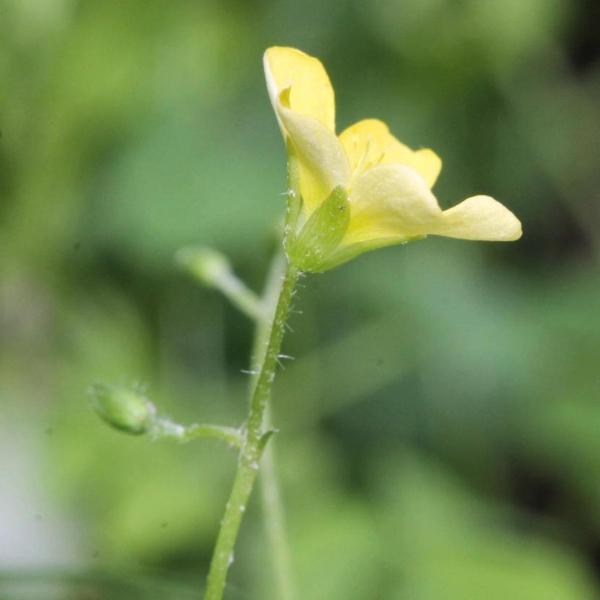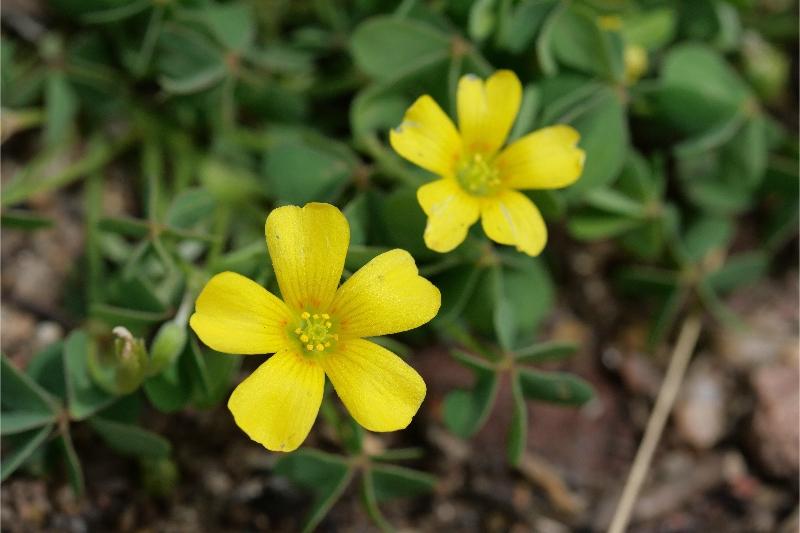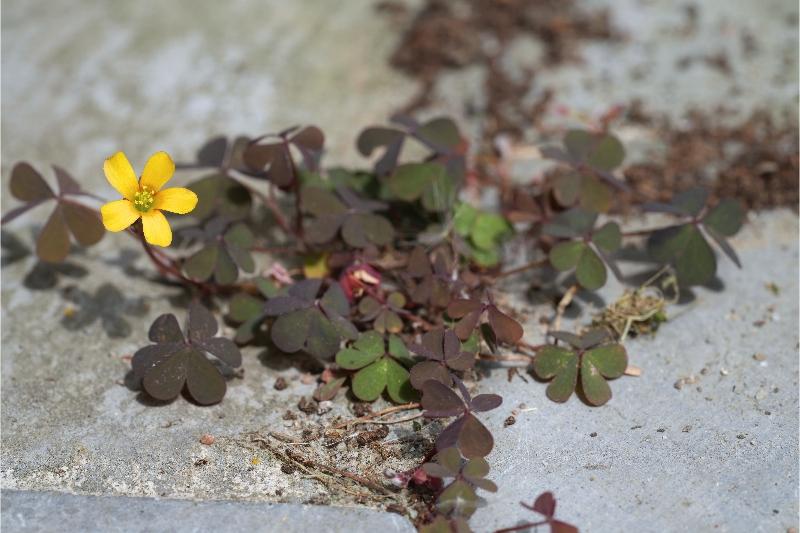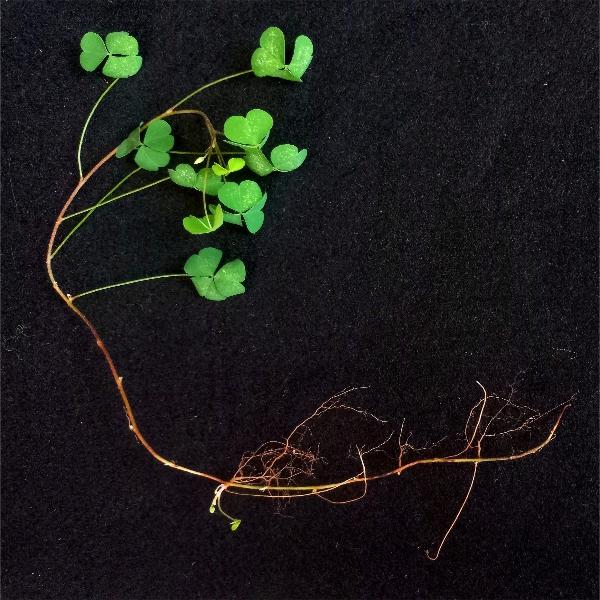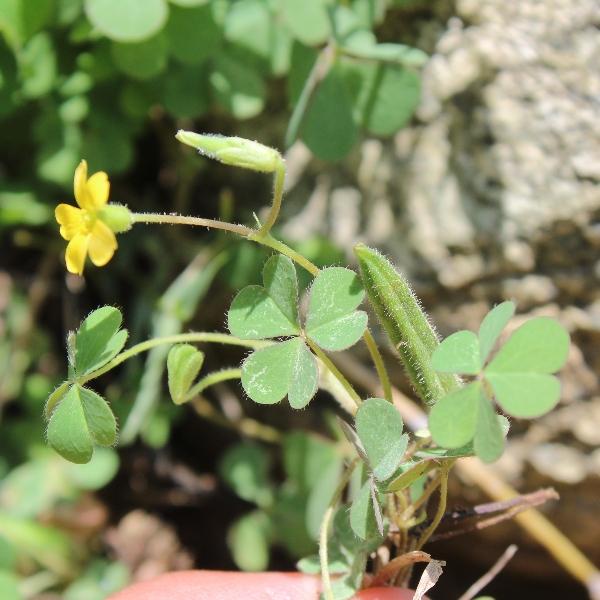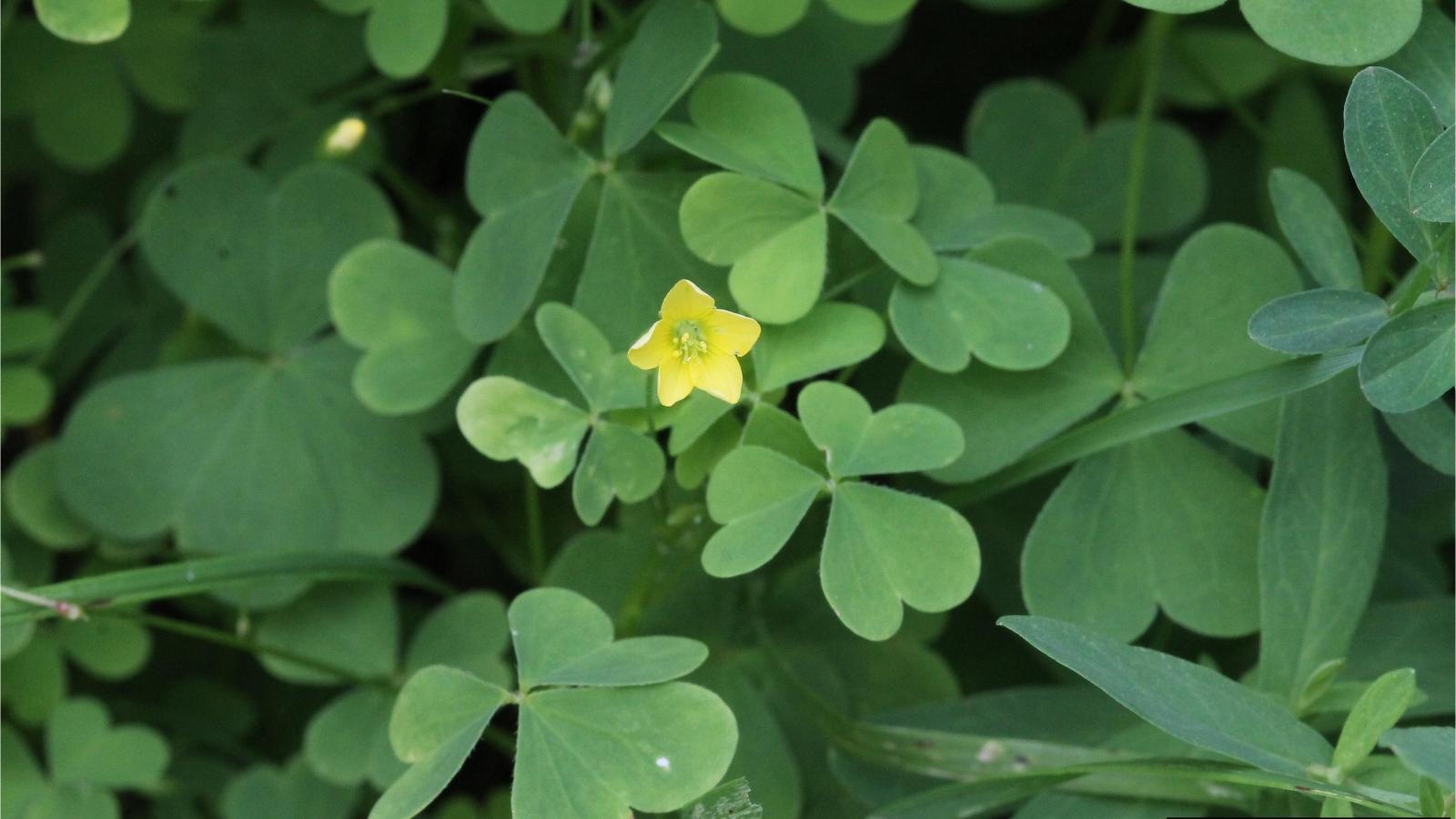
Several species of woodsorrel (Oxalis) occur in Maryland. The species typically encountered growing as weeds are:
- creeping woodsorrel (Oxalis corniculata), non-native
- slender yellow woodsorrel (Oxalis dillenii), native
- common yellow woodsorrel (Oxalis stricta), native
Common yellow woodsorrel is often found in lawns, while creeping woodsorrel is more commonly found in garden beds and pavement gaps. Woodsorrels can also be found in container plantings.
What traits do these woodsorrels have in common?
Creeping, slender yellow, and common yellow woodsorrel share several flower and foliage traits, and they all spread by seed.
- The small ¼- or ½-inch wide flowers are yellow with 5 petal-like sepals. They are borne on long stalks that arise from the leaf axils (where the leaves attach to the main stem).
- The leaf arrangement is alternate on the stem (they do not attach directly opposite each other).
- The leaves have long petioles (stalks connecting them to the main stem).
- Leaves are divided into 3 heart-shaped, evenly-spaced leaflets. This shape and arrangement superficially resembles clover leaves. The leaf margins are entire, meaning that they do not have lobes, serrations, or scallops along their edges.
- The leaflets tend to fold down (like a closed umbrella) during the middle of the day and overnight.
- Seeds are produced in ½-inch slender, upright pods which burst explosively when the seeds are ripe.
How do these woodsorrels differ?
As its common name implies, creeping woodsorrel is a lower-growing, sprawling plant that is more likely to produce runners and root at the nodes (the locations where leaves join the main stem) compared to the more upright-growing slender and common yellow woodsorrels. The runners that yellow woodsorrel can produce are rhizomes (below-ground stems), which have a white to pinkish color; the runners on creeping woodsorrel are stolons (above-ground stems).
The leaves of creeping woodsorrel are more often purplish than the leaves of the other two species, but this alone is not a reliable trait separating them. Purple-leaved woodsorrels can be hard to spot when growing in a mulched bed because the foliage tends to blend in.
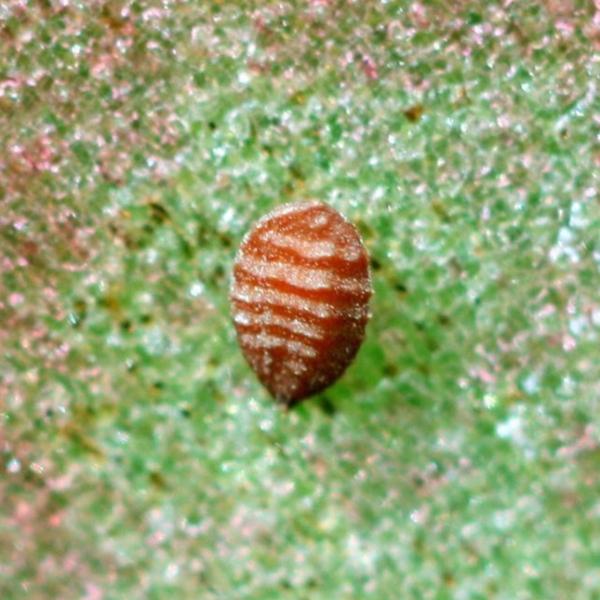
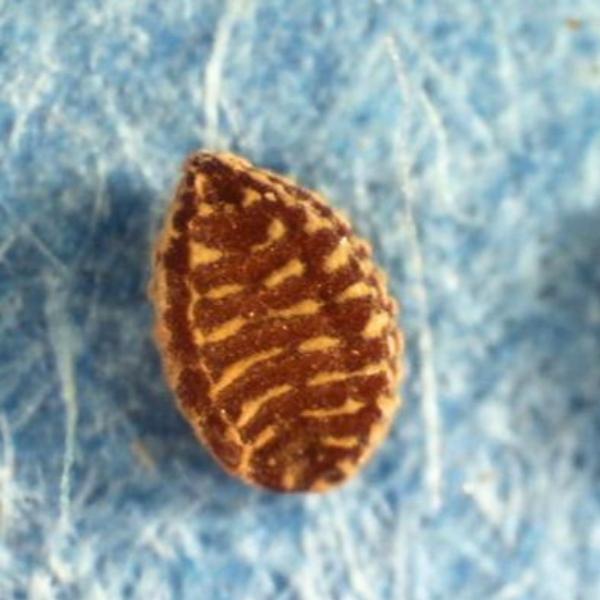
It can be hard to identify these three species with certainty, and hybridization may occur, making key features harder to distinguish. Fine details requiring magnification are needed to separate them. For example, the stem hairs on slender woodsorrel lay fairly flat and close to the stem, while common yellow woodsorrel stems are hairless or have hairs that stick outwards from the stem. The texture and coloration of the surface of their tiny seeds also differs.
Try using identification keys or species descriptions (there will be a lot of terminology used) if you want to remove creeping woodsorrel but allow the native woodsorrels to grow in certain areas.
- Oxalis key | Native Plant Trust
- Oxalis corniculata | Flora of North America
- Oxalis dillenii | Flora of North America
- Oxalis stricta | Flora of North America