Skip to main content
Menu
Get Involved
Give
Contact
Ask Extension
About
Leadership
UMD Extension Impact
Careers
Directory
Civil Rights Compliance
Extension Advisory Council and Committees
Program and Organizational Development
Resources
Animal Agriculture
Plant Agriculture
Yard & Garden
Pests
Natural Resources
Environment & Energy
Agribusiness Management
Food & Nutrition
Health & Well-Being
4-H & Youth Education
Programs
4-H Youth Development
Family & Consumer Sciences
Agriculture & Food Systems
Environment & Natural Resources
Home & Garden Information Center
Locations
Publications
News & Events
All News
Events
Best Management Practice
Home
Resources
Best Management Practice
For full functionality of this site it is necessary to enable JavaScript. Here are
instructions for how to enable JavaScript in your web browser
.
Sort by:
Date
Title
Updated: May 20, 2025
Infiltration Trench or Basin
An infiltration trench or basin is a long, narrow, stone-filled trench that collects stormwater and allows for infiltration into the soil, or a constructed depression where runoff and sediment are trapped while water infiltrates the soil.
Updated: May 20, 2025
Riparian Buffer Planting
The riparian area is the strip of land running parallel to a stream, river, bay, or other waterway. Maintaining this area in a vegetated state that includes a variety of trees, shrubs and grasses creates a buffer that protects the waterway from land use activities.
Updated: May 20, 2025
Shoreline Management
Shoreline management refers to a variety of practices that reduce shoreline erosion. There is no one-size-fits-all method for managing shorelines, as site-specific plans for stabilizing a shoreline must take into account local geology, wave energy, sea level rise, and historic and current erosion conditions.
Updated: May 15, 2025
Bioswales and Open Vegetative Channels
Open channels convey stormwater runoff and provide treatment as the water is conveyed. Runoff passes through vegetation in the channel, the subsoil matrix, and/or infiltrates the underlying soils.
Updated: May 15, 2025
Septic Pumping
Septic systems achieve nutrient reductions through several management practices, including routine maintenance and pumping.
Updated: May 15, 2025
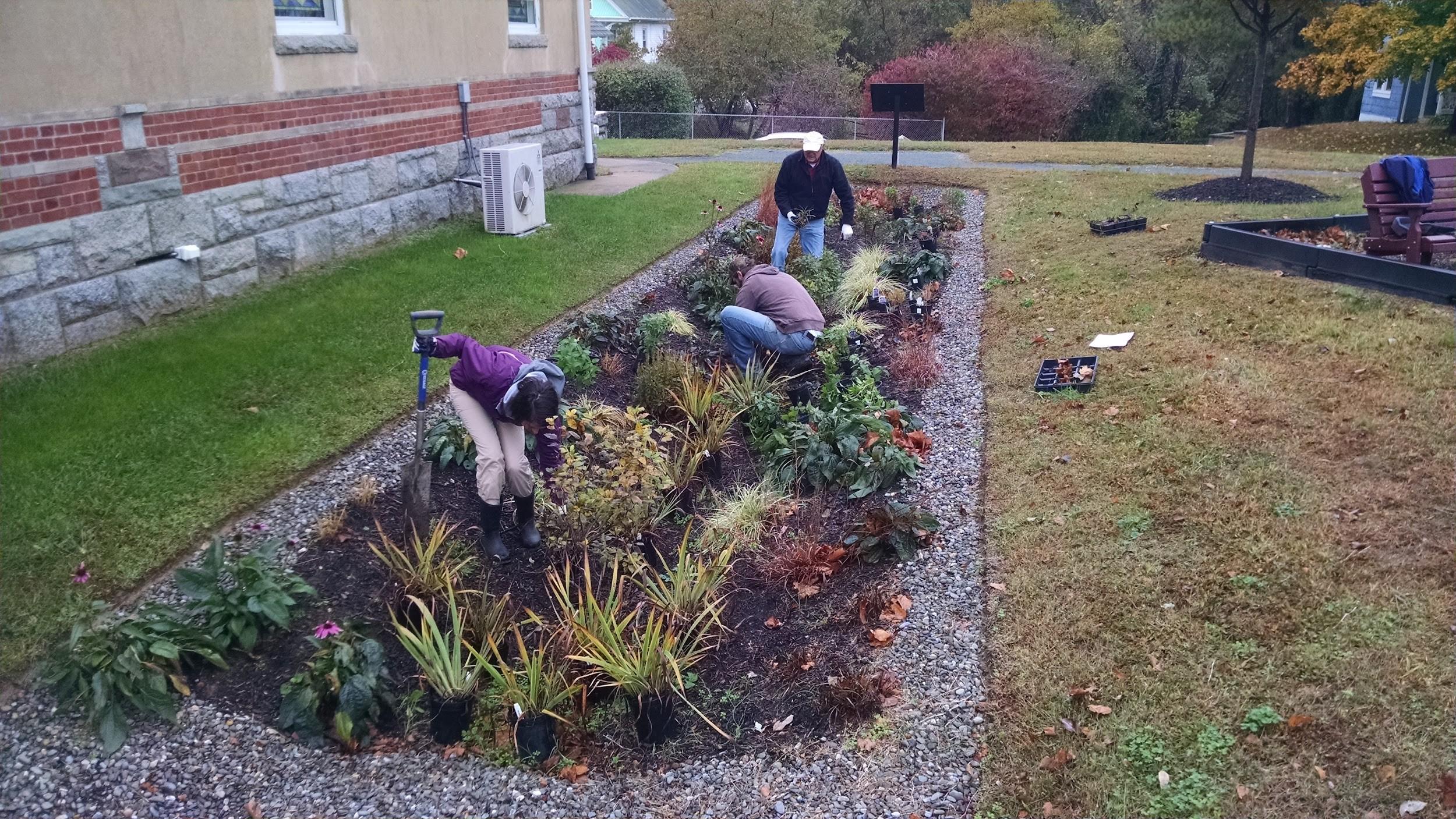
Rain Gardens
A rain garden is a planted depression in the landscape designed to collect and temporarily store stormwater runoff, allowing it to be absorbed into the soil, taken up by plants, or evaporated.
Updated: May 15, 2025
Permeable Pavers
Permeable pavers or porous pavement reduce runoff volume by allowing water to filter through open voids in the pavement surface to a washed gravel subsurface storage reservoir.
Updated: May 15, 2025
Downspout Redirect
Downspout redirection changes the flow of rooftop stormwater so that it is no longer directed to an impervious surface or piped into a sewer system or body of water. Instead, it is directed to a pervious or permeable surface such as a yard, garden, or conservation landscape.
Updated: May 15, 2025
Conversion from Turfgrass to Conservation Landscaping
Conversion from Turfgrass to Conservation Landscaping is a practice that replaces sections of turfgrass with native plants.
Updated: May 15, 2025
Conversion from impervious to turf/conservation landscaping
Conversion from Impervious to Turf/Conservation Landscaping involves removing impervious surfaces and replacing them with pervious or permeable surfaces such as a yard, garden, or conservation landscape that allow rainwater to soak into the ground.
First
Previous
Page
1
Current page
2
Page
3
Page
4
Next
Last