Skip to main content
Menu
Get Involved
Give
Contact
Ask Extension
About
Leadership
UMD Extension Impact
Careers
Directory
Civil Rights Compliance
Extension Advisory Council and Committees
Program and Organizational Development
Resources
Animal Agriculture
Plant Agriculture
Yard & Garden
Pests
Natural Resources
Environment & Energy
Agribusiness Management
Food & Nutrition
Health & Well-Being
4-H & Youth Education
Programs
4-H Youth Development
Family & Consumer Sciences
Agriculture & Food Systems
Environment & Natural Resources
Home & Garden Information Center
Locations
Publications
News & Events
All News
Events
Insect Pest - Beetles
Home
Resources
Insect Pest - Beetles
For full functionality of this site it is necessary to enable JavaScript. Here are
instructions for how to enable JavaScript in your web browser
.
Sort by:
Date
Title
Updated: October 23, 2024
Tomato Ripening Problems and Cucumber Beetles
Tomato Ripening Problems and Cucumber Beetles
Updated: October 23, 2024
Tomato Ripening Problems and Cucumber Beetles
Several growers have complained that their second set of tomatoes is catfaced or are deformed and ripening poorly. Their first set of tomatoes looked good, but the second set is having problems in scattered areas throughout the field.
Updated: October 23, 2024
New Grower Training - Vegetable IPM
New Grower Training - Vegetable IPM
Updated: October 23, 2024
Early Warning: Multi-Colored Asian Ladybeetle (MALB) For Grape Growers
Over the past few years, harvesting of some Maryland and Eastern U.S. grapes has been complicated by the presence of Multicolored Asian Ladybeetles (MALB - Harmonia axyridis). The adult beetles can damage fruit in the field but most importantly, acts as a contaminant of the harvest, “fatally” tainting the wine made from the grapes.
Updated: October 23, 2024
Summary of the Comparative Efficacy of Common Active Ingredients in Organic Insecticides Against Difficult to Control Insect Pests
There exists a lack of control efficacy information to enable decision-making about which organic insecticide product works best for a given insect pest. Here we summarize results of 153 field trials on the control efficacy of common active ingredients in organic insecticides against groups of the most difficult to control insect pests. The performance of organic products Entrust (spinosad), Azera (pyrethrin and azadirachtin), PyGanic (pyrethrin) and Neemix (azadirachtin) varied widely among pest groups, as well as among pest species within a group, providing an overall reduction in pest infestations by 73.9%, 61.7%, 48.6% and 46.1%, respectively.
Updated: October 23, 2024
August IPM Insect Scouting Tips
August IPM insect scouting tips on soybean, field corn, and sorghum.
Updated: October 23, 2024
Fungal Entomopathogens: An Enigmatic Pest Control Alternative
Entomopathogens are bacteria, fungi, protozoans or viruses that can infect and subsequently cause disease in insects and other arthropods. They can indirectly impact cropping systems by serving as naturally suppressors of insect and mite pests. When there are epizootic outbreaks, entomopathogens are capable of causing rapid declines in large populations of their arthropod hosts. Many of these naturally occurring pathogens have been formulated and commercialized as insecticides.
Updated: October 23, 2024
Unusual Pest Found in Tomatillo Crop
I was at a farm the other day that had a wide variety of crops on it and the grower showed me what we at first thought were odd-looking Colorado potato beetle larvae in their tomatillos, but they did not really look like CPB.
Updated: October 23, 2024
Feeding Damage by Blister Beetles
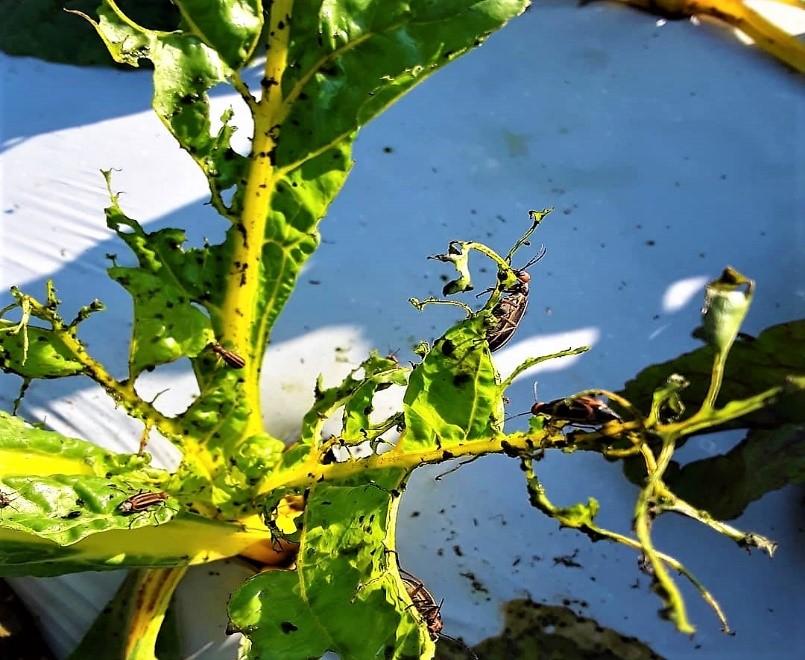
Normally at this time of year when I talk about any insect problems in crucifers I talk about harlequin bugs that feed by sucking out plant juices and inject toxins into the plant. But I have seen several fields and even some high tunnels with blister beetles feeding and defoliating several different vegetables such as tomato (including the fruit), leafy greens, crucifers, spinach and especially swiss chard (fig. 1). Blister beetles begin feeding on the edges of leaves eventually leaving only stems (fig. 1). The presence of blister beetles now is not unusual as they are often found in large clusters in late summer-early fall. They can arrive in large groups, seemingly overnight and can do a great deal of damage in a short period of time.
Updated: October 23, 2024
Early Season Insect Management: Flea Beetles
Grape Flea beetles, Altica spp. (Coleoptera: Chrysomelidae), are small (4-5 mm), oval shaped, metallic blue-purple beetles that jump when disturbed.
First
Previous
Page
1
Page
2
Current page
3
Page
4
Next
Last