
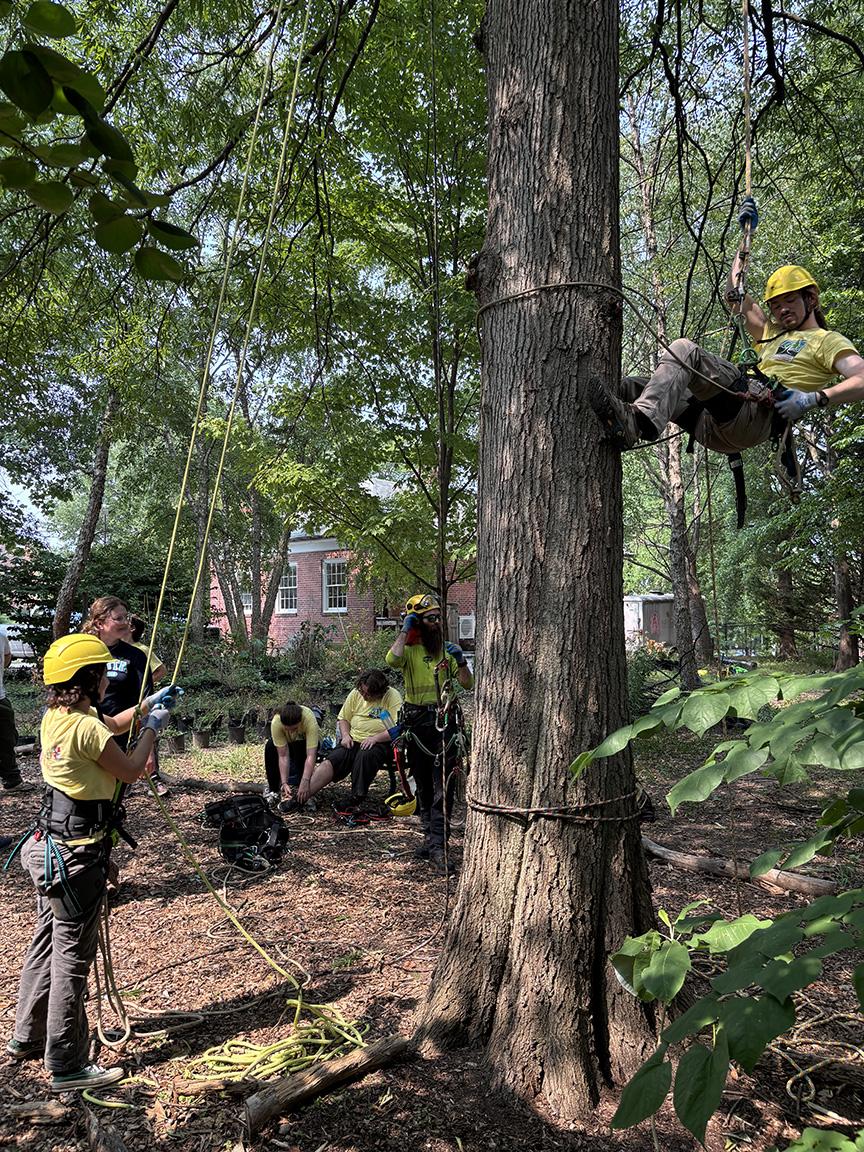
The rope is taut. A yellow helmet catches the light through the leaves. Below, a group of high school students watches as one of their classmates works his way up a tree, learning techniques used by professional arborists.
For a few minutes, this isn't a classroom. It's not a college tour. And it isn't a lecture about possible careers.
The student is trying one.
That is the idea behind the University of Maryland's Urban Forestry Careers Camp, a weeklong residential program that brings high school students to the College Park campus to explore the science, technology, people and professions that shape urban forests.
In July 2026, 26 students—25 from communities across Maryland and one from Virginia—spent a week learning about urban forestry, arboriculture and natural resources through a combination of fieldwork, professional demonstrations, career conversations and exploration across the University of Maryland campus and beyond.
And along the way, they discovered that "urban forestry" can mean far more than they thought.
“I really enjoyed learning about all of the careers and jobs you can have in urban forestry. I thought it was really cool you could work with wildlife, insects, computers and high tech and all sorts of other interesting areas. It has really broadened my thinking of what I want to do when I grow up.”
That may be the most important outcome of the camp.
More Than Trees
Urban forestry is easy to underestimate.
A tree on a city street can look deceptively simple: trunk, branches, leaves. But caring for that tree can involve arboriculture, entomology, plant health, soil science, wildlife, data collection, technology, landscape architecture, public policy, community engagement and environmental equity.
The camp is designed to make those connections visible.
Students learn how to inventory trees, measure diameter, identify species and evaluate condition. They examine urban tree health and pests, explore wildlife issues, and learn how professionals assess and manage trees in places where people and infrastructure are part of the ecosystem.
They also hear directly from people doing the work.
University faculty and Extension educators are joined by professionals from government, nonprofit organizations and industry. Students learn about urban silviculture and the USDA Forest Service's urban and community forestry work. They hear from Maryland forestry leaders and explore careers in landscape architecture, green infrastructure, urban agriculture and other fields that intersect with urban forests.
The result is a much larger picture of what a natural resources career can look like.
Learning By Doing
The camp's curriculum is deliberately experiential.
Students don't just hear about tree inventories. They conduct them.
They don't just hear about arboriculture. They put on helmets and climbing gear.
They don't simply talk about urban forests. They walk through neighborhoods and field sites, examine trees in context, and talk with professionals about the decisions they make every day.
A field experience with Casey Trees in Washington, D.C., introduced campers to the work of an urban forestry organization and to questions of tree equity. At the U.S. National Arboretum, students encountered a different view of trees, research and public horticulture. Other experiences brought them into contact with municipal forestry, urban tree health, wildlife, food forests and professional tree care.
Each experience adds another piece to the picture.
And because the program is residential, students don't simply attend a series of sessions and go home.
They live together.
They eat together. They explore the University together. They meet professionals together. And they begin to build a community of peers who are asking many of the same questions about what comes next.
The Extension Connection
For Extension, that combination is powerful.
University of Maryland Extension has a unique role in connecting the University's research and expertise with communities, youth, public agencies, nonprofit organizations and private industry. UFCC puts that role into action.
The program creates a space where university knowledge becomes something students can touch, test, measure and experience.
It also creates connections between students and people working in the field.
A campus arborist can talk about tree investigations. An urban forester can explain what it is like to manage trees across an entire city. An entomologist can show how insects affect tree health. A landscape architect can demonstrate how trees and green infrastructure shape communities.
For a teenager trying to decide what to do after high school, those conversations can be transformative.
The camp's organizers describe the experience simply: learn, do, meet professionals, imagine a career.
Changing a Trajectory
The impact is not always visible in a pre- and post-test.
Sometimes it appears in a sentence written by a teenager at the end of the week.
In an earlier year of the camp, one student wrote that the experience was "the best week of my life" and described urban forestry as a potential calling. That student also described feeling welcomed and valued as an individual.
Those responses point to something deeper than career awareness.
Young people need opportunities to discover what they are good at. They need adults who can show them possibilities they haven't considered. And they need places where they can see themselves belonging.
A week spent on a university campus, surrounded by professionals and peers who share an interest in the natural world, can make a future that once felt abstract begin to feel real.
From Pilot to Possibility
The 2026 camp was especially significant because it marked the third and final year of the original grant-funded pilot.
The Maryland Forestry Foundation was able to provide UFCC tuition support through a grant from the Maryland Department of Natural Resources. Housing, meals, field trips, recreational activities, instruction, educational materials and other programming were covered, with students responsible for a $150 activity fee.
That investment made possible something that is difficult to provide through a traditional day camp: a fully immersive college and career experience.
The next challenge is sustainability.
For 2027 and beyond, the Maryland Forestry Foundation is seeking local sponsorships and broader partnerships with municipalities, green school programs and other stakeholders interested in developing the next generation of urban forestry professionals.
That transition also presents an opportunity for AGNR and Extension.
The camp has demonstrated a model for connecting youth development, experiential education and workforce development around an increasingly important environmental field.
The students arrive thinking they are coming to learn about trees.
They leave understanding that trees are connected to almost everything else.
Technology.
Wildlife.
Communities.
Design.
Public health.
Climate resilience.
And careers.
For one camper, that realization opened up a much bigger question about the future.
For the College of Agriculture and Natural Resources, it offers a glimpse of what a land-grant university can do especially well: put knowledge in young people's hands and give them the chance to imagine what they might do with it.
This piece written with the assistance of AI