

Many people have had unfortunate experiences as a result of white-tailed deer overpopulation. Lyme disease, vehicle collisions, and crop losses are examples. Deer can also cause significant landscape damage, both from browsing foliage or twig tips and by injuring young trees. "Buck rub," when male deer rub antlers on tree trunks and other woody vegetation in autumn, can seriously injure or kill a young tree.
With the current overabundance of deer, gardening with plants resistant to deer browsing is key to successful gardening in Maryland. There is no deer-proof plant, and frustratingly, lists of which plants are deer-resistant vary so much they are sometimes in direct contradiction with one another. This is because deer food preferences vary depending on what else is available to eat at any particular time and location. When their favorite foods are in short supply, they will eat whatever remains, even plants like milkweed that would otherwise be toxic. The following lists consist of species that usually do not suffer significant browsing damage.
Grasses, sedges, and rushes
| Common name | Botanical name |
|---|---|
| Bushy beardgrass | Andropogon glomeratus |
| Splitbeard bluestem | Andropogon ternarius |
| Broomsedge | Andropogon virginicus |
| Blue sedge | Carex glaucodea |
| Pennsylvania sedge | Carex pensylvanica |
| Tussock sedge | Carex stricta |
| Northern river oats / Indian woodoats | Chasmanthium latifolium |
| Slender woodoats | Chasmanthium laxum |
| Wavy hairgrass | Deschampsia flexuosa |
| Bottlebrush | Elymus hystrix |
| Virginia wildrye | Elymus virginicus |
| Purple lovegrass | Eragrostis spectabilis |
| Soft rush | Juncus effusus |
| Coastal panicgrass | Panicum amarum |
| Switchgrass | Panicum virgatum |
| Little bluestem | Schizachyrium scoparium |
| Indiangrass | Sorghastrum nutans |
Ferns
| Common name | Botanical name |
|---|---|
| Maindenhair fern | Adiantum pedatum |
| Lady fern | Athyrium felix-femina |
| Eastern hayscented fern | Dennstaedtia punctilobula |
| Wood fern | Dryopteris marginalis |
| Ostrich fern | Matteuccia struthiopteris |
| Sensitive fern | Onoclea sensibilis |
| Cinnamon fern | Osmundastrum cinnamomeum |
| Christmas fern | Polystichum acrostichoides |
| Western brackenfern | Pteridium aquilinum |
| New York fern | Thelypteris noveboracensis |
Other herbaceous plants
| Common name | Botanical name |
|---|---|
| Yarrow | Achillea millefolium |
| White snakeroot | Ageratina altissima |
| Nodding onion | Allium cernuum |
| Plantain-leaved pussytoes | Antennaria plantaginifolia |
| Wild columbine | Aquilegia canadensis |
| Jack-in-the-pulpit | Arisaema triphyllum |
| Wild ginger | Asarum canadense |
| Milkweed species | Asclepias sp. |
| Green-and-gold | Chrysogonum virginianum |
| Whorled coreopsis | Coreopsis verticillata |
| Squirrel corn | Dicentra canadensis |
| Flowering spurge | Euphorbia corollata |
| White wood aster | Eurybia divaricata |
| American alumroot | Heuchera americana |
| Harlequin blueflag | Iris versicolor |
| Great blue lobelia | Lobelia siphilitica |
| Virginia bluebells | Mertensia virginica |
| Scarlet bergamot | Monarda didyma |
| Wild bergamot | Monarda fistulosa |
| Spotted beebalm / Dotted horsemint | Monarda punctata |
| Eastern pricklypear | Opuntia humifusa |
| Golden groundsel | Packera aurea |
| Mayapple | Podophyllum peltatum |
| Greek valerian | Polemonium reptans |
| Common cinquefoil | Potentilla simplex |
| Clustered mountain-mint | Pycnanthemum muticum |
| Narrowleaf mountain-mint | Pycnanthemum tenuifolium |
| Eastern coneflower | Rudbeckia fulgida |
| Black-eyed Susan | Rudbeckia hirta |
| Cut-leaved coneflower | Rudbeckia laciniata |
| Brown-eyed Susan | Rudbeckia triloba |
| Lyreleaf sage | Salvia lyrata |
| Bloodroot | Sanguinaria canadensis |
| Narrowleaf blue-eyed grass | Sisyrhinchium angustifolium |
| Early goldenrod | Solidago juncea |
| Gray goldenrod | Solidago nemoralis |
| Wrinkle-leaved goldenrod | Solidago rugosa |
| White panicle aster | Symphyotrichum lanceolatum |
| American germander | Teucrium canadense |
| Rue anemone | Thalictrum thalictroides |
| Heart-leaved foamflower | Tiarella cordifolia |
| Red trillium | Trillium erectum |
| Sessile trillium | Trillium sessile |
| New York ironweed | Vernonia noveboracensis |
| Adam's-needle yucca | Yucca filamentosa |
Woody plants (trees and shrubs)
| Common name | Botanical name |
|---|---|
| Devil's walkingstick | Aralia spinosa |
| Red chokeberry | Aronia arbutifolia |
| Pawpaw | Asimina triloba |
| Summersweet / Sweet pepperbush | Clethra alnifolia |
| Sweetfern | Comptonia peregrina |
| Eastern redcedar | Juniperus virginiana |
| American holly | Ilex opaca |
| Spicebush | Lindera benzoin |
| Sweetgum | Liquidambar styraciflua |
| Sweetbay magnolia | Magnolia virginiana |
| Waxmyrtle | Morella cerifera |
| Pitch pine | Pinus rigida |
| Winged sumac | Rhus copallinum |
| Black elderberry | Sambucus canadensis |
| Blackhaw | Viburnum prunifolium |
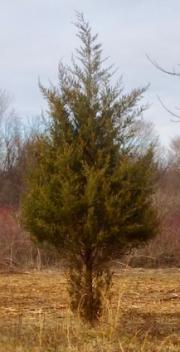
As an example, although Eastern redcedar is deer-resistant, when deer are overpopulated they will eat the lower twigs, leaving a characteristic silhouette that has a narrow or bare base to the height of the browse line.
If a native plant is too vulnerable to survive deer in your garden, it's also too vulnerable to survive deer in local parks. Although Maryland has hundreds of thousands of acres of natural areas in which native plants could thrive, species susceptible to browsing are being eaten into oblivion and overrun with invasive species that deer often don't eat. As we lose these plant species, we also lose the insects, songbirds, and other wildlife that depend on them. The only effective and long-term solution to the challenges of gardening with deer pressure, or to the conservation of native vegetation in natural areas, is to bring the deer population back down to sustainable levels (that which a balanced, healthy ecosystem can support).
Deer favorites
Some native plant species are favorite food sources for white-tailed deer. As a result,
they are disappearing from natural areas.
| Common name | Botanical name |
|---|---|
| White turtlehead (host plant for our state butterfly) | Chelone glabra |
| Pink Lady's Slipper and all other orchids | Cypripedium acaule |
| Turk's-cap lily | Lillium superbum |
| Solomon's plume | Maianthemum racemosum |
| Eastern ninebark | Physocarpus opulifolius |
| Smooth Solomon's-seal | Polygonatum biflorum variety biflorum |
| Pinxterbloom azalea | Rhododendron periclymenoides |
| Smooth blue aster | Symphyotrichum laeve |