
BEAN LEAF BEETLES SHOWING UP IN EARLY SNAP BEANS
Veronica Yurchak, Vegetable Specialist, University of Maryland; vjohnso4@umd.edu
BEAN LEAF BEETLES SHOWING UP IN EARLY SNAP BEANS
Veronica Yurchak, Vegetable Specialist, University of Maryland; vjohnso4@umd.edu
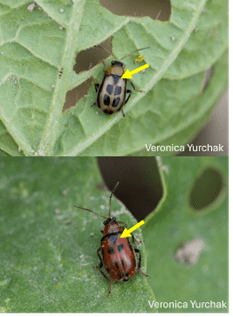
Bean leaf beetles (BLB), C. trifucata, are showing up in snap beans in some areas of the Eastern Shore. This sporadic pest has the potential to cause serious damage to snap beans, soybeans, and other legume crops. Adult beetles are relatively small and range in color from yellow to red with varying numbers of black spots along their wing covers (Fig. 1). The distinguishing characteristic is a small black triangle on the upper side where the wing covers meet. This can help distinguish this pest from the spotted cucumber beetle, which is considered only a minor foliar pest of legumes. There are typically three generations per year, with the first generation of overwintering adults emerging early in the season around the same time as snap bean planting. Adult females lay a total of 250-350 eggs over their lifetime at the base of snap bean plants. The larval stage feeds on roots in the soil but is typically not considered a major concern for the crop. The adult beetle causes the majority of the damage and can severely defoliate early seedlings and even kill plants when infestations are high enough. If occurring later in the growing season, BLB can also cause feeding scars on pods resulting in an unmarketable crop.
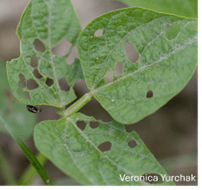
BLB feeding damage to seedlings is easily recognized and appears as holes chewed in the plant leaves that may become larger as the plant grows (Fig. 2). The treatment threshold for BLB in snap beans is 20% defoliation in the prebloom stage or 10% defoliation during podding. Both pyrethroids and neonicotinoids are labeled for BLB control in snap beans and can be found in the Mid-Atlantic Commercial Vegetable Production Recommendations Guide. An efficacy trial conducted at the Virginia Tech ESAREC in Painter, VA also found BLB reductions using the organic insecticides SpinTor and Entrust.
This article appears on June 7, 2025, Volume 16, Issue 3 of the Vegetable and Fruit News