darker green stripes on beech leaves

Beech leaf disease symptom. Photo: Jim Chatfield, OSU Extension

Updated: June 12, 2025

Key points about Beech Leaf Disease

  • Beech leaf disease (BLD) causes significant dieback, decline, and death of beech trees.
     
  • The disease is caused by an invasive foliar-feeding nematode (a microscopic worm), Litylenchus crenatae subsp. mccannii. The nematode overwinters in leaf buds, and enters leaves as they develop in the spring. Scientists are trying to find out how the nematodes spread and how they can be managed to protect tree health.
     
  • All beech species, including native American beech (Fagus grandifolia), European beech (Fagus sylvatica), and Oriental beech (Fagus orientalis) are susceptible to the disease. American beech, native to eastern North America, is an important forest tree recognized by its smooth gray bark. Beeches are also planted as ornamental trees in the landscape.
     
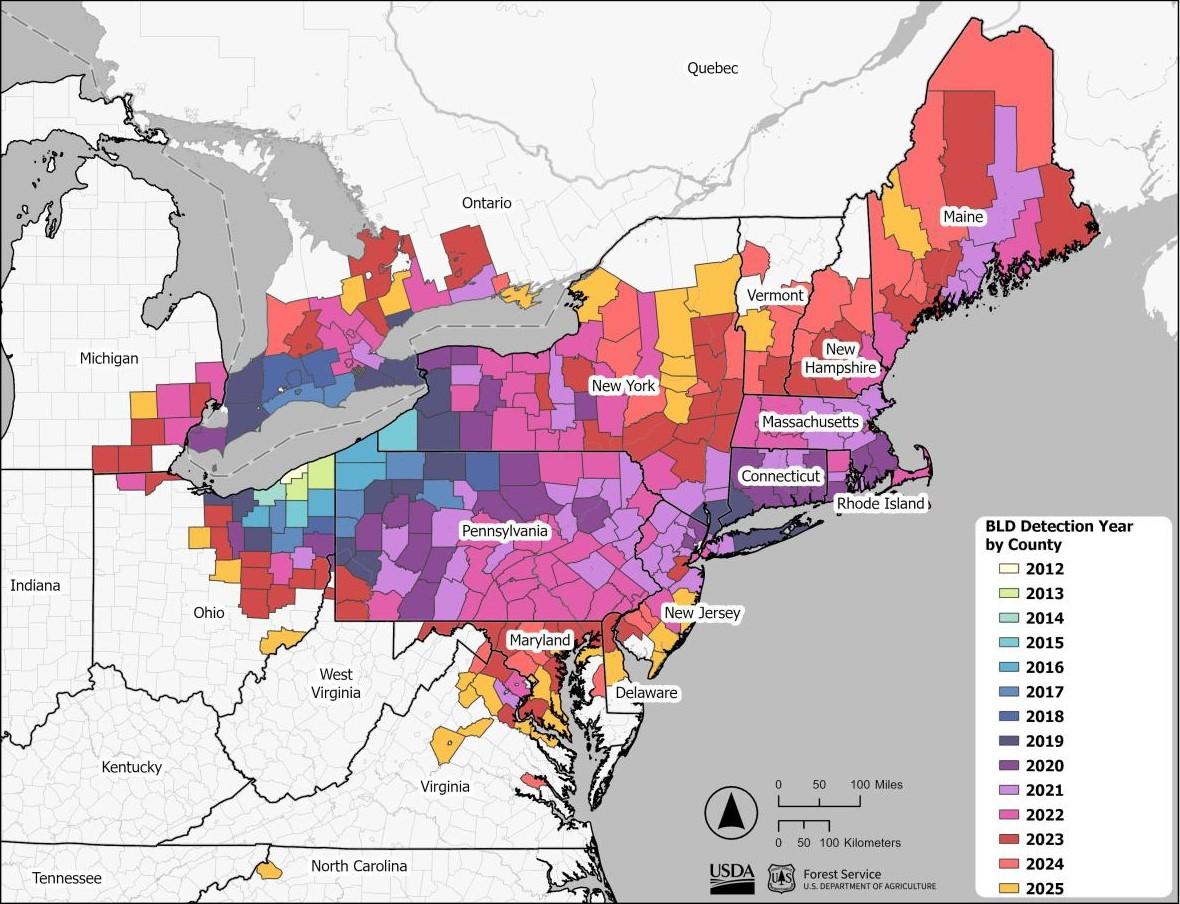
  • BLD was first detected in the Cleveland, Ohio area in 2012. Since then, it has been detected in multiple states in the region, including Pennsylvania, Virginia, West Virginia, Delaware, New Jersey, Ohio, Michigan, New York, Connecticut, Massachusetts, Rhode Island, New Hampshire, Vermont, and Maine, plus the Canadian Province of Ontario. The Maryland Department of Agriculture confirmed the presence of beech leaf disease in Maryland in September 2023. It is currently present in many Maryland counties.
Beech Leaf Disease range map 2024
The spread of beech leaf disease through 2024. Map generated by the USDA Forest Service.
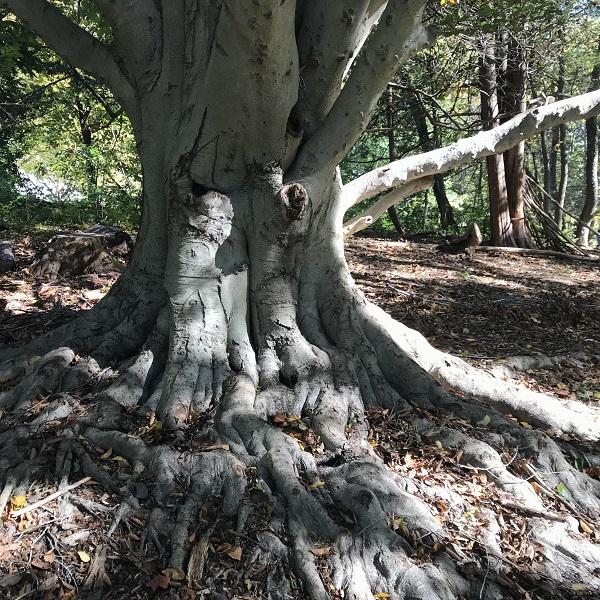
the smooth grey bark of a beech tree
The smooth, iconic, grey bark of a mature American beech tree. Photo: C. Carignan, UME

Symptoms of Beech Leaf Disease

  • Dark stripes or bands between the veins of leaves are a distinct, early symptom of BLD infection.
    • They are visible immediately upon bud-break in the spring.
    • The bands are best seen by looking at the leaves from below and allowing sunlight to pass through the leaf tissue.
  • Leaf tissue thickening and distortion can also be observed as symptoms progress.
  • Infected leaves may be unevenly distributed in the lower canopy of a tree.
  • Over time, the canopy becomes thin (sparse) due to premature leaf drop and aborted leaf bud development. This stresses and weakens trees, causing them to die.

Dark bands on the leaves of American beech, a symptom of Beech Leaf Disease. Photo: Matthew Borden, Bartlett Tree Experts, Bugwood.org

Damage to American beech, caused by Beech Leaf Disease. Photo: Matthew Borden, Bartlett Tree Experts, Bugwood.org

Damage to European beech, caused by Beech Leaf Disease. Photo: Matthew Borden, Bartlett Tree Experts, Bugwood.org

What to do if you find Beech Leaf Disease

  • Report beech leaf disease symptoms to the Maryland Department of Agriculture by email: fpm.mda@maryland.gov. Reports are encouraged from counties that have not yet been added to the detection map above.
  • If you are uncertain as to whether the symptoms you are seeing are beech leaf disease, you can first send digital photos to us at Ask Extension and we can assist with preliminary identification.
  • Work with a certified arborist or licensed tree expert with experience diagnosing beech tree conditions. Laboratory analysis of a sample may be needed to confirm a diagnosis.

Additional resources

(PDF) Beech Leaf Disease Pest Alert | USDA Forest Service

Beech Leaf Disease & Management Options | Rutgers Cooperative Extension

Beech Leaf Disease Confirmed in Virginia | Virginia Department of Forestry

New Leaf Disease is a Beech | The Maryland Invasive Species Council 

Compiled by Debra Ricigliano (retired), HGIC. Reviewed by Dr. Dave Clement, Extension Specialist, Plant Pathology. Revised by Christa Carignan, Horticulturist, HGIC (5/24), and by Miri Talabac, Horticulturist, HGIC (6/25)