
Beekeeping- Start Sampling for Varroa Mites
By Hayden Schug, Charles County Ag Agent, University of Maryland Extension
While sampling colonies for a varroa mite trial over the last two weeks, I noticed a large increase in mite populations at a couple of different locations. This is a good reminder that mid to late August and through September are often when varroa populations begin to spike. As colonies reduce drone production later in the summer, mites shift into worker brood. You can often see heavy infestations by opening patches of drone brood built between boxes or along the bottoms of frames (Fig 1).
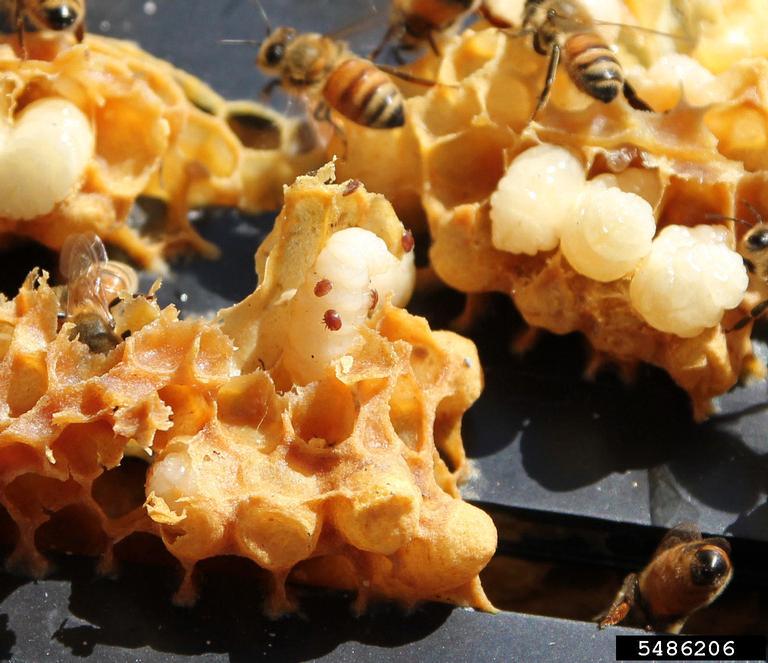
Beekeepers should conduct mite washes and treat as needed. Treatments are usually recommended when mite washes reach 2% to 3%, or about 6 to 9 mites per 300 bees (half a cup). Studies have also shown that washes using alcohol or soapy water are more accurate than powdered sugar rolls, so if you are using powdered sugar, you may want to lower those treatment thresholds. Learn how to do an alcohol wash: https://extension.psu.edu/how-to-do-an-alcohol-wash
Several treatment options are available, including Formic Pro (formic acid) (temperature restrictions of between 50–85°F), Apiguard (thymol) (temperatures needed above 60°F), Apivar (amitraz), and registered oxalic acid products (does not kill mites beneath brood cappings, so repeated treatments may be necessary depending on product). The best choice depends on temperatures, colony strength, brood presence, and whether honey supers are on the hive. Always follow the specific product label, including application instructions and restrictions.
If you are using the new Norroa treatment, remember that it is not a rescue treatment. Norroa suppresses mite reproduction, but it will not knock down an already high population. If mite numbers are high, a faster-acting treatment may be needed before using Norroa, such as oxalic acid or another treatment with a short residual.
In the hives we have been working with, Norroa has kept mite levels at or near zero in some colonies, while mite populations in others have increased quickly. We do not know exactly why, but some colonies may have started with higher mite populations that were missed during the first wash. These are only our observations, but it may be worth washing your hives again if Norroa was applied several weeks ago.
This article appears in September 2026, Volume 17, Issue 8 of the Vegetable and Fruit News
Vegetable & Fruit News is a research-based publication for the commercial vegetable and fruit industry available electronically from April through October. Published by the University of Maryland Extension Agriculture and Food Systems team.
Subscribe