

FS-1102 ❘ November 2019
Creating Opportunities to Reach Underserved Communities: Making Connections via Outreach, Networking, and Partnerships
By Vernelle Mitchell-Hawkins
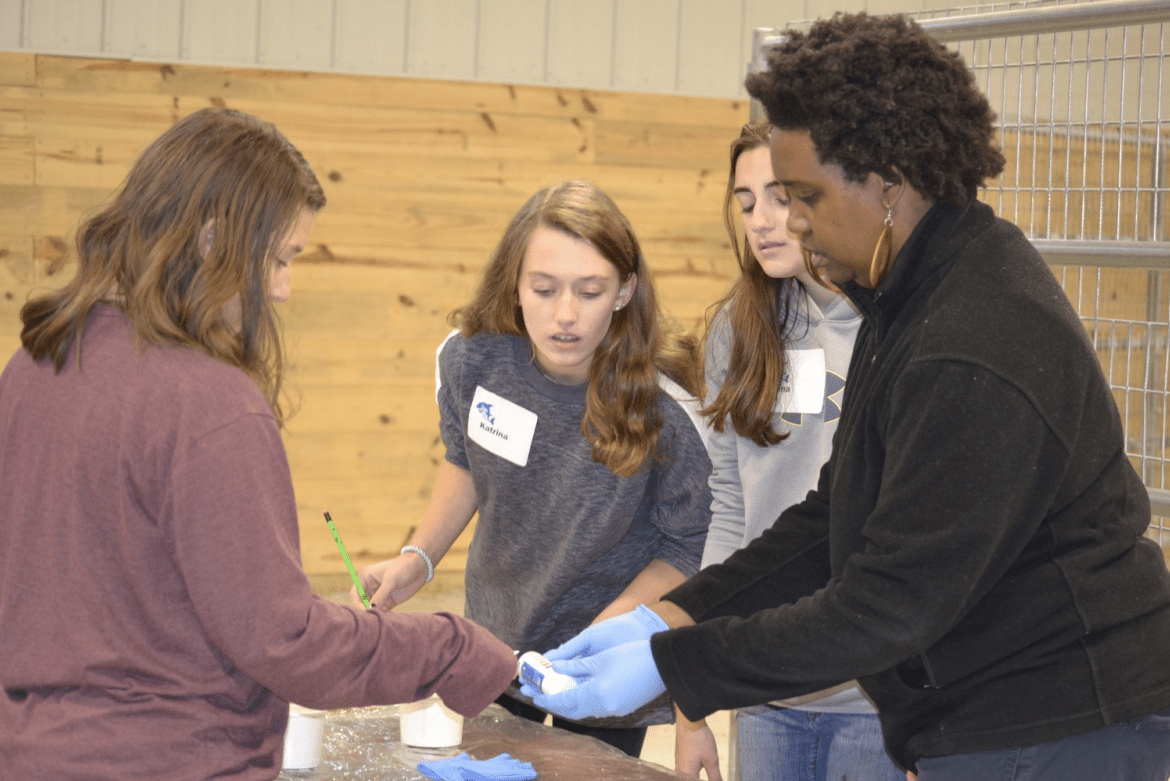
Maryland is considered “America in miniature.” Like many other states in the country, Maryland represents a very diverse area in terms of landscape, climate, culture and inhabitants. For decades, 4-H has been an organization that has recognized the diversity of not only Maryland but all states and has provided youth development programs that evolve to meet the needs of the ever changing society (Figure 1, Junge 2006).
Although deeply rooted in an agricultural foundation, 4-H has broadened its scope in recent years to provide developmental support for youth in non-farm based rural, urban and suburban areas. Historically, these areas have been considered “underserved.” According to Junge (2000), an underserved area is one where 4-H is not currently serving the community. This could be based on demographics, geographic location or resource availability (ex. income, transportation, employment status, etc).
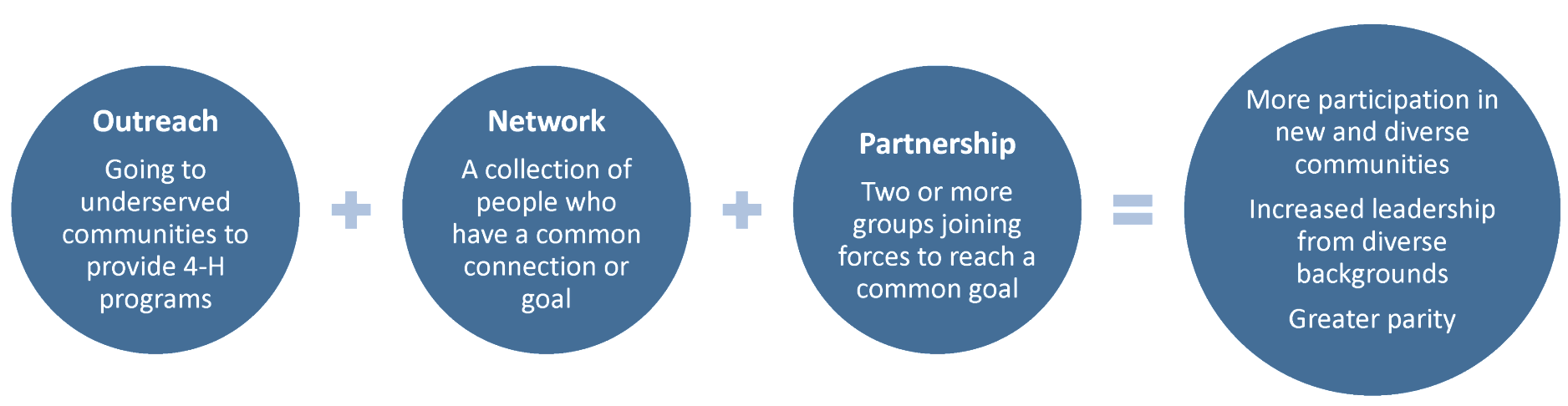
In keeping with the tradition of 4-H, it is important that educators find innovative ways to create opportunities to increase their networks. Outreach, networking and partnership are ways to share the mission of 4-H and provide positive youth development to underserved populations (Figure 2). By making time to stretch outside of the traditional delivery methods, new populations of youth can be reached. New leaders from diverse backgrounds will emerge and parity can be improved. Building networks will cause the educator to become a professional connection maker – making connections that will translate into stronger youth for tomorrow.
This publication will share strategies that can be used to create opportunities to reach underserved communities using needs-based outreach, networks and partnerships.
Finding Underserved Areas: Assessing the Needs of the Community
One of the first steps to creating opportunities is to determine where to begin. It is important to know where to start and what services are needed in an area. A needs assessment is a common tool used to inform youth and community development using systematic approach to data collection (Worker et al. 2017). During the process educators can conduct secondary source studies. These would include collecting information from census data, school/ educational statistics, community demographics, etc.
Another source of assessment data is the primary source. Primary sources are individuals that can provide direct information on the community and can be valuable in terms of increasing the network. When looking to create opportunities to reach youth in underserved areas, 4-H educators/agents commonly assess a variety of stakeholders including youth, volunteers and community members to create a current snapshot of a community. Key informant interviews are conducted by educators with “key” members of the community (ex. volunteers, community leaders, business members, school personnel, etc.). Questions are designed intentionally to gauge what is needed as well as available assets. Spending a little time with key informants could reveal a wealth of skill level and “warm introduction” opportunities that would have been otherwise unknown. After the assessment has been conducted, data is used to ensure that educational programs are offered that meet the needs of the community (Teuteberg & Cummings 2017).
Why Outreach?
Outreach programming is one strategy that can help to bridge the access gap between underserved communities and quality youth development programming. Outreach is a concept that requires an informed and intentional effort to expand the footprint of positive youth development through 4-H programming in a community. This outreach or spread of the 4-H experiential learning model has provided opportunities for more youth to receive benefits associated with “learning by doing.” As an organization, 4-H’s various delivery modes include community clubs, afterschool programs, camps and school enrichment to reach youth (Fields 2011). Historically, the community club is the most recognizable 4-H delivery mode. Adult volunteers serve as group leaders that meet regularly in a designated space in order to deliver positive youth development. “Making all reasonable efforts” in 4-H refers to making sure that educators and program planners make an intentional effort to inform and invite all audiences to participate. The challenge for educators lies in the ability to continue to reach new, underserved audiences and share the opportunity for positive youth development.
Forming the Network
All educators have what is considered a network. The network is a collection of people who have a common connection or goal. It is based on the concept of crossing boundaries of individuals or organizations to reach a common goal. These boundaries could be presented as socio-economic, geographic, community, resource based, etc. (Trevillion 2018).
The important part of establishing and maintaining a sustainable network is the ability to help improve the opportunities for positive youth development. If starting in a new location, the network may be small at first but can grow exponentially in time. Proper use of the network will lead to increased outreach opportunities, thereby improving parity. When making network connections, it is important to consider the following:
- Goals/objectives of the organization/individual (What do they need?);
- Goals/objective of the 4-H program (What do you need?);
- Establish connections in objectives (Are there intersections where parties can help each other reach objectives?)
The goal for a successful educator would be to ensure that University resources were offered to all community inhabitants equitably. Using outreach opportunities to increase the network(s) of the educator can lead to an increase in parity. Parity is the measurement that determines the level of inclusion of programs, in relation to the ethnic makeup of the community.
Partnerships
The network is the starting point for creating a sustainable presence in an underserved community. After connecting with a network individual/ organization, it is advised to arrange a time to speak further with the organization to learn more about the work and look for intersections – opportunities to partner. Intentional conversation networks can evolve into partnerships. Partnerships can evolve into programming opportunities and increase access. Taking time to find partnerships where both organizations can benefit is key to sustainable programming in underserved audiences. Fields (2011) states that clear expectations of parties involved, ongoing staff training, regular partner meetings and joint projects all help to make successful partnerships within a community.
Community Events
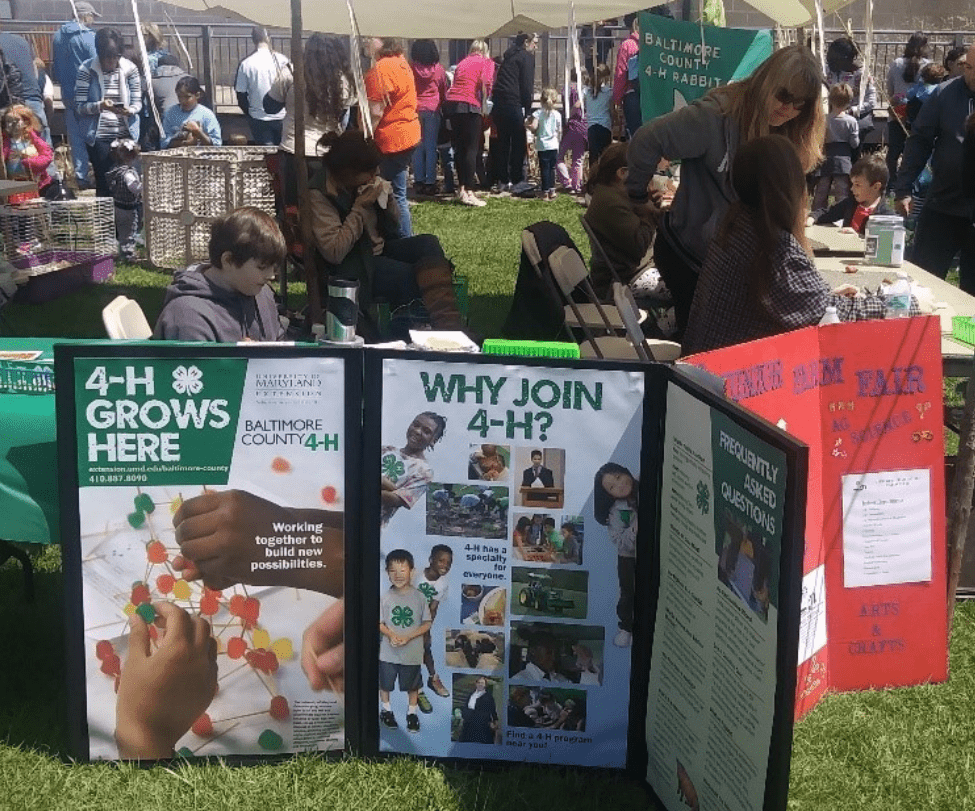
Youth members pledge their heads, hearts, hands and health to their clubs, community, and their world. In association, 4-H youth are often given opportunities to attend community events to demonstrate or share their projects. As educators, the same opportunity can be used to extend their own network. With some basic tools (described later), educators can use the local Garden Show, Pet Expo, Community Fair, Ethnic Festival, or Block Party to showcase 4-H (Figure 3). In most cases, these opportunities will not come to the inbox.
Educators can sometimes become discouraged if the opportunities do not seek out the services of Extension. In underserved areas, Extension and the educator(s) are unknown to the community. Create a calendar of upcoming events and reach out to inquire about attending as a presenter, exhibitor or guest. Local newspapers, television stations, electronic ticketing sites or social media outlets may list events that could be useful for creating/increasing the network. It is important not to get discouraged. Professional follow up and patience is key.
Associations (Local, State or National)
Professional associations are another way to make new networks. When searching for associations to join, it is important that the organization has a close tie with the National 4-H Mission Mandates that include science, health and community engagement. For example, Parent Teacher Associations/ Organizations often have county-level meetings that are open for members. There are afterschool networks in many states that offer seminars and conferences. Other associations may include afterschool associations or retired teachers/civic workers.
Civic Groups
Civic organizations are often looking to partner with other non-profits. Depending on the focus of the organization, they may have youth programs in want of participation. An example would be veterans groups, sorority or fraternities. Although membership may not be open to the public, an email or invitation to a 4-H event (as judges, key informants or guest speakers) can be a way to open the dialogue in increase the network.
Guest Programming
Making contact with the licensing agency for a state can yield a list of licensed childcare facilities that offer afterschool programs. In larger centers, providers may be open to “guest programs” that are low to no cost and provide research based experiences. The partnership of the center with 4-H provides credibility for them and increases the network for the educator. Some communities have established aftercare programs in recreational areas. These programs can be another outlet for “guest programming.” Local libraries provide opportunities for outreach. Many libraries rely on community input for programming opportunities that will benefit youth. At events, be sure to collect contact information of participants as well as community members that want to engage more with positive youth development.
References
Fields, N.I. (2011). Strategies for 4-H Youth Development Educators on Outreach Programming [Fact Sheet]. Retrieved from https:// extension.umd.edu/learn/publications/strategies-4-h-youth-developmenteducators-outreach-programming
Junge, S.K. (2006) 4-H Youth Development Programming in Underserved Communities.
Teuteberg, D. and Cummins, M. (2017). Using Community Assessments to Improve 4-H Youth Development Programming Efforts. Journal of Extension, 55(4), 4TOT9.
Trevillion, S. (2018). Networking and Community Partnership. Routledge.
Worker, S.M., Schmitt-McQuitty, L., Ambrose, A., Brian, K., Shoenfelder, E., Smith, M. (2017). Multiple-Methods Needs Assessment of California 4- H Science Education Programming.
Vernelle Mitchell-Hawkins
vmh@umd.edu
This publication, Creating Opportunities to Reach Underserved Communities: Making Connections via Outreach, Networking, and Partnerships(FS-1102), is a part of a collection produced by the University of Maryland Extension within the College of Agriculture and Natural Resources.
The information presented has met UME peer-review standards, including internal and external technical review. For help accessing this or any UME publication contact: itaccessibility@umd.edu
For more information on this and other topics, visit the University of Maryland Extension website at extension.umd.edu
University programs, activities, and facilities are available to all without regard to race, color, sex, gender identity or expression, sexual orientation, marital status, age, national origin, political affiliation, physical or mental disability, religion, protected veteran status, genetic information, personal appearance, or any other legally protected class.
When citing this publication, please use the suggested format:
Mitchell-Hawkins, V. (2019). Creating Opportunities to Reach Underserved Communities: Making Connections via Outreach, Networking, and Partnerships (FS-1102). University of Maryland. go.umd.edu/FS-1102