
Fungicide Considerations in Corn and Soybeans
By Andrew Kness, Senior Agriculture Agent, University of Maryland Extension, Harford County
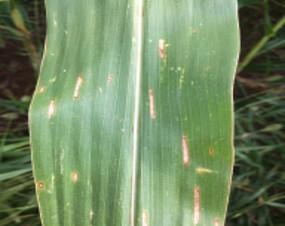
This past week (the week of June 28) I have heard mumblings of suspected tar spot in northern Maryland and Southern Pennsylvania. If true, this would be the earliest detection of this disease in Maryland and has growers thinking about fungicide applications. I have also seen gray leaf spot (GLS) starting to pop up in many fields. Many growers and consultants are starting to ask the question, "should we be concerned about these early findings?” Early detection of these foliar diseases in corn is not ideal but it is also not a reason to panic. We must still be diligent and disciplined in our integrated pest management (IPM) approach before making any panic decisions, especially when grain prices are so low.
As most of the corn crop in Maryland is at or near tassel, this is the time to weigh your options for a fungicide application. Research consistently shows that a fungicide applied at VT provides the greatest likelihood of an economic return on investment. In some very heavy disease pressure situations there may also be a benefit to a second application made after tassel but these situations are less common.
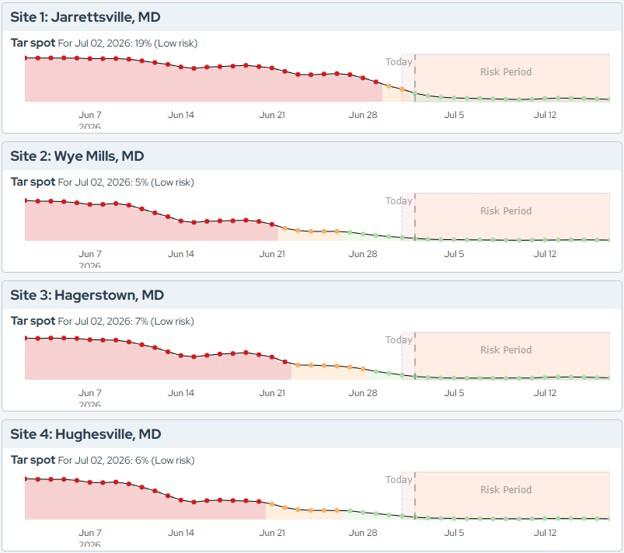
When considering a fungicide application, pay attention to the weather and disease models. The Crop Protection Network has a nice disease forecast tool found at https://connect.doit.wisc.edu/cpn-risk-tool/. Current risk for tar spot disease development is low (~5% risk probability) across the state, due to the extreme hot weather we are currently experiencing. The current 30-day average temperature across much of the state is approaching 80 F, outside of the optimum window for tar spot disease development of 63-74 F. Risk models, however, are very high (98-100%) for gray leaf spot (Figure 2). Tar spot gets a lot of attention because it’s new, but gray leaf spot (GLS) is a very damaging disease of corn and has the potential to impact our yields more than any other foliar disease of corn (on the average year).
Additional factors that you will want to consider when determining to apply a fungicide or not are the hybrid genetics and the field history. There are modern hybrids that have exceptional GLS resistance and there are others that are lacking. Keep this in mind when deciding where to target your fungicide applications. Fields planted to corn after corn, especially in no-till situations, will also be at a higher risk of developing many foliar diseases, as well as ear rots. There are a lot of corn acres across Maryland this year, so don’t forget where you have corn on corn acres–these fields are at higher risk for disease. Also consider the hybrid’s standability because stalk-rotting fungi can cause serious harvest concerns on brittle corn hybrids.
This brings me to soybean. Most foliar diseases of soybean typically do not develop until the plants reach R1 (beginning flowering). With the hot, dry weather we have experienced this year, soybeans have been slow to grow. This means that there is not as dense of a canopy (at least not yet) that would facilitate the development of many of our foliar diseases. The Crop Risk Tool currently predicts low risk (25-30% probability) for our soybean crop across the state for developing frogeye leaf spot but this could change as plants get closer to R3.
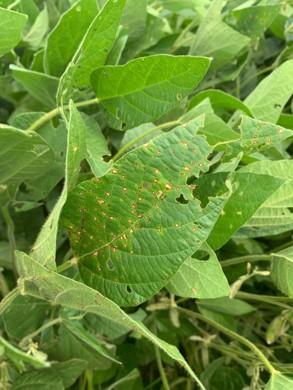
For soybeans, the majority of research indicates that a single fungicide application made at R3 (beginning pod; at least one pod on the four uppermost nodes on the main stem is at least 3/16 of an inch) has the greatest probability of an economic return on investment. An analysis of hundreds of research plots from the US and Canada also shows that the average yield response to a fungicide application in soybeans is 1.64 bushels/acre. This is also consistent with my research trials conducted here in Maryland across 3 locations since 2019 where the average yield response in these trials has been 1.86 bu/a. With $11 soybeans on the board, a 1.86 bushel response may not be enough to cover your cost of application. Therefore, it may pay to focus your fungicide applications to fields that pose higher risk for developing diseases like frogeye leaf spot (Figure 3). These factors would include varieties that have less resistance, fields planted after soybeans, no-till fields, early planted full season fields, fields that have prolific vegetative growth, and fields that tend to experience prolonged leaf wetness due to topography and/or the local microclimate of that particular field.
For additional information regarding fungicide efficacy for corn and soybeans, I recommend consulting the Fungicide Efficacy Tables for corn and soybeans published by the Crop Protection Network.
This article appears in July 2026, Volume 17, Issue 4 of the Agronomy News.