
How to Protect Your Profit by Identifying Hidden Costs in Fruit and Vegetable Marketing
As a fruit or vegetable grower, you probably track your costs of production such as seeds, transplants, fertilizer, pest management, labor, irrigation, harvesting, and. However, profitability is also influenced by another group of expenses that may be less visible in farm records: transaction costs (TCs).
Transaction costs are the time, money, and effort needed to conduct business beyond the direct cost of producing a product (Mukoviz et al., 2022; Williamson, 2025). For fruit and vegetable growers, these costs can arise while searching for customers, gathering market information, negotiating prices and delivery conditions, transporting products, completing regulatory paperwork, maintaining certifications, and following up on payments.
Individually, many of these expenses may seem insignificant. However, when accumulated over a production and marketing season, they can substantially reduce the income retained by the farm. This may be particularly important for beginning and small-scale fruit and vegetable growers operating with limited labor, small sales volumes, perishable products, and limited market channels (Sultan et al., 2021). Small and beginning farmers have a higher cost of production than larger farmers who can take advantage of economies of scale (DJOKOTO, 2022; Neill & Morgan, 2021).
Where Are Transaction Costs Hiding?
A useful first step is to recognize that transaction costs occur throughout the marketing process, not only when a product is sold.
Finding buyers and markets requires time. You may spend hours making phone calls (bill and time), searching online, visiting markets, attending meetings, communicating with restaurants, or developing relationships with wholesalers. Fuel, mileage, internet services, advertising, and the value of the grower's time are all costs associated with finding and maintaining customers.
Negotiating a sale also has a cost. Fruit and vegetable growers may negotiate price, quantity, product quality, packaging, delivery schedules, and payment terms. If you do not have current market information, you may accept an unfavorable price simply because the product is highly perishable and must be sold quickly.
Transportation and deliverycan represent another substantial hidden expense. Fuel is only one component. Mileage, vehicle depreciation, tolls, parking, loading and unloading time, waiting at delivery locations, and product losses during transportation should also be considered. A market may generate high gross sales but still provide a relatively low return when these costs are included.
Paperwork and compliancerequire both money and time. Food safety requirements, licenses, permits, insurance, certifications, taxes, and recordkeeping can involve application fees as well as hours spent understanding requirements, completing forms, maintaining records, and renewing documentation.
Finally, costs can continue after the product has been delivered. Following up on invoices, collecting late payments, resolving disagreements over product quality, replacing rejected products, or documenting that delivery requirements were met all require resources. A sale is therefore not necessarily complete simply because the vegetables have left the farm.
A Market Trip May Cost More Than You Think
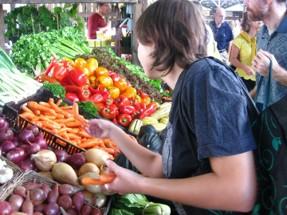
Consider a grower deciding whether to sell at a particular farmers market (Figure 1). Looking only at gross sales can give an incomplete picture of profitability.
The grower should consider: fuel and mileage; market fees; parking and tolls; packaging; labor used for loading, transportation, setup, selling, and cleanup; phone and internet expenses associated with the market; time spent traveling and waiting; and the value of unsold or spoiled produce.
For example, if a grower generates $1,000 in sales at a market but incurs $100 in market fees, $75 in transportation expenses, $250 in marketing labor and time, and $100 in unsold produce, only $575 are left to cover the costs of producing those vegetables, including labor and management time.
This does not necessarily mean the grower should leave that market. The market may provide other benefits, including customer development, brand recognition, or opportunities for future sales. Rather, growers should understand the true cost of participating in the marketso that they can make informed business decisions.
Five Questions to Ask
Fruit and vegetable growers can begin identifying transaction costs by asking five simple questions:
- How much does each market trip or delivery actually cost?
- Do I compare prices and marketing opportunities before selling?
- Do I assign a value to my own time?
- Do I track expenses associated with finding and maintaining customers?
- Do I regularly compare the profitability of my different market channels?
These questions are particularly important when comparing farmers markets, roadside stands, community-supported agriculture (CSA), restaurant sales, wholesale markets, food hubs, and institutional buyers. A channel offering the highest selling price does not necessarily provide the highest profit if the costs of accessing and servicing that market are also high.
Recognizing Warning Signs
Several warning signs may indicate that transaction costs are reducing farm profitability. Growers should pay attention when they routinely accept the first price offered, rarely compare markets, spend substantial amounts of time searching for buyers, find that paperwork consistently takes longer than expected, experience increasing transportation costs, or regularly wait for customers to pay outstanding invoices.
Recognizing these patterns allows growers to move from simply experiencing hidden costs to actively managing them. Practical Ways to Reduce Hidden Costs
- Reducing transaction costs does not necessarily require eliminating an activity. Instead, the objective is to conduct necessary business activities more efficiently.
- You can start by tracking one category of hidden costs each week. Recording mileage, travel time, market fees, marketing expenses, and payment delays can gradually reveal where money and time are being lost.
- Comparing market channels is also important. Rather than evaluating a market solely by gross sales or selling price, consider the total costs required to participate in that market.
- Digital market information and recordkeeping tools may reduce the time required to locate buyers, compare market opportunities, maintain records, and communicate with customers. Similarly, cooperatives, food hubs, and farmer groups may allow growers to share some transportation, marketing, certification, or distribution expenses.
- Extension education can also help you strengthen recordkeeping, pricing, enterprise budgeting, market research, and profitability analysis. These skills allow you to incorporate hidden business expenses into routine decision-making instead of discovering them only after profits have declined.
For fruit and vegetable growers, profitability depends on more than producing a good crop and obtaining a good selling price. The costs involved in getting that crop from the farm to a paying customer also matter. Searching for buyers, negotiating sales, transporting produce, completing paperwork, maintaining market relationships, and collecting payments all consume farm resources. Because these expenses are distributed across many activities, they can easily remain hidden.
The principle is simple: you cannot manage costs that you do not measure. By identifying and tracking transaction costs, fruit and vegetable growers can better understand the true profitability of their marketing decisions, compare market opportunities more accurately, and identify practical ways to keep more of what they earn.
Learn more: UMD Extension Farm and Agribusiness Management resources
Acknowledgment:
This work is sponsored by the Rural Maryland Council's Rural Maryland Prosperity Investment Fund Grant Program.
References
DJOKOTO, J. G. (2022). Farm Size and Efficiency Nexus: Evidence From a Meta-Regression. Review of Agricultural and Applied Economics, 25(1), 30–41. https://doi.org/10.15414/raae.2022.25.01.30-41
Mukoviz, V., Leshchii, L., Khodakivska, O., Prokopova, O., & Kuzub, M. (2022). Accounting for transactions costs of agricultural producers in the shadow economy. Agricultural and Resource Economics: International Scientific E-Journal, 8(2), 67–85. https://doi.org/https://doi.org/10.22004/ag.econ.322721
Neill, C. L., & Morgan, K. L. (2021). Beyond Scale and Scope: Exploring Economic Drivers of U.S. Specialty Crop Production With an Application to Edamame. Frontiers in Sustainable Food Systems, 4(January), 1–10. https://doi.org/10.3389/fsufs.2020.582834
Sultan, H., Rachmina, D., & Fariyanti, A. (2021). Effect of Transaction Costs on Profit and the Capital Formation of Soybean Farming in Lamongan Regency, East Java. AGRARIS: Journal of Agribusiness and Rural Development Research, 7(1), 111–126. https://doi.org/10.18196/agraris.v7i1.4427
Williamson, O. E. (2025). Transaction Cost Economics. In Handbook of New Institutional Economics (pp. 47–71). Springer Nature Switzerland. https://doi.org/10.1007/978-3-031-50810-3_4
This article appears in August 2026, Volume 17, Issue 7 of the Vegetable and Fruit News