
New World Screwworm
Since the 1960s, the New World Screwworm (NWS) has been declared eradicated from the United States, although there was still a large population in Mexico and Central America. Depending on the winds and weather, we could still see the pest show up here in the US, mainly in Texas and Florida. Recently, there has been a resurgence of the Screwworm in Mexico, which led to the closure of livestock trade through the U.S. Southern Border Ports from May 11 to September 15, 2025.
In June, USDA launched a plan to combat NWS by protecting the borders, increasing eradication efforts, and increasing awareness. The plan can plan can be found on https://www.usda.gov/sites/default/files/documents/nws-visit-policy-brief.pdf.
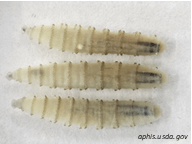
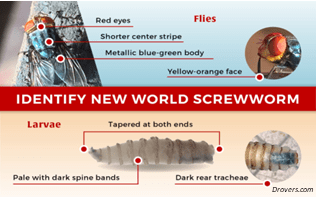
The New World Screwworm is simply a blowfly; a metallic-blue parasitic fly with three dark stripes along its back. The larvae (maggots) of the screwworm feed on the wounds of warm-blooded animals. These larvae burrow into the wound, causing extensive damage by tearing apart the tissue with their sharp mouth hooks. Once the larvae feed on the flesh for about a week, they will fall to the ground to burrow in the soil and mature. The mature screwworm will emerge and mate 3-5 days later.
It is important to take proactive steps to protect your animals from the Screwworm. MDA has released preventative measures, which include:
- Inspecting wounds for signs of fly eggs or larvae
- Clean and treat wounds immediately
- Implement a good fly control program using repellants, traps, and insecticides
- Quarantine all new arrivals before introducing them to the herd.
- Animals suffering from the infestation may exhibit the following signs:
- Bloody drainage from a cut or wound
- White or cream-colored runny substance in or around a wound
- Presence of maggots in wounds
- Fever or reduced appetite
If screwworms are suspected, contact the Maryland State Veterinarian immediately. Her office number is (410) 841-5810, or after hours, she can be reached at (410) 841-5971.
This article appears in October 2025, Volume 16, Issue 7 of the Agronomy News.