
Profit By Choice, Not by Chance: Replacing Guesswork with Research-Based Variety Selection
Nicole M. Fiorellino, Extension Agronomist
As we are beginning to harvest plots for our University variety trials plots, I am thinking about making research-based, unbiased variety and hybrid selections. It can be challenging to recommend that farmers utilize the results of University official variety trials (OVTs) when some farmers have already made variety selections before the results are published. However, the principles of using University OVT results or other variety performance data to make good seed selections still apply. A more detailed article on this topic can be found at https://go.umd.edu/interpretingtrials but I am going to hammer home an important point with this article.
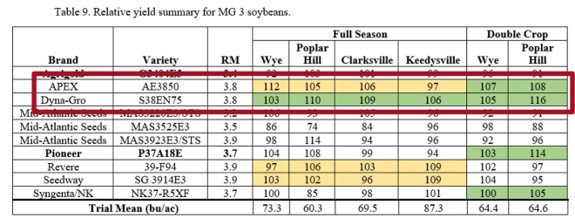
While it can be tempting to simply select the highest yielding variety from any published source, that shortcut may not result in similar results in your field. If you prefer to only use one piece of information from the nearly 30 pages of my OVT reports, I urge you to understand and utilize the relative yield data tables that I include at the beginning of both the corn and soybean OVT reports (which can be found at https://psla.umd.edu/extension/md-crops/). Relative yield is the ratio of the yield of a variety at a location to the mean yield of all the varieties at that location expressed in percentage. A variety that has a relative yield consistently greater than 100 across all testing locations is considered to have excellent stability. Let’s look at an example: a new soybean variety (NF3574E) is included in this year’s trials. It is a maturity group 3.5 and it yielded 76 bushels per acre (bu/ac) at Wye Research Center in Queenstown. To determine its relative yield, we divide 76 bu/ac for the variety by the average of all MG 3 soybeans at Wye, which is 73 bu/ac. When multiplied by 100, the value of 104 relative yield is determined.
(76 ÷ 73) × 100 = 104 RY
If relative yield for the variety was above 100 at all OVT locations across the state, one would conclude that this variety has good yield stability, meaning that it performs well (above the average) in all conditions across Maryland (Fig 1). Thinking for a moment about the geographic and climatic differences between Keedysville, MD and Salisbury, MD, an individual variety that can perform in each of these locations is likely to perform well even under stressful conditions at your farm. Reviewing the previous years of UMD corn and soybean OVT results will provide the reader with an important point: in any year, there are only a few hybrids and varieties that achieve relative yield > 100 at all test locations. Results for the 2024 soybean OVT are shown in Figure 1.
What if the source of yield data that I am using to make my variety selection does not report relative yield? It is possible to calculate it yourself if the average yield for the data is presented in the source you are using. You may be able to contact the author to obtain such information or request they report relative yield data to you. You may want to consider the value of the source of the data if they are not providing average yield data along with individual variety data.
A final thought about variety selection is combining OVT relative yield results with seed costs and comparing that to your crop budgets. Consider a situation where a farmer spends way beyond their budget for the highest yielding variety from local OVT results, as they are convinced they will produce the same high yield observed in the OVT results. When that variety does not yield as well on a farmer’s field as it did in the OVT, that farmer will lose money. In an alternative situation, a farm selects a moderately-priced variety with yield stability, that is, high relative yield across the state. The farmer produces a yield similar to what he projected based on the OVT results and, if he budgeted based on average yields, he is likely to make money, even if he did not produce the highest yield.
Look for UMD OVT results soon! We aim to report results within two weeks of harvesting our last test location. Corn OVT results should be published within the next few weeks and soybean OVT results will hopefully be about a month behind corn OVT. Current and previous OVT results can be found at https://psla.umd.edu/extension/md-crops/.
This article appears in October 2026, Volume 17, Issue 7 of the Agronomy news.