RnR cover Beltsville

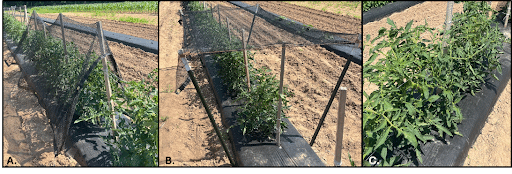
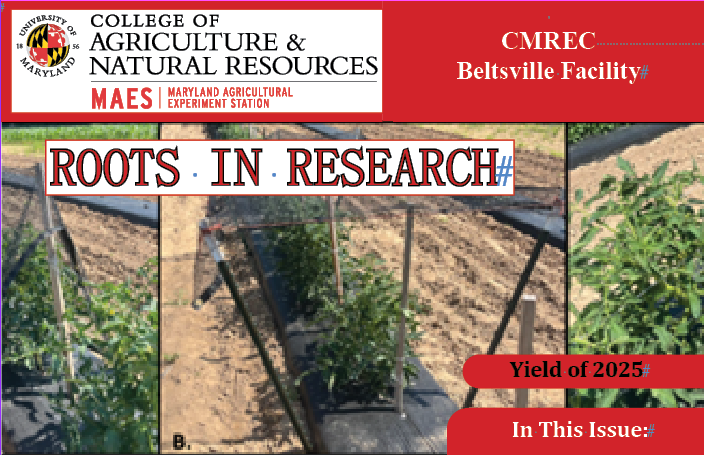
Figure 2. (A) Depicts subplot treatment with shade cloth tented over tomato stakes (stake); (B) depicts subplot treatment with shade cloth suspended over t-posts (tpost); (C) depicts unshaded control treatment (none).

Updated: October 28, 2026

It would be fair to say that the 2025 crop season was a bit of a struggle. With seemingly constant power outages due to USDA’s aging power infrastructure and the departure of Chris Athey (Ag. Tech. Supervisor) to WMREC, the Beltsville facility was short-handed and literally in the dark for too much of the growing season. Thanks to many late nights worked by Kevin, crops nevertheless got planted and research projects were carried out without too much delay. However, after a spring and early summer with relatively regular rainfall, we had less than half an inch in the month of August. Fortunately, most crops had received adequate rainfall through the critical periods except for double-crop beans. By the end of 2025, we welcomed two new crew members to the Beltsville facility: Ben Ehrenreich (Ag Tech Lead) joined in September, followed by Emmett Brew (Ag Tech Supervisor) who joined in December. The 2026 field season is looking more promising, as the Beltsville facility will start with a full crew.

Alan Leslie
MAES Center Director
WMREC | CMREC | LESREC

Download PDF

UMD Bee Lab and the New UMD Bee Squad

https://www.umdbeelab.com/ https://umdbeesquad.com/
The Honey Bee Lab at the University of Maryland has diverse personnel with multidisciplinary scientific
backgrounds who bring a fresh perspective to solving problems. Research in the laboratory is focused
on an epidemiological approach to honey bee health. We are proud to share our research into the major
mechanisms that are responsible for recurring high loss levels in honey bee populations, such as pests and
pathogens associated with honey bees, loss of natural forage habitat due to large monocultural croplands, and
pressure from human induced changes in the environment.
Our team has led and managed the USDA APHIS National Honey Bee Disease Survey since 2009. We are also
a major partner and founding member of the Bee Informed Partnership (BIP), who collaborates closely with
beekeepers from across the country to study and better understand the loss in honey bee colonies in the
United States.

You can find Realtime results about these efforts at our database portals: https://research.beeinformed.org/state_reports/ 

Click to purchase UMD Honey
Donations
If you are able to help support our mission
to improve honey bee health, we greatly
appreciate whatever you can give.
You may donate online using the University of
Maryland "Giving to Maryland" Honey Bee Lab
Donation Site.
Thank you for your support!

New Statewide Vegetable Production Specialist at UMD Extension

Dr. Veronica Yurchak recently wrapped up her first field season as University of Maryland Extension’s new Vegetable Production Specialist. Based at the Wye Research and Education Center in Queenstown, Dr. Yurchak leads a statewide program with research located at several UMD research farms. After earning her PhD in Entomology from UMD, she is focusing on advancing integrated pest management (IPM) strategies while expanding her research into broader vegetable production methods.
Growers can look forward to her regular insect scouting tips and timely updates in UMD Extension’s Fruit and Vegetable News. Dr. Yurchak is available to assist with production challenges and crop diagnostics—don’t hesitate to reach out!

Email: vjohnso4@umd.edu         
Phone: (443) 446-4266

Study to determine the risk of diamide seed treatment insecticides on monarch butterfly habitat established  downslope of agricultural fields

Niranjana Krishnan, PhD - Assistant Professor,  Department of Entomology
Maryland Pesticide Safety Education Program Coordinator

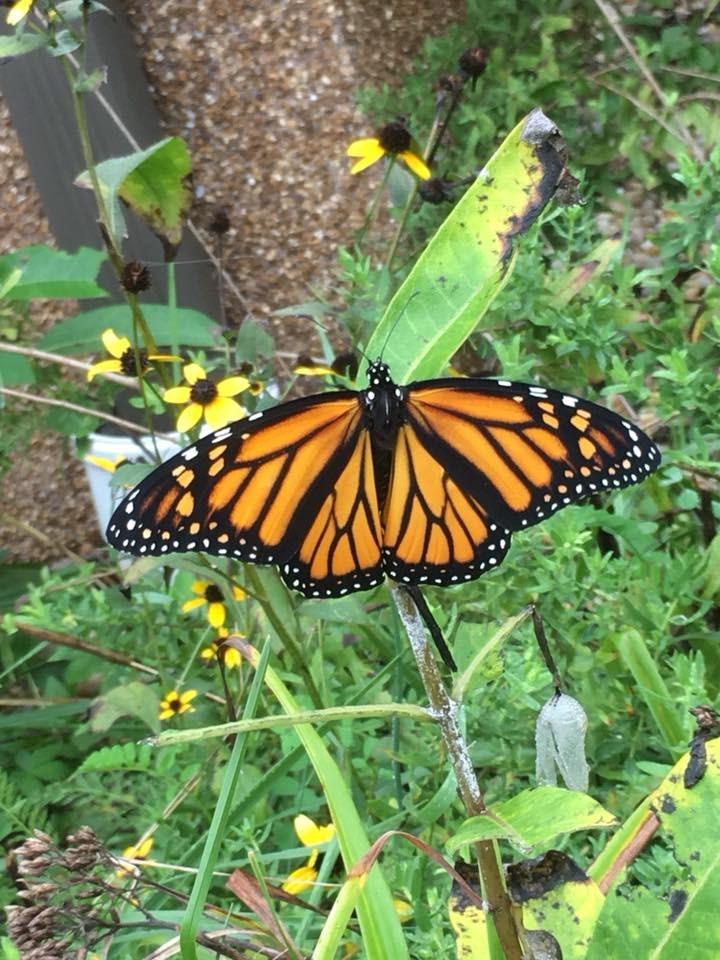
In 2024 and 2025, in Beltsville, MD, we undertook studies to determine the risk of diamide seed treatment insecticides on monarch butterfly habitat established downslope of agricultural fields, potentially through USDA conservation programs like Conservation Reserve Program (CRP) CP42 and the Environmental Quality Incentives Program (EQIP). Seed treatment insecticides can leach off the seed and move downslope through subsurface water flow. Milkweed plants near the downslope edge of the field could systemically pick up diamide residues and monarch larvae could be exposed by consuming the milkweed leaves. We are comparing pesticide residue data with larval counts from the same plots, along with published chronic toxicity data, to assess the potential risk to monarch butterflies, a species of conservation concern.
 

Using Shade Cloth to Reduce Blossom End Rot in Field Grown Tomatoes

Veronica Yurchak1 and Terry Patton2
1University of Maryland Extension, 2Department of Entomology (retired)

Introduction and Background
During the summer of 2024, intense heat and drought conditions across Maryland intensified irrigation demands and severely compromised fruit quality for commercial tomato operations. Blossom-end rot (BER) was particularly prevalent, potentially driven by localized calcium deficiencies as heat stress inhibited both photosynthesis and the transpiration-driven translocation of nutrients. To address these challenges, a study was initiated in 2025 to evaluate the efficacy of shade cloth in mitigating heat stress and reducing BER incidence in field-grown tomatoes. While previous regional research indicated that 30% shade cloth could improve general marketable yields, its specific impact on BER remains under-investigated in Maryland. This report evaluates the 2025 findings and outlines the expanded research objectives planned for the 2026 season.

Methods 
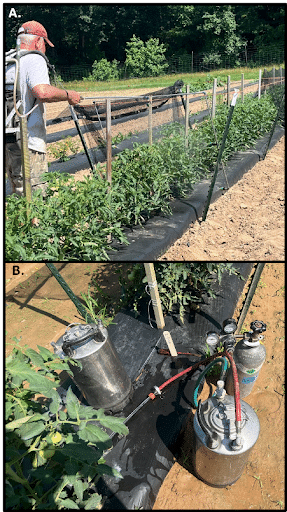
Experimental Setup & Design: Treatments were organized in a randomized complete block split-plot design and were replicated three times. Whole plot treatments included three supplemental calcium application scenarios: weekly foliar-applied (foliar), weekly soil-applied (drip), and no supplemental calcium (none); (Fig. 1). Subplot treatments included three shade treatments applied to five tomato plants per plot: 30% shade cloth tented over tomato stakes (stake), 30% shade cloth suspended horizontally using t-posts (t-post), and no shade cloth (none); (Fig. 2). Tomatoes were transplanted on 15-May and all whole-plot and sub-plot treatments were initiated at the onset of crop flowering on 23-June. All shade cloth was removed on 30-July.
Data Collection: All ripe tomatoes were harvested weekly, counted, and weighed to obtain a measurement of total yield. All tomatoes exhibiting signs of BER were counted and recorded.
 

Results
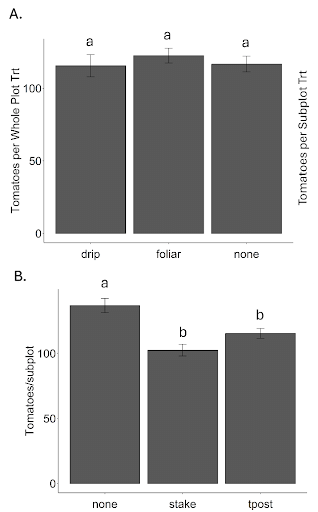
A total of 4,258 tomatoes were harvested between 29-July and 28-Aug across all treatments; of those, 17 exhibited signs of BER. Average tomato yield did not differ among whole plot treatments (Figure 3A), however, significantly fewer tomatoes were harvested from both shaded treatments compared to the no-shade control treatment (Figure 3B). 

Discussion 
Several factors likely contributed to the low incidence of BER observed in 2025, most notably a decrease in extreme heat events. Tomatoes typically exhibit signs of heat stress above 95°F. July 2024 experienced nine days above this threshold, while July 2025 only experienced one. Additionally, the total rainfall in July 2025 was substantially higher at 8.39 inches, compared to 1.51 inches in 2024. This abundant moisture may have improved water and nutrient translocation and helped buffer soil temperatures against the heat, even within the plasticulture production environment. The overall low incidence of BER in this experiment precluded analysis of the influence of shade cloth on BER. Furthermore, the vigorous vegetative growth and substantial plant height of the 'Mountain Fresh +' variety created spatial constraints that necessitated the removal of the shade cloth after only four weeks. This shortened duration may have limited the potential impact of the treatment during the critical fruit-set period.

Future Work
To build upon these findings, the experiment will be refined and replicated in 2026. A Roma-type cultivar, known for its shorter stature and heightened susceptibility to BER, will replace the previous variety to increase the probability of BER. This change in plant architecture will also facilitate a more extended duration for shade cloth treatments. Furthermore, the scope of the study will be expanded to evaluate the impact of the shade cloth on canopy microclimates, specifically investigating how these altered environments influence insect pest populations and the prevalence of natural enemies.