

FS-2024-0713 | November 2025
Ten Ways to Increase Your Public Speaking Confidence
Navonne Owen, UME 4-H Educator, Caroline County

Personal and professional success requires the ability to communicate ideas clearly and confidently. An important component of communication is public speaking. According to business educator Kat Kadian-Baumeyer, “Public speaking is the process of speaking to a group of people in a structured, deliberate manner intended to inform, influence, or entertain the listeners.” (Kadian-Baumeyer & Farland, 2014). It can be an effective way to share an important message.
Public speaking is a common fear for both youth and adults. In fact, the “fear of public speaking or public speaking anxiety is a type of social anxiety and the single most commonly feared situation in the population” (Ebrahimi, et. al, 2019). The anxiety of public speaking can be tied to personal factors like self-confidence, past experience, training, culture, and context. Studies conducted by psychologist Dr. Carol Dwerk found that the largest contributors to the anxiety of public speaking are: the fear of failure, and the fear of rejection of one’s self or one’s ideas (Tucker, et al, 2019).
The fear of failure can result from several sources: “real or perceived bad experiences involving public speaking in the past, lack of preparation, lack of knowledge about public speaking, not knowing the context, and uncertainty about one’s task as a public speaker (such as being thrown into a situation at the last minute)” (Tucker, et al., 2019). The fear of rejection of one’s self or one’s ideas may be rooted in a false belief that the audience will reject your ideas or you as a person.
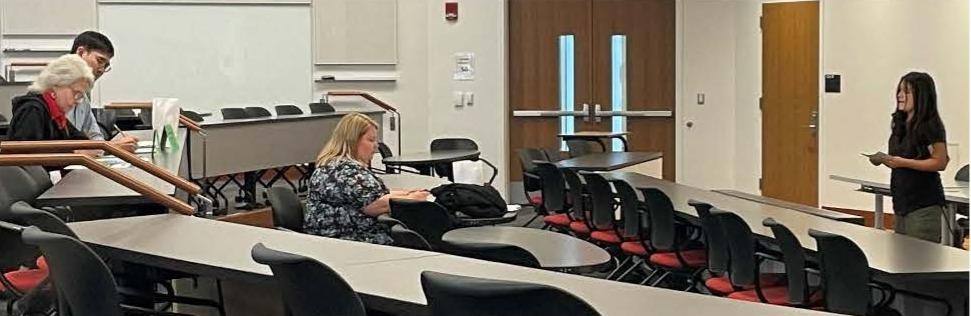
While public speaking is a common fear and it can be scary, it does not have to be! Incorporating simple techniques into your preparation process and presentation is a great way to increase confidence in your public speaking ability. And, knowing how to approach the public speaking task and explain your ideas can help lessen the fear of failure and rejection.
- Know Your Topic – Write and plan your speech about something you know. The more familiar you are or the more you care about your topic, the easier it can be. Consider sharing personal and practical experiences. Your topic should showcase your skills, knowledge, intelligence, and capabilities.
- Know Your Audience – Knowing your audience in advance can help you plan a better speech. If possible, find out:
- Who – Identify who your audience will bein terms of age, gender, experience, level of understanding, etc. Knowing this information in advance provides a vital component to your speech: making sure it is interesting, age appropriate, relatable, and timely.
- What – Identify the audience’s needs and interests. Focus on the information you want to share, and tailor your speech to address the audience’s needs or interests for knowledge and skills.
- Why – Identify why the audience is there. The audience could be there to learn, be inspired, or be influenced. Think about how you can teach, inspire, or influence them through your speech.
- Get Organized – Plan your speech in advance, including any visual aids. Use note cards or slides to stay organized. Write an outline that includes an introduction, body, and summary, keeping the purpose of the speech and information you are sharing as the focus to stay on track. Highlight the key words that are important to your speech and add transitions or segues to your note cards or outline to stay structured.
- Practice – Practice your speech multiple times in advance. Practice can include:
- Timing – Set a timer to track pacing. This can reveal the need to slow down or speed up, if needed. This is an important component, especially if you are new to public speaking. Many beginners will talk faster than during normal conversation. Timing is also important if your speech has time requirements or limits. If time limits exist, craft a speech that is shorter than the time allotted.
- Recording – Record your practice. Watch the recording to identify ways you can improve (i.e. body language, posture, pronunciation, volume, gesturing, smiling, poise, etc.). A creative way to practice, especially in the absence of a recording device, is to use a mirror. Viewing yourself give a speech in this manner can also highlight ways to improve body language, posture, and more.
- Feedback – Have friends, family, or co-workers listen to your speech in advance. They can provide valuable and constructive feedback for improvement.
- Breathe – Before starting your speech, make sure to take at least two deep, slow breaths. This can be very calming. Remember to pause and breathe during your speech too.
- Smile – Smiling can help overcome jitters. It also can make you appear and feel more confident and relaxed. Please note that if the speech is on a serious topic, smiling might not be appropriate.
- Focus – Focus on your material. While it is important to make eye contact and engage with the audience during the speech, stay on track. Make sure you are focused on why you are there: to give a speech that educates, inspires, or influences. Keep your goal and objectives at the forefront of your presentation.
- Stay positive – Positive thoughts and emotions can help decrease the fear and anxiety of public speaking while increasing the likelihood of success. Imagine that your speech will go well. If something goes wrong during the speech, remaining positive and calm can help to get back on track.
- Anticipate and prepare for challenges – Challenges like nerves, noise interruptions, losing your place in the speech, etc. can happen. Everyone makes mistakes. Use the mistake or challenge as an opportunity to improve your skills. Try to:
- Anticipate – Think of possible challenges that could arise, such as losing a notecard or getting off track during your speech. Others will be beyond your control, such as fussing infants, talking audience members, cell phones ringing, technology issues, and more. Identifying these possible scenarios in advance can help with the anxiety of giving a speech.
- Prepare – Have a plan ready to deal with challenges. Possible plans include pausing your speech for noise disruptions, typing your speech on a larger sheet of paper as a back-up for the notecards, providing hand-outs of your slides (if applicable) or materials for tech issues, and injecting humor where appropriate in the case of a mistake or disruption. Check technology requirements in advance, including internet access, WIFI availability, connection cords, etc. Plan to handle any challenges that may arise with confidence, grace, and patience. Some challenges (facilities, weather/environmental, emergencies, technology issues, etc.) are out of your control.
- Recognize and celebrate your success – Give yourself a pat on the back for overcoming a fear, showcasing your effort and talent, and giving your speech. If the speech went off track or you made a mistake, it is likely that the audience did not even notice. Try not to be too critical of yourself and try to learn from any mishaps. Be proud and confident.
Anxiety in certain situations is normal. This is true with public speaking. Incorporating these techniques into the preparation and presentation of your speech can make you a more confident speaker.
References
Ebrahimi, O. V., Pallesen, S., Kenter, R. M. F., & Nordgreen, T. (2019). Psychological Interventions for the Fear of Public Speaking: A Meta-Analysis. Frontiers in psychology, 10, 488. https://doi.org/10.3389/fpsyg.2019.00488.
Kadian-Baumeyer, K. & Farland, B. (2014; updated 2023). How Public Speaking Differs from Casual Conversation. In Communications 101: Public Speaking. https://study.com/academy/lesson/public-speaking-vs-the-conversation.html.
Tucker, B., Barton, K., Burger, A., Drye, J., Hunsicker, C., Mendes, A., & LeHew, M. (2019). Exploring Public Speaking: Edition 4.2. Communication Open Textbooks. https://oer.galileo.usg.edu/communication-textbooks/1/
NAVONNE OWEN
nowen@umd.edu
This publication, Ten Ways to Increase Your Public Speaking Confidence (FS-2024-0713), is a part of a collection produced by the University of Maryland Extension within the College of Agriculture and Natural Resources.
The information presented has met UME peer-review standards, including internal and external technical review. For help accessing this or any UME publication contact: itaccessibility@umd.edu
For more information on this and other topics, visit the University of Maryland Extension website at extension.umd.edu
University programs, activities, and facilities are available to all without regard to race, color, sex, gender identity or expression, sexual orientation, marital status, age, national origin, political affiliation, physical or mental disability, religion, protected veteran status, genetic information, personal appearance, or any other legally protected class.
When citing this publication, please use the suggested format:
Owen, N. (2025). Ten Ways to Increase Your Public Speaking Confidence (FS- 2024-0713). University of Maryland Extension. go.umd.edu/FS-2024-0713