

Colorado spruce (Picea pungens, including the blue forms, Picea pungens glauca) are widely planted in Maryland, despite not being well-adapted to our climate and growing conditions. There are two main fungal diseases that commonly affect them which cause needle loss and branch dieback. These infections can overlap and accelerate their decline.
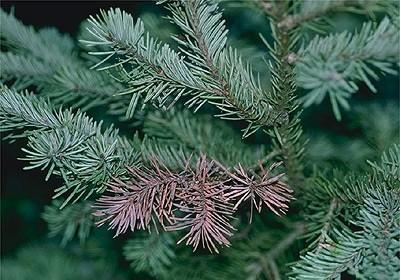
Needle cast (needle blight)
The most common foliage problem of blue spruce in Maryland is a disease caused by the fungus Rhizosphaeria kalkoffii.
Symptoms
- On the lower branches, typically on trees aged between about 8 and 15 years old, the first-year needles will turn yellow in midsummer.
- The needles then turn brown or purplish-brown before they fall off through the late summer into autumn.
- Needle loss symptoms will continue to spread upward and around the tree. Branches will decline and die after 3 to 4 years of successive defoliation.
- Using a land lens magnifier or microscope, tiny black spheres (the fungal spore structures) can be seen along the bottom of the needles.
Cytospora canker
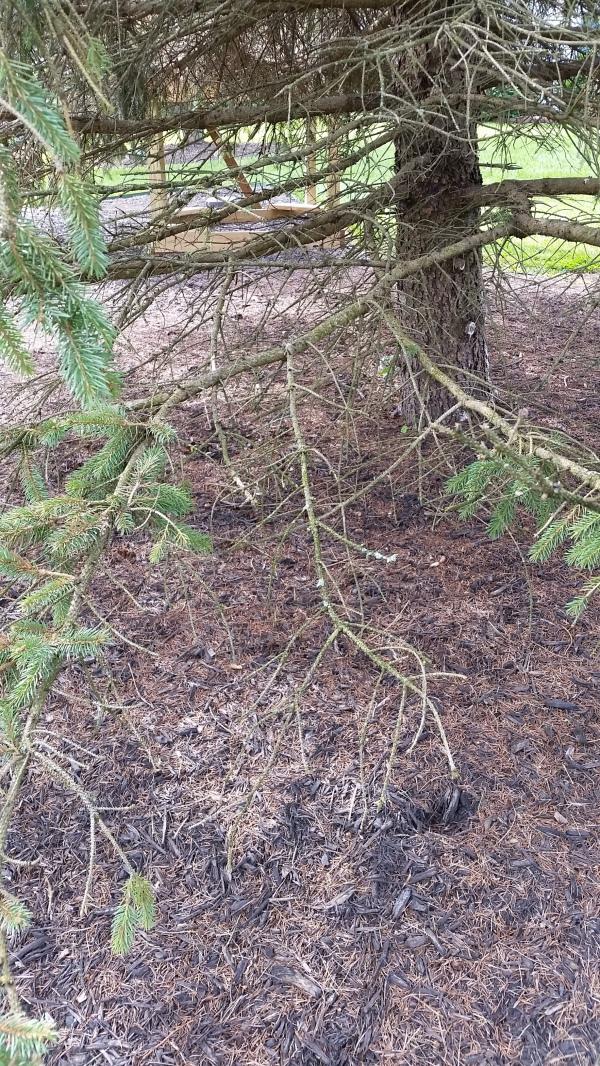
Photo: Ask Extension
The most common dieback disease of blue spruce in Maryland is caused by the fungal pathogen Leucostoma kunzei.
Symptoms
- Needles develop an off color or turn brown, starting on the lower branches of 10- to 15-year-old trees in spring through early summer. The symptoms then progress to entire branches.
- The discolored needles can remain attached during the summer until they defoliate over the winter season, leaving bare twigs and stems.
- The ornamental value of infected landscape spruces will decline after several years of defoliation and symptom progression up the tree.
- The dark fungal fruiting bodies may be hard to find, since the diseased bark is stuck together by the crystallized resin.
Infection starts in the spring on wounds caused by pruning cuts, insect or hail damage, or cracks caused by ice or heavy snow load. The disease causes large amounts of resin flow that appear as streaks of crusty white sap as it dries on the bark. Depending on rainfall patterns (wetter weather can lead to more severe outbreaks), the infection period can extend from spring through autumn. Drought-stressed spruces are more vulnerable to this disease.