
Baltimore City Examining Ways to Protect Urban Forests from Deer
For the first time, Baltimore City is examining white-tailed deer overpopulation and the issues that deer cause within its parklands and across several ecologically significant natural areas. Using a Maryland Dept. of Natural Resources Community Forestry Catalyst Fund grant, the city has laid the foundation to manage deer populations and spur forest regeneration within city limits and adjacent private properties. A density of 20 deer per square mile or lower is the city’s benchmark, which provides a healthy, sustainable deer population that can coexist with a natural area without significant environmental damage. Currently, West Baltimore’s Gwynns Falls-Leakin Park is home to approximately 69-86 deer per square mile; other parks have even higher densities. The DNR is working with the city to establish a partnership park model for Gwynns Falls-Leakin Park to share resources and work together to improve the park. Strategies being considered include precision sharpshooting, controlled hunting, traditional hunting, deer exclusion areas, and repellents, each of which has proven to work well in nearby jurisdictions. Read more here.
New Report Documents the Impact of the Forestry Industry on the Maryland Economy
BEACON, the Business Economic and Community Outreach Network at Salisbury University, with the support of the Maryland Agricultural and Resource-Based Industry Development Corporation (MARBIDCO), has completed an economic impact study to measure the importance of resource-based industries (RBI) to the State of Maryland. These industries represent a significant and crucial segment of the Maryland economy.
The report shares that the forestry sector contributed over $4.2 billion to the State’s economy (13.8% of RBI total), supported 14,099 jobs (13.0% of RBI total), and over $139.5 million in State and local tax revenue (12.7% of RBI total).
Read the forestry sector report here. The full RBI report is available here.
2025 Tax Tips for Forest Landowners Now Available
If you have forest acreage, be aware that many of your management activities can have tax implications — not just if you sell timber. In addition, new legislation in 2025 changed many tax provisions, and adds new incentives for capital investment. The US Forest Service, with its partners at the universities of Florida and Georgia, has issued its annual Tax Tips For Forest Landowners guide. The five-page publication provides information about important concepts and classifications, including real world examples with calculations.
The publication provides general information to support you and your tax advisor. It is not financial, tax, or legal advice. Please consult your tax advisor about your specific tax situation.
Are Native Fungi the Key to Controlling EAB?
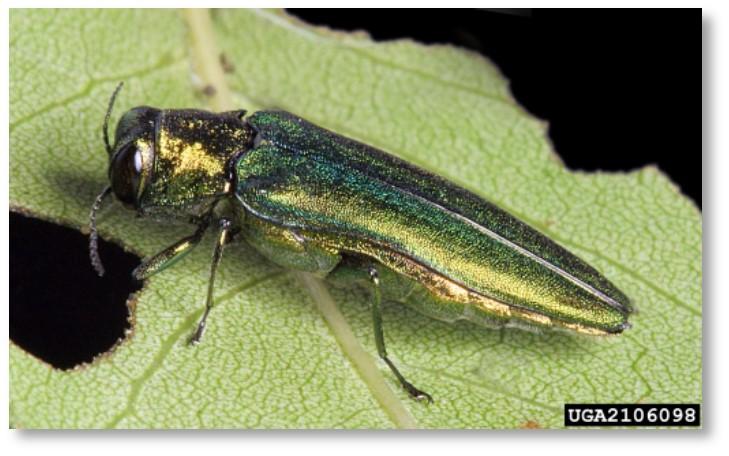
Emerald ash borers have carved a deadly path through North America’s ash trees, leaving foresters with few practical options at large scales.
Now, scientists at the University of Minnesota have uncovered an unexpected ally already living in those forests: native fungi that can rapidly kill the invasive beetles. In lab tests, four locally sourced fungal strains cut emerald ash borer survival to just a few days, pointing to a new, biologically based way to slow the pest’s spread.
Read a summary of the university’s findings at this link. The full research results can be found in Forests here.
Branching Out, Vol. 34, no. 1 (Winter 2026)
Branching Out is the free, quarterly newsletter of the Woodland Stewardship Education program. For more than 30 years, Branching Out has kept Maryland woodland owners and managers informed about ways to develop and enhance their natural areas, how to identify and control invasive plants and insects, and about news and regional online and in-person events.