
From Winter 2026 issue of Branching Out. Subscribe to Branching Out here. Read more Invasives in Your Woodland articles here. This article contains information current as of date of publication.
The Maryland Department of Agriculture has a responsibility to monitor the importation, breeding, distribution, and sale of invasive plants. In January 2026, the agency updated its “Maryland Prohibited Invasive Plant list,” which lists plants that may not be acquired or sold in-state after the regulation’s effective date. Existing nursery stocks of prohibited plants have a phase-out period of one year for potted plants and two years for in-ground plants. The update includes several species that have appeared in previous spotlight articles, including Japanese barberry, wintercreeper, and Callery pear. Also now subjected to the new phase out regulation is the subject of this issue’s spotlight: the Japanese angelica tree.
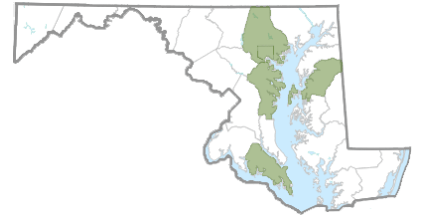
The Japanese angelica tree is also called Japanese aralia (based on the Latin name, Aralia elata) or Angelica. The plant is a native of China, Japan, Korea, and nearby regions, and was introduced to the United States in 1830 as an ornamental plant. According to Evan Hunt, Easement Steward at The Brandywine Conservancy, it likely naturalized shortly after its introduction; however, its invasive tendencies in the Mid-Atlantic states were only first observed in the early 2000s. Since that time, the species has become well established in the northeast, Pennsylvania and Delaware. Although there are relatively few sightings of it in Maryland, as reported to the Maryland Biodiversity Project (see the map below), its resemblance to a native plant, Devil’s walking stick (Aralia spinosa), may lead observers to confuse the two. The Rutgers University Environmental Stewards blog noted that Japanese angelica tree is almost identical to the native Devil’s walking stick, and that “a report by Moore et al. (2009) concluded that after looking at herbarium and field collections, almost all recent reports of Devil’s walking stick in the northeastern United States have been based on misidentification of Angelica tree.”
What is it?
The Japanese angelica tree is a deciduous shrub or small tree, typically reaching heights of 20 to 40 feet. This fast-growing invasive spreads in forest edges, canopy gaps, and rights-of-way, where it displaces native vegetation and alters habitat structure.
How does it spread?
This species spreads both by seed and vegetative shoots. Birds eat its abundant black fruits and disperse the seeds over long distances, while root suckers and resprouting from cut or injured stems allow it to form dense thickets.
How can I identify it?
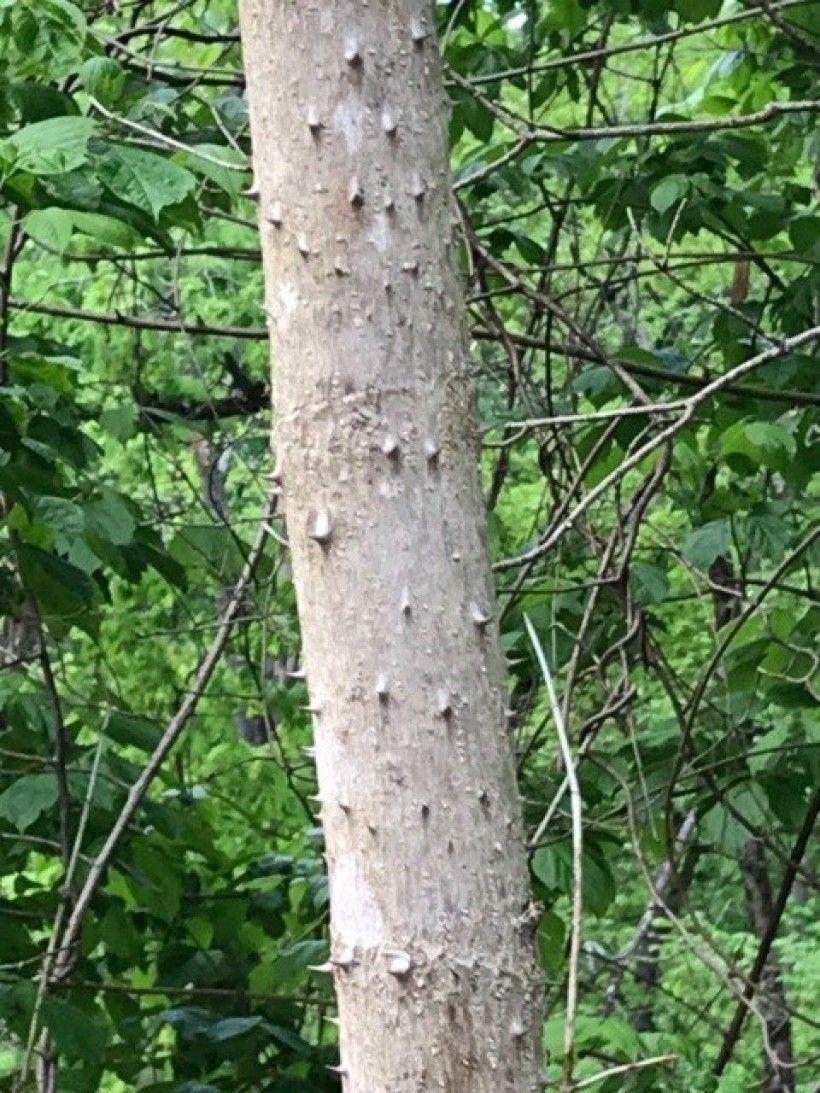
If you suspect that you have Japanese angelica tree in your woodland, winter is a good time to start your investigation. Look for stems that are covered with spines and prominent leaf scars. Japanese angelica tree has large, dark green compound leaves 2–4 feet long, which turn yellow to reddish-purple in the fall. (Look for the veins in the leaflets; if the veins extend into the marginal teeth, it's a Japanese angelica tree. If they don't, it’s a Devil's walking stick.) In late summer the tree bears broad clusters of small white flowers followed by dark berries. See the photo gallery below.
How can I control it?
Control methods include both mechanical and chemical strategies. Hand-pull young plants, and treat larger individuals with foliar sprays, basal bark, or cut-stump treatments with herbicides like triclopyr or glyphosate. Monitor for new seedlings and prevent reinvasion by cutting flowers before they fruit. Plant native species in treated areas to reduce the chance of new sprouting.
For more information:
Learn more about Japanese angelica tree:
Plant Invaders of Mid-Atlantic Natural Areas Field Guide
Invasive Species Spotlight: Japanese Angelica Tree (Aralia elata) (The Brandywine Conservancy)
December Invasive Plant of the Month: Angelica tree (Rutgers University)