
Maggots in Cole Crops and Alliums
By Hayden Schug, Agent, Charles County, UMD & Veronica Yurchak, Extension Vegetable Specialist, UMD.
While scouting fields earlier this week, cabbage maggot larvae were found feeding on mature cole crop roots in Southern Maryland. Onion maggot larvae were also found feeding on mature onions on the Eastern Shore. Although these maggots are a pest growers typically associate with spring production, populations can persist throughout the growing season, particularly during periods of cooler weather or when irrigation has been high. While the first generation typically causes the greatest economic damage, cabbage maggots can produce 3-4 generations each year, with the final generation often remaining active into October during warmer years.
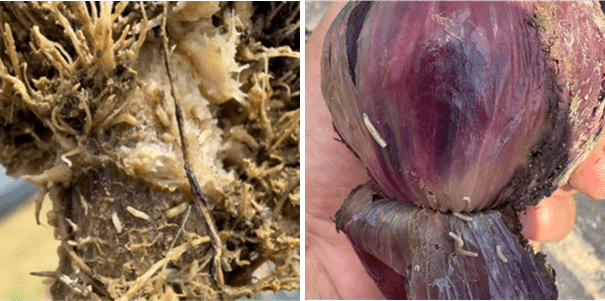
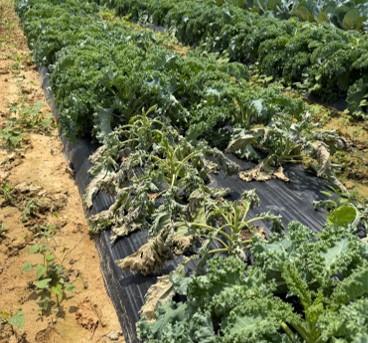
Adult onion and cabbage maggots are both small gray flies that resemble small house flies. The adults lay eggs in the soil at the base of plants, and once the eggs hatch, the white larvae (maggots) begin feeding below ground level on bulb/roots and lower stems (Fig. 1). Eggs typically hatch within 3-7 days, allowing larvae to quickly begin feeding on plants. Because the damage occurs beneath the soil surface, infestations can often go unnoticed until plants begin showing above ground symptoms. The first signs of injury are often plants that appear stunted, wilt during the heat of the day despite proper soil moisture, or begin to yellow (Fig. 2). Pulling affected plants often reveals tunneling in the bulb/roots or lower stem. Feeding wounds also provide entry points for secondary diseases such as bacterial soft rot, increasing losses beyond the initial insect damage. In severe infestations, the root system may be so heavily damaged that plants pull from the soil with little effort because much of the root tissue has already been consumed or damaged. Affected roots may also have a soft, decaying appearance and produce a noticeable rotting odor. Young seedlings and recently transplanted cole crops are especially vulnerable, while larger, well-established plants are generally better able to tolerate some level of feeding.
Unfortunately, once maggots have entered the roots/bulbs there are no rescue treatment options, making preventative management critical. For future plantings, growers can reduce maggot pressure by avoiding successive host crop plantings in the same field, incorporating crop residue soon after harvest, and allowing it to fully decompose before planting another cole crop. Floating row covers can also be highly effective when installed immediately after planting to prevent adult flies from laying eggs around the base of susceptible plants. Be sure to place row covers prior to the start of adult fly activity to ensure no egg laying occurs before the exclusion netting is established. Where maggots have been a recurring problem, the use of treated seeds or transplant insecticide applications may be a good option, particularly for higher-value crops. Products containing cyantraniliprole (Verimark) are commonly used as transplant tray drenches, while directed applications of products such as Belay, Warrior II, or Mustang may also provide control when directed at the base of the transplants where flies are likely to lay their eggs.
Regardless of the product selected, applications are most effective when the insecticide is concentrated around the base of the plant where eggs are deposited. Even under good management, some level of feeding injury should be expected. As always, follow all label restrictions and application recommendations.
This article appears in July 2026, Volume 17, Issue 6 of the Vegetable and Fruit News