
In the summer of 1988, in a time when most Americans got their news from newspapers and three major network news programs, many were horrified and shocked by the news about wildfires in Yellowstone National Park. Part of the reaction was due to hearing that the National Park had a management policy of letting fires burn as part of the natural landscape unless they threatened visitor facilities. This was a long-standing policy in Yellowstone, but as the fires--and the sensational images accompanying the hyperbolic news coverage--continued throughout July and August, public reaction was increasingly negative. For generations of Americans who had been raised with Smokey Bear and the impression that all wildfires were not only dangerous but also needed to be put out as soon as possible, the stories out of Yellowstone were hard to swallow. At the time, I was a National Park Service Ranger at the Gateway Arch in St. Louis, and even there--halfway across the country--I received numerous comments on the situation in Yellowstone, which were often prefaced with either “Isn't it a shame” or “How can the Park Service allow this to happen?” It was difficult to try to explain the policy and how fire is part of the natural landscape, and how plants and wildlife often benefited afterwards.
Fast forward almost 40 years, and not only has the media landscape changed significantly, but the understanding of the benefits of fire -- especially when used as a prescribed effort -- has changed as well. Researchers have an improved awareness of how certain plant and wildlife species respond to periodic fire and are recognizing the value of Indigenous knowledge related to fire as a management tool. In fact, many landowners in the Mid-Atlantic region are learning that prescribed fires can help them achieve their management goals for their property.
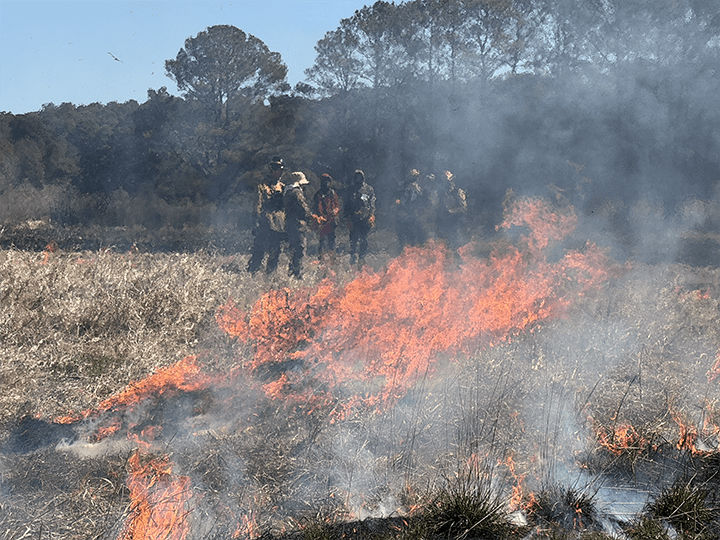
According to the Virginia Land Conservation Assistance Network, prescribed burning is most often used to accomplish objectives such as:
· Increase production of desired grasses, forbs and woody plants
· Improve watershed function resulting in increased water quantity and quality
· Suppression and management of woody species and invasive plants
· Improve forage and browse quality and/or palatability
· Increase availability of desirable forage and browse plants
· Achieve desired composition of grasses, forbs and woody plants
· Improve animal performance and achieve control of certain parasites and pests
· Enhance nutrient cycling
· Removal of thatch or vegetation accumulation
· Reduce hazardous fuel loads
· Improve wildlife habitat
The evolving understanding of the need for periodic fire as well as the understanding that fire can be used to alter and create habitat for wildlife, such as for Northern bobwhite quail and other grassland dependent species, has contributed to the emergence of a new partnership in Maryland.
The Maryland Prescribed Fire Council (marylandprescribedfire.org) was established in 2024. Its mission is to “to protect, promote, and expand the safe and responsible use of prescribed fire in Maryland; foster the exchange of information, techniques, and experiences of the Maryland prescribed fire community, and increase public understanding of the importance and benefits of prescribed fire.” The Council consists of a number of land management partners in Maryland, including the Maryland Fire Service, The Nature Conservancy, and the University of Maryland Extension. Their new website offers resources, a calendar of upcoming educational sessions, and the opportunity for any organization or individual interested in learning about or promoting prescribed burning to join the council.