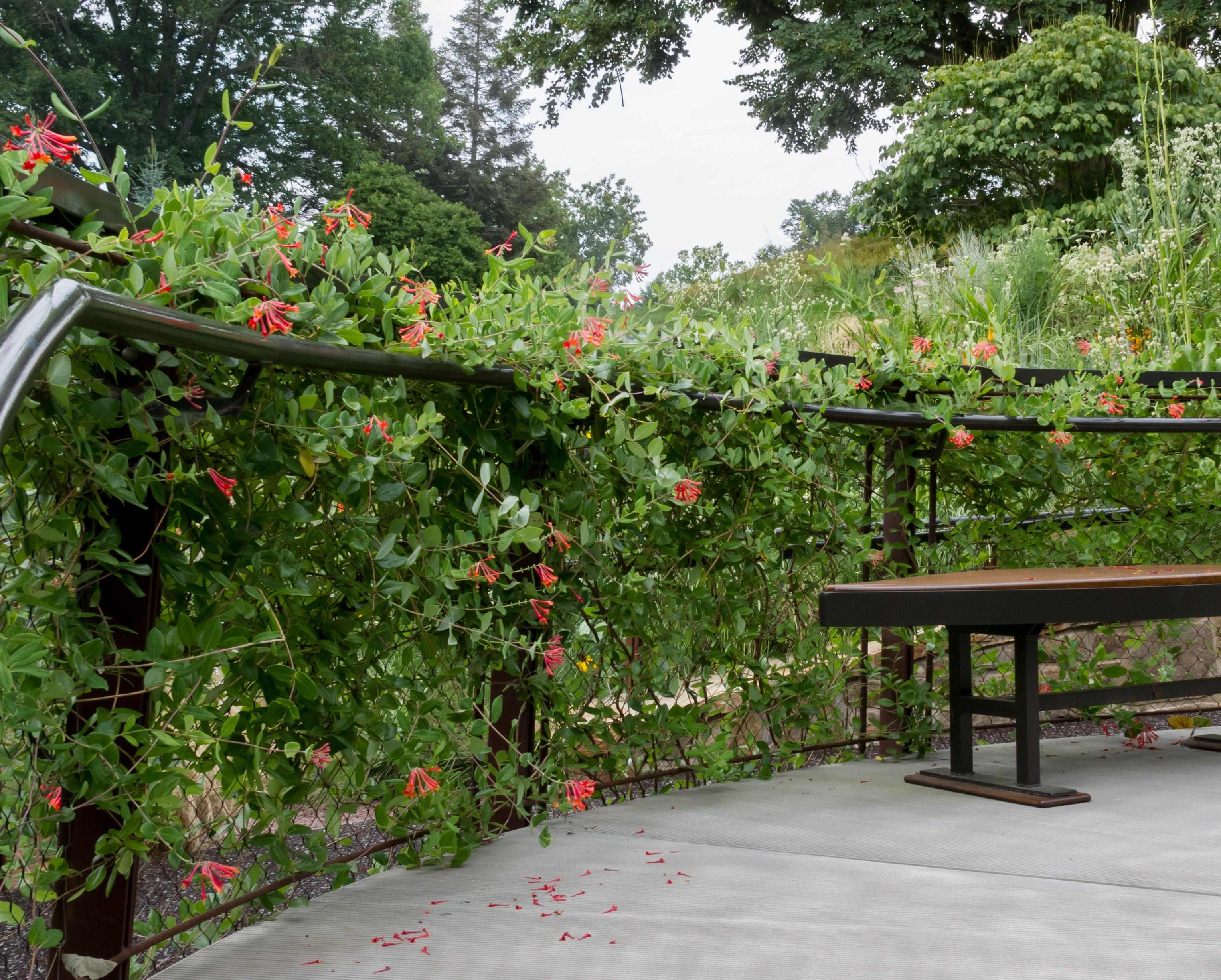
vines with red flowers used on a railing

Coral honeysuckle (Lonicera sempervirens) climbing on a railing. Photo: Miri Talabac, University of Maryland Extension

Updated: July 16, 2026

Using vines in the garden

Vines—plants with climbing, running, or trailing stems—can be both functional and decorative in any type of garden. For functional purposes, vines may be used to provide shade over porches, decks, or patios; to decorate fences, walls, or doorways; to cover and stabilize slopes to prevent erosion; and to screen unsightly views or “soften” the appearance of objects. Vines can also offer food and shelter for birds, butterflies, and beneficial insects that share our green spaces and provide valuable ecosystem services. No matter your goals, vines offer a rich source of material for creating interesting, graceful, and beautiful plantings.

Choosing vines for your garden

When choosing a vine, consider its purpose, natural growth habit, and the site conditions you have available.

  • Do you want a perennial vine or an annual one? 
    • Woody perennial vines add new growth each year from the previous year’s stems.
    • Herbaceous perennial vines lose their foliage after the first freeze in the fall and regrow from the root system each spring. 
    • Annual vines live for only one season and have to be started anew each year. (This page addresses perennial vines only.)
  • Is the vine's climbing habit appropriate for the type of support you have? Vines with holdfasts, for example, cling directly to surfaces and can damage wood siding or other surfaces if they are not trained to a separate trellis. Large-maturing vines will put a lot of weight onto a support structure, which needs to be very sturdy and rot-resistant.
  • Does your planting site receive mostly sun or shade? Does the soil drain well, or tend to get soggy or dry quickly?
  • Do you want a vine that offers certain characteristics, such as flowers in a particular season or wildlife value? Vines native to Maryland are adapted to local conditions and offer support to native the wildlife with which they have co-evolved.

Growth habits of vines

Vines can be categorized based on how they climb:

Clinging

Clinging vines attach themselves directly to a surface. Examples are Virginia creeper (Parthenocissus quinquefolia), Boston ivy (Parthenocissus tricuspidata), and climbing hydrangea (Hydrangea anomala petiolaris). They climb by growing small root-like holdfasts that attach to a wall or other structure. Sometimes these holdfasts are modified tendrils with small, circular, adhesive discs at the tips.

Grabbing

Grabbing vines use winding tendrils or leaf-like appendages to grab onto their supports. Examples are Clematis and grapes. Twine or wire strung between larger support posts or mounted in front of a wall can be used for these vines to give them additional support.

Twining

These vines climb by wrapping their stems around their supports. Examples include wisteria and honeysuckle. All vines do not twine in the same direction, yet the method of climbing is not haphazard. The plants of a particular species invariably twine in one direction, so it is important to start the winding of young vines around their support in the correct direction. For example, American wisteria (Wisteria frutescens) twines in a counter-clockwise direction.

Sprawling

Sprawling vines, such as roses, lie on their supports, and may secure themselves with thorns or stem prickles. To remain tidy, sprawlers need to be tied up or interwoven into their supports.

Clinging

Virginia creeper's adhesive discs cling to a wall.

Photo: Miri Talabac, University of Maryland Extension

Clinging

Woodvamp (Decumaria/Hydrangea barbara), a southeastern U.S. native species, illustrates the ability of clinging vines to scale a vertical wall with no need be tied up or to wrap around their support.

Photo: Miri Talabac, University of Maryland Extension

Grabbing

Native yellow passionflower (Passiflora lutea) uses tendrils to grab any nearby support, like this low tree branch.

Photo: Miri Talabac, University of Maryland Extension

Grabbing

Clematis uses a leaf stem (petiole) like a tendril to wrap around a support. Due to the limited length of the petiole, the support needs to be fairly slender so it can wrap all the way around.

Photo: Miri Talabac, University of Maryland Extension

Twining

Pipevine (Isotrema macrophyllum, formerly Aristolochia macrophylla) wraps its stems around taut vertical wires strung between building columns as a minimalist trellis. If an arbor or pergola support post isn't too wide, twining vines can support themselves by wrapping around the post. (Avoid having twining vines wrap around a tree trunk.)

Photo: Miri Talabac, University of Maryland Extension

Sprawling

Climbing prairie rose (Rosa setigera), an eastern-central U.S. native, is anchored to a garden wall. Climbing roses are a prime example of sprawling vines, as they would form a wide-arching shrub or thicket without a support to lay on (and in the case of roses, hook their thorns onto) for stability. In gardens, such vines need to be tied up as they grow.

Photo: Miri Talabac, University of Maryland Extension

Examples of hardy vines

Coral Honeysuckle

Coral honeysuckle (Lonicera sempervirens) growing on a trellis.

Photo: Rachel Rhodes, University of Maryland Extension

Coral Honeysuckle

Coral Honeysuckle (Lonicera sempervirens) is native to Maryland.

Photo: Rachel Rhodes, University of Maryland Extension

Crossvine

Crossvine (Bignonia capreolata 'Dragon Lady') in native within Maryland's coastal plain. It is one of the only non-invasive vine species that will retain some leaves in the winter (it can be considered semi-evergreen). Cultivar 'Dragon Lady' is redder overall than the wild type, which has more red-and-yellow bicolored flowers.

Photo: Miri Talabac, University of Maryland Extension

American Wisteria

American wisteria (Wisteria frutescens) is native to the eastern U.S., although it does not occur naturally in Maryland. Overall, it is less rampant than the invasive Asian wisteria species (Wisteria floribunda and W. sinensis), and the flowers open later, in shorter clusters, over a longer window of time, and are not strongly scented by comparison.

Photo: Miri Talabac, University of Maryland Extension

Japanese Climbing Hydrangea

Japanese climbing hydrangea (Schizophragma hydrangeoides 'Roseum') clinging to a support post for a large shade structure. Several species of climbing hydrangeas are one of the most suitable vines for shaded sites, although they can be slow to establish before flowering well.

Photo: JC Raulston Arboretum

Hybrid Clematis

A hybrid Clematis vine growing over an arbor. It is common for clematis (and most woody vines) to develop a leafless base as they mature.

Photo: Kaitlyn Baligush, University of Maryland Extension

Vine species lists

Maryland native perennial vines

Species native within Maryland
Common NameBotanical NameLightMoistureClimbing/TypeComments
CrossvineBignonia capreolataFull Sun/Partial SunDry to WetGrabbing/Woody/Semi-evergreenNative to MD coastal plain; tubular flowers range in color (yellow, orange, red, bronze); blooms on old wood
Trumpet Creeper / Trumpet VineCampsis radicansFull Sun/Partial SunDry to MoistClinging/Woody//DeciduousVigorous grower; suckers profusely; attracts hummingbirds; long flowering season
Virgin’s Bower / Devil’s Darning NeedlesClematis virginianaFull Sun to Full ShadeDry-MoistTwining/Woody/DeciduousHost of Clematis Clearwing Moth; white flowers; blooms on new wood
Pipevine / Dutchman’s PipeIsotrema macrophyllum (previously Aristolochia macrophylla)Full Sun/Partial SunMoistTwining/Woody/DeciduousRare in Maryland; Host plant for Pipevine Swallowtail butterfly; shade-tolerant
Coral HoneysuckleLonicera sempervirensFull Sun/Partial SunDry to MoistTwining/Woody/DeciduousNectar source for Ruby-throated hummingbirds; blooms on old wood and new wood; semi-evergreen in Zone 8 and mild winters; susceptible to powdery mildew and aphids
Virginia CreeperParthenocissus quinquefoliaFull Sun to ShadeDry to WetGrabbing/Woody/DeciduousFast growing; berries valuable for wildlife (not edible for people); red fall color
Yellow PassionflowerPassiflora luteaPart ShadeMoistGrabbing/HerbaceousUncommon; foliage host for Variegated Fritillary butterfly larvae (caterpillars)

U.S. native perennial vines

Species native in the Eastern U.S.
Common NameBotanical NameLightMoistureClimbing/TypeComments
Carolina JessamineGelsemium sempervirensFull Sun/Light ShadeDry to MoistTwining/Woody/Semi-EvergreenNative to the southern U.S. (Virginia to Florida); semi-evergreen; fragrant yellow flowers
Purple Passionflower / MaypopPassiflora incarnataFull Sun/Partial ShadeDry to MoistGrabbing/HerbaceousNative to Southeastern US; host plant for Variegated Fritillary butterfly; may sucker aggressively
Climbing Prairie RoseRosa setigeraFull to partial sunMoistSprawling/Woody/DeciduousNative to Central and Eastern US
American WisteriaWisteria frutescensSun to Part ShadeMoist to Wet

Twining

counterclockwise


Native from Virginia to Florida; heat and drought tolerant; less aggressive compared to non-native Wisteria
Kentucky WisteriaWisteria macrostachyaFull sunMedium moistureTwining counterclockwise/WoodyNative to South-central US
GrapesVitis spp.
(Vitis labrusca is a parent of popular cultivated varieties.)
Full SunWell-drainingTwining/WoodyEdible fruits for people and wildlife; pests include spotted lanternfly and Japanese beetles; Maryland native grapes are not readily available at garden stores

Non-native perennial vines

Species not native to the U.S.
Common NameBotanical NameLightMoistureClimbing/TypeComments
ClematisClematis spp.Full sun to partial shade; Shade for the root area
 
Moist, well-drainingTwining - Most are Woody/DeciduousHundreds of species and cultivars are available; 3 groups based on flowering and pruning time
Climbing HydrangeaHydrangea anomala subsp. petiolarisPartial shade to full shadeMoist, well-drainingClinging/Woody/DeciduousWhite flowers in early summer; slow to establish
Japanese Hydrangea VineHydrangea hydrangeoides (previously Schizophragma hydrangeoides)Partial shade to shade; blooms best in dappled shadeMoist, well-drainingClinging/Woody/DeciduousCultivar ‘Moonlight’ has showy white flowers and gray-green leaves
Boston IvyParthenocissus tricuspidataFull Sun to Partial ShadeMoist/Occasionally DryClinging/Woody/DeciduousAttractive fall color
Climbing RosesRosa (various species and hybrids)Most prefer full sunMoist, well-drainingSprawling/Woody/DeciduousVarious types that produce long, vigorous canes; fragrance and disease resistance varies

Do not plant invasive species

Several species of vines are invasive in Maryland residential and natural landscapes. When left unmanaged, many will grow large enough to climb trees and shade the canopy, leading to tree decline. In some cases, twining stems will "strangle" a trunk and kill small trees. Once established, these plants are difficult to remove — do not plant them!

Invasive vines
Common NameBotanical Name
Chocolate VineAkebia quinata
PorecelainberryAmpelopsis glandulosa var. brevipedunculata
Oriental BittersweetCelastrus orbiculatus
Sweet Autumn ClematisClematis terniflora
WintercreeperEuonymus fortunei
English IvyHedera helix
Japanese HopHumulus japonicus
Japanese HoneysuckleLonicera japonica
Mile-a-MinutePersicaria perfoliata
Wisteria (non-native species)Wisteria floribunda, Wisteria x formosa, Wisteria sinensis

Support structures

A unique aspect of vines is their need for some type of structural support. A variety of purchased or homemade structures can be used to add a vertical design element to a garden. Explore options such as trellises, arches, obelisks, lattices, poles, cages, and arbors. If you select a vine that does not cling or grasp naturally, you will need to “train” the plant so that it will weave into your chosen structure. Begin to train or guide the vine onto the structure when it is young.

Planting vines

Vines are usually purchased as container-grown plants. They can be planted at any time when the soil is workable (not frozen), but fall and spring are the best times. A fall-planted vine will have more time to begin establishing its root system before hot weather (and higher water demand) begins the following summer.

To plant vines, follow the same steps as you would for growing other types of perennial plants. 

  • Select a plant that is appropriate for your site conditions. The “right plant in the right place” approach will minimize the chances of plant stress and subsequent plant health problems.
  • Test your soil and amend it, if necessary. Mixing 3 to 4 inches of well-rotted compost into the top few inches of the planting area can improve the soil's water-holding capacity and structure.
  • Dig a hole two times as wide but no deeper than the height of the container in which the plant was grown. The top of the root ball should be set evenly with or slightly above the soil grade.
  • Loosen the plant's roots. If they were circling around the inside of the container or crowded in the pot (“root bound”), slice the root ball with a knife or other sharp tool in a few places and set the roots so that they are pointing outward from the stem.
  • Water thoroughly after planting.

Care and maintenance

Watering: The amount and frequency of watering will depend on the type of vine selected, soil conditions, and weather.

  • Newly planted vines: Check soil moisture at least once each week for their first growing season and monitor it carefully for the first two years. This is a critical period for good root establishment.
  • The best way to check soil moisture is with your hand. Dig down or press a finger several inches into the soil. If it feels dry to the touch, water the root area thoroughly so that water soaks down into the top 6 inches of soil. You can use a small shovel or trowel to dig and check the soil moisture at that level.

Mulching: The same benefits of mulching that apply to trees and shrubs apply to vines. Mulch materials such as leaves or wood chips should cover the entire root zone area and should be no more than three inches deep.

Fertilizing: Test your soil every three years to determine its pH, organic matter, and nutrient content. Vines usually do not need regular fertilization. If your soil test identifies any nutrient deficiencies, you can correct them using an organic or synthetic fertilizer, following the product instructions. Apply fertilizer in early spring prior to new growth.

Monitoring: Insects, diseases, and environmental factors can damage vines. Become an observant gardener and monitor your plant(s) regularly. At the first sign of a problem, determine the cause before taking any action. Misapplied pesticides (including fungicides and insecticides) can do more harm than good. Send photos of symptoms to Ask Extension or contact your local Extension office for assistance with diagnosing problems.

Pruning

Pruning techniques vary depending on the type of vine and its specific use. The general principles for pruning deciduous shrubs also apply to woody vines.

  • Pruning stimulates new growth; it does not stop growth. 
  • Vines can be pruned to temporarily limit their height and weight, or to direct the growth in a particular way.
  • Diseased or dead stems can be pruned out at any time. Cut back to healthy wood.
  • Vines that bloom before early summer (mid-June) can be pruned immediately after the flowers fade. (Example: Wisteria)
  • Vines that bloom in summer or fall can be pruned in late winter or early spring. (Example: Trumpet vine)
  • Vines grown for foliage instead of flowers: prune in early spring before new leaves appear.
  • Old vines can be rejuvenated by cutting all but a few stems near the ground. Do severe pruning in the dormant season. 
  • Annual thinning of old and weak stems encourages new growth. Thin any crowded stems by cutting them to the ground.
  • Some common vines grow vertical stems rapidly, with just a few lateral (side) branches. These “leader” branches can be pinched off at the tip or pruned back during the growing season to develop more horizontal branches. Horizontal branches tend to grow more slowly and produce more leaves, flowers, and fruit than vertical branches.

Pruning Hybrid Clematis: Clematis plants are categorized into groups based on their growth and flowering habits and recommended pruning timeframes. Commercial growers refer to categories A, B, and C (or sometimes 1, 2, and 3). When you purchase a Clematis, note which category it belongs to (check the plant tag or take note of the name and check references).

  • Category A (or 1): Flowers early in spring (before June) on old growth from the previous year. Prune immediately after the flowers finish blooming, and no later than July.
     
  • Category B (or 2): Flowers on new and old wood. This category is divided into two subgroups.
    • B1: Flowers in early summer (May-June) on old stems and again in September on the current season’s new stems. Lightly prune back some of the stems in early spring. Occasional hard pruning to refresh the plant will result in only September flowers for that year
    • B2: Flowers from June through September on both the previous and current year’s stems simultaneously. Prune according to either B1 or C groups.
       
  • Category C (or 3): Flowers anytime from June to September on the current season’s new stems. Prune in late winter or early spring.

References

Cullina, William. (2002). Native Trees, Shrubs, and Vines: A Guide to Using, Growing, and Propagating North American Woody Plants. New England Wildflower Society.

Cutler, Karen Davis. (2003). How to Prune Your Vines and Other Climbing Plants | Brooklyn Botanical Garden.

Author: Christa K. Carignan, Horticulturist, Coordinator of Digital Horticulture Education, HGIC, University of Maryland Extension.
Reviewed by Miri Talabac, Horticulturist and Coordinator, HGIC, University of Maryland Extension. August 2024.
Revised July 2026.

Still have a question? Contact us at Ask Extension.