

Updated: May 11, 2026
AgFS and UME Logo


IPM Threshold Guide for Vegetable Crops

This reference was adapted from the University of Maryland and Delaware Cooperative Extension Filed Crop and Vegetable IPM Pest Management Manuals.

Compiled R. D. Myers 2000, 2018; Updated 2026

Compilation and layout assistance by Carol Jelich, Master Gardener, Anne Arundel County

This reference was adapted from the University of Maryland and Delaware Cooperative Extension Filed Crop and Vegetable IPM Pest Management Manuals

Reviewed by Galen Dively, Terrance Patton, and Sandra Sardenelli, University of Maryland, College Park

ECONOMIC THRESHOLD

Level of pest activity when control action is suggested to prevent economic injury
COLE CROP INSECTS

Plant Emergence (or Transplanting) to Beginning of Heading or Reproductive Development

CABBAGE ROOT MAGGOT

  • Control when planting

FLEA BEETLES:

  • > 50%of newly emerged plants infested and "shothole injury" is present.
  • Treatment thresholds for leafy cultivars not available

CABBAGE APHIDS AND OTHER APHID SPECIES

  • Broccoli and Cauliflower:  infestations of all species combined reach nearly 100%
  • Brussel Sprouts:  > 15% of plants are aphid infested from transplanting till 3 weeks before harvest
  • Cabbage:  2% of plants are infested with 5 or more aphids on leaves

THRIPS

  • Fresh market cabbage:  > 20%of plants infested

IMPORTED CABBAGEWORM, CABBAGE LOOPERS & DIAMONDBACK MOTH CATERPILLARS

  • Sample 50 plants - treat when count is > 0.5 larval units per plant
  • Weighting factor for larval unit determination:
    • Cabbage Looper: large=1.0 small=0.7
    • Imported Cabbageworm: large=0.07 small=0.1
    • Diamondback Caterpillar: any size=0.1

Heading or Sprout Development

CABBAGE APHIDS AND OTHER APHIDS

  • Treat when 2% of plants are infested with > 5 aphids

IMPORTED CABBAGEWRM, CABBAGE LOOPERS & DIAMONDBACK MOTH CATERPILLARS

  • Cabbage – treat when count is > 0.5 larval units per plant
  • Broccoli, Cauliflower and Brussel Sprouts – treat when > 1 caterpillar per 25 plants

CUCURBIT INSECTS

Plant Emergence to Three Leaf Stage

SPOTTED AND STRIPED CUCUMBER BEETLES 

  • For wilt susceptible cucumbers and muskmelons – use systemic insecticide treatment at planting time Provisional threshold for pickling cucumbers – foliar insecticide when 20% of plants are infested with cucumber beetles

Three Leaf Stage to Harvest Maturity

MELON APHID

  • Provisional threshold > 20% of runners have > 5
    aphids on leaves

THRIPS

  • Heavy infestation, leaf injury, plants not actively
    growing

SPIDER MITES

  • > 50% of runners show early leaf injury on crown
    leaves and live mites present

SPOTTED AND STRIPED CUCUMBER BEETLES

  • Thresholds not available
  • Treat moderate to high CB infestations levels on wilt susceptible varieties
  • Treat all cucurbits when high CB infestations cause excessive fruit damage

LEAFHOPPERS

  • Severe leaf injury expected to retard fruit maturity and affect yield

SQUASH VINE BORER

  • As soon as moths are trapped

LIMA BEAN INSECTS

Bloom to Harvest

PLANT BUGS (LYGUS)

  • Early bloom to harvest >6-10 adult/nymphs per 20
    sweeps
  • After mature bud set >20-40 adults/nymphs per 20
    sweeps

CORN EARWORM

  • > 50% of larvae are > 1/2"

Fordhook Lima Beans:

  • Up to 4 weeks from harvest > 1 larvae per 6' of row
  • Less than 4 weeks from harvest 3 larvae per 6' of
    row

Baby Lima Beans:

  • > 1 larvae per 6' of row, from late flat pod stage to
    harvest

PEA INSECTS

PEA APHID 

  • 50 aphids per sweep or 5-10 per Plant

PEPPER INSECTS

Early Fruit Set to Harvest 

GREEN PEACH APHID 

  • Before fruit formation > 2 aphids per leaf
  • Once fruit is present 4 aphids per leaf 

PEPPER MAGGOT 

  • As soon as flies are caught on sticky traps 

EUROPEAN CORN BORER 

  • When fruits are forming on plants > 25 moths
  • black light trapped per 5 days
  • Shorten treatment schedules if > 100 moths black light trapped per 5 days, or apply sprays according to specific pheromone trap catch instructions 

CORN EARWORM 

  • When fruits are forming on plants, >100 moths black light trapped per 5 days, or apply sprays according to specific pheromone trap catch instructions

POTATO INSECTS

Early Fruit Set to Harvest 

POTATO FLEA BEETLE

  •  >20% leaf loss 

COLORADO POTATO BEETLE 

  • Overwintered >5 adults per 10 plant clusters and
  • > 10% of shoots chewed off at ground level 

ALL STAGES

Chemical treatments: 

  • Defoliation 20% and density per 10 plant clusters
  • > 5 adults or > 40 small larvae or 15 large larvae or combination of any 2 stages, at 1/2 above levels 

Bt treatment: 

  • 10% plant infestation,
  • > 30% eggs hatched (trigger date)

Greater Than 12" Shoots to Bloom

GREEN PEACH APHID, POTATO APHID

  • Prior to bloom - 2 per leaf
  • During bloom - 4 per leaf
  • Within 2 weeks of vine kill - 10 per leaf

MELON APHID

  • Prior to bloom >1 per leaf
  • During bloom > 2 per leaf
  • Within 2 weeks of vine kill > 5 per leaf

POTATO LEAFHOPPER

  • > 3 adults per sweep or > 1 nymph per 10 leaves

EUROPEAN CORN BORER

  • 100 moths black light trapped per 5 days, or apply
    sprays according to specific pheromone trap catch
    instructions, or 5% of leaves are infested with egg
    masses.

Bloom to 50% Leaf Yellowing or Vine Kill

COLORADO POTATO BEETLE

  • Defoliation > 30% and potential for further damage

SNAP BEAN INSECTS

SNAP BEAN INSECTS 

  • Plant Emergence to 3rd Trifoliate Stage 

SEEDCORN MAGGOT 

  • 5 to 10 maggots per seed 

THRIPS 

  • > 6 per leaflet with leaf injury 

SPIDER MITES 

  • > 20 live mites per leaflet 

BEAN LEAF BEETLE AND MEXICAN BEAN BEETLE 

  • Pre trifoliate stage 6 or more per row foot
  • Post-trifoliate stage 20% leaf loss, > 2 per plant 

Prebloom Stage (3rd Trifoliate to Bud) 

POTATO LEAF HOPPER 

  • > 5 adults+nymphs per sweep 

MEXICAN BEAN BEETLE 

  • > 20% defoliation 

BEAN APHID 

  • 50% or more have 5 or more aphids per terminal, distributed throughout 

GREEN CLOVERWORM 

  • >20% defoliation and >15 larvae < 1"per sweep 

Bloom to Harvest 

LEAFHOPPERS 

  • During podset >25 per adults/nymphs per sweep
  • During bloom >12 adults/nymphs per sweep 

MEXICAN BEAN BEETLE 

  • Defoliation > 10% during podding and population present 

EUROPEAN CORN BORER

  •  >25 moths black light trapped per 5 days, or apply sprays according to specific pheromone trap catch instructions 

CORN EARWORM 

  • > 100 moths black light trapped per 5 days, or apply sprays according to specific pheromone trap catch instructions

SWEET CORN INSECTS

CUTWORM 

  • 1-2 leaf - 10% damaged plants
  • 3-4 leaf - 5% damaged & 4 larvae per 100 plants 

WHITE GRUB 

  • Heavy soils - 2 per sq. ft.
  • Sandy soils - 1 per sq. ft. 

WIREWORM 

  • 1 per bait station 

SLUG 

  • Spike to 3 leaf - 5 per plant 

STALKBORER

  • 4%, 6% or 10% damaged at the 2, 3 or 4 leaf stage 

ARMYWORM 

  • 35% of plants > 50% defoliated & larvae < 3/4” 

EUROPEAN CORN BORER 

  • Not irrigated - 80% infested with live larvae
  • Irrigated - 50% infested with live larvae 

CORN ROOTWORM

  • 1 Western or 2 Northern per plant 

FLEA BEETLE 

  • For Stewart’s wilt susceptible varieties from spike stage to silking >5% of plants infested 

CORN EARWORM 

  • At tassel emergence >15% tassel infestation From tasseling to harvest -1st spray at 30% silk and apply subsequent sprays according to 5-day black light trap catch, or apply sprays according to specific pheromone trap catch instructions

TOMATO INSECTS

Plant Emergence or Transplant to 10" Plants 

COLORADO POTATO BEETLE 

Overwintered CPB: 

  • At plant emergence - adults reducing plant densities below recommended levels for maximum yield
  • Actively growing > 15 adults per 10 plants 

10" Plants to Early Fruit Set 

COLORADO POTATO BEETLE 

All stages 

  • Chemical Treatments: Defoliation 20% throughout and > 20 adults and/or larvae per 10 plants
  • Bt Treatment: 10% plant infestation with egg masses and > 30% eggs hatched (trigger date) 

10" Plants to Early Fruit Set 

POTATO APHID, GREEN PEACH APHID 

  • Natural controls not present and > 20% of terminals are infested 

SPIDER MITES 

No specific threshold - treat during hot dry weather when damage is noticed due to heavy infestations 

HORNWORMS 

20 % defoliation and further damage potential 

Early Fruit Set to Fruit Maturity or Vine Kill 

COLORADO POTATO BEETLE 

  • Defoliation potential > 10% or > 2% of plants have at least 1 freshly-injured fruit 

TOMATO PINWORM 

  • Active leaf mines > 0.7 per trifoliate leaf 

TOMATO FRUITWORM

  •  > 5 damaged fruit in sample of 200 (2.5% damage)

WEEDS OF FIELD CROPS

ANNUAL WEEDS 

# per 25 sq. ft. to cause 10% loss: 

  • Cocklebur - 3
  • Jimsonweed or Velvetleaf- 3
  • Pigweed, Lambsquarters or Morningglory - 5
  • Annual grasses - 20 

PERENNIAL WEEDS 

% of field infested: 

  • Light <5%
  • Moderate <10%
  • Heavy <30%
  • Severe >30% 

NOXIOUS WEEDS 

no threshold, eliminate all

IPM DEFINITIONS

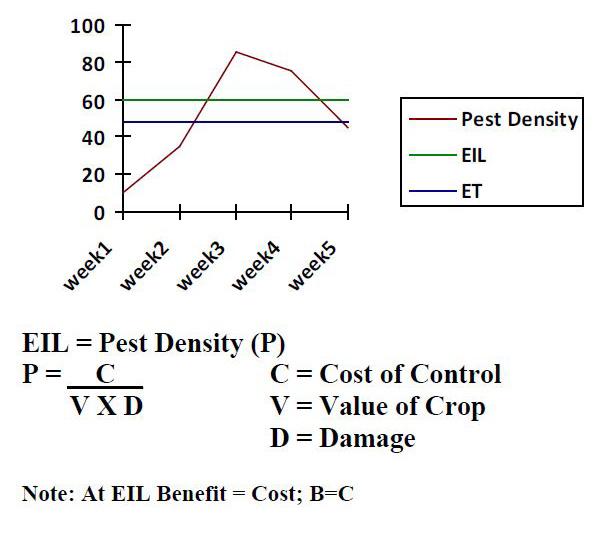
Economic Injury Level - EIL

“The lowest pest population density that will cause economic damage. At the EIL the Cost of Control equals the Benefit of Control.”

Economic Threshold (Action or Treatment Threshold) - ET

“The density of a pest at which control measures should be implemented to prevent an increasing pest population from reaching the EIL - ET is generally 80% of the EIL.”

IPM Graph


Downloadable pdf