
Key points about planting privacy screens
- Choose a variety of different plants for your privacy screen rather than many plants of a single kind.
- Screens with a variety of plants are more resilient to diseases, pests, and climate change.
- Prioritize native plants and avoid invasive ones such as bamboo and Japanese barberry. A variety of options are provided in the list below.
Whether your goal is to plant a screen to create privacy, reduce noise, or block an unsightly view, these practices are recommended to help you achieve your project successfully and sustainably.
Choose a variety of different plants for your privacy screen
- Create a natural screen by using a variety of different plants rather than a row of all the same type. A mixed screen will be more resilient to challenges such as droughts, flooding, pests, and diseases.
Climate change is causing more extreme weather fluctuations in Maryland. In an extremely rainy year, for example, plants that are intolerant of wet soil (e.g., yews) may not survive. If you have a screen consisting of just one kind of plant and a problem occurs, you risk losing the investment you made in an entire row of plants. A mixed planting that consists of a variety of different plant species provides some assurance that if one type of plant develops problems, you will not lose the whole row to the same issue.
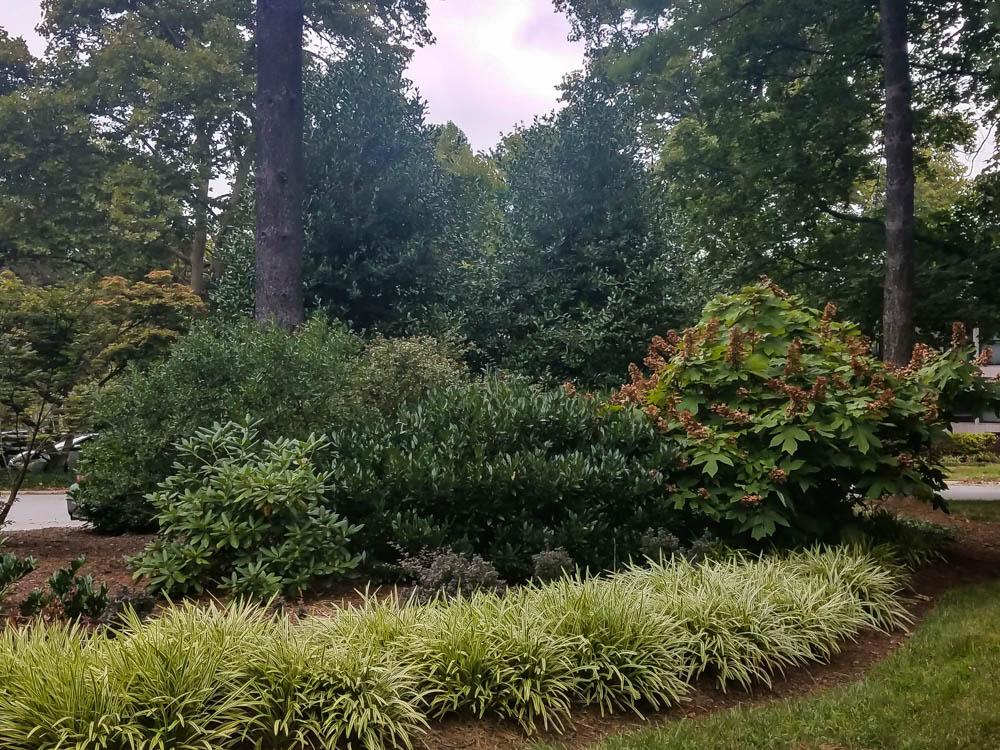
- A screen with plant diversity has added benefits. Structural diversity refers to layers of plants of different heights and forms (trees, shrubs, ornamental grasses, groundcovers). Landscapes with more structural diversity a) have greater visual interest and b) support more wildlife such as pollinators and beneficial insects that provide the services of pollination and pest control. Studies have shown that landscapes with more plant species and structural diversity tend to have fewer pest outbreaks.
- A mixed screen can be designed to have a neat and tidy appearance. Layer larger plants as your backdrop with medium-height plants in front and between them and put ornamental grasses or groundcovers around the perimeter.
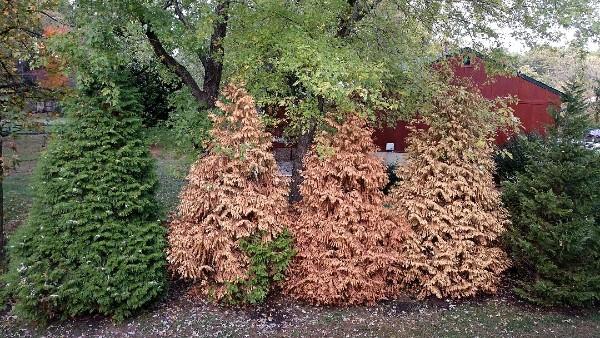
Photo: University of Maryland Extension
Choose native plants for your screen
The use of native plants has advantages:
- Native plants are adapted to local soils and climate conditions and generally require less fertilizing and watering once they are established. (Read What is a Native Plant?)
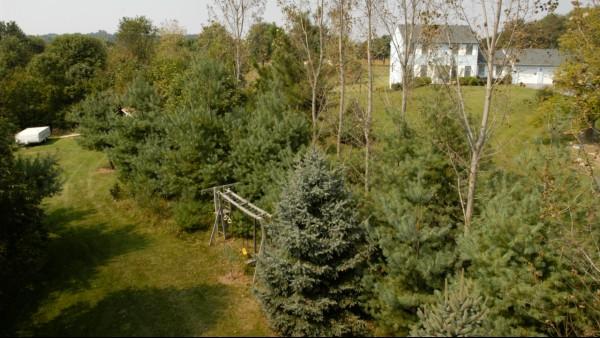
- Native plants interact favorably with natural areas beyond your property. Plants in your screen may have berries, seeds, or pollen that will disperse into wild areas by wind, water, and/or wildlife. If you choose native plants, their dispersal and cross-pollination with plants in natural areas will support local ecosystems and wildlife rather than harm them.
- Native plants support wildlife. Songbirds, butterflies, and other types of wildlife rely on native plants for food and habitat. Populations of birds, insects, and other beneficial wildlife are in decline due to habitat loss. Your plant choices matter and can support animals that provide pollination, pest control, and natural beauty.
- Our plant list includes species that are native and adapted to the Maryland Coastal Plain (C), Piedmont (P), and Mountain (M) regions. Refer to the Chesapeake Bay Native Plant Center page to find your region.
- Refer to the Maryland Native Plant Society for sources of native plants.
Avoid invasive plants
Make sure your plant choices are not invasive in Maryland. Some exotic, non-native plants used for screens in the past (bamboo, European privet, Chinese silvergrass, Chinese wisteria, Japanese barberry, and burning bush) are now invasive in natural areas.
Invasive plants are problematic because they grow rapidly and displace native plants, change soil chemistry, degrade wildlife habitat, and alter fire frequency. It is costly to the state and residents to mitigate the effects of invasive species.
Refer to the Maryland Department of Agriculture’s list of invasive plants and the (PDF) Plant Invaders of Mid-Atlantic Natural Areas Field Guide.
Make informed decisions
Our basic plant list provides a few options to consider for privacy screening. Take time to research these plants in greater detail to become familiar with the growing conditions they require and their suitability for your location. Consider:
- Will your site accommodate the mature height and width of the plants?
- Do the plants tolerate existing growing conditions such as dry or wet soil?
- What is the natural climate range of the plants?
- Do you have access to a water source for irrigation?
- Are utilities located above or below the planting area?
Deer-resistance ratings are provided for general guidance. They are not a guarantee that deer will avoid your plants. Any of the plants on this list may be browsed if deer populations are high and deer are hungry. Deer tend to taste a variety of plants and prefer tender new growth. Deer damage may occur on young plants more so than on older plants. Protect new plants with tree tubes or fencing if deer pressure is high.
Some good resources to use for research on plant characteristics include:
Plant correctly for success
It is essential to plant correctly so that your natural screen becomes established successfully in its first one-to-two years.
- Test your soil prior to planting and contact Miss Utility before you dig.
- Read our guidelines on how to plant container trees and shrubs. Be mindful of planting depth and root placement as well as watering. For example, roots circling around the outside of the root ball should be pruned and spread out in the planting hole.
- Avoid excess mulch. A mulch layer should be no more than 2-3” deep and avoid placing mulch directly against tree trunks.
- Provide adequate spacing for your plants. Plants that are crowded will compete for water, nutrients, and light, resulting in a decline over time.
By investing time in proper planting and plant care, you will be on track to enjoy a beautiful and sustainable natural privacy screen for years to come.