
Pollinator Protection for Commercial Vegetable Growers
By Veronica Yurchak, IPM Vegetable Specialist, University of Maryland; vjohnso4@umd.edu
The importance of pollinators in Maryland agriculture
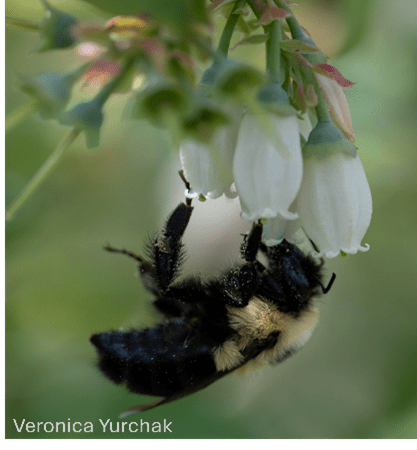
Bees, along with a handful of other insect pollinators, play a critical role in Maryland agriculture, ensuring fruit set in dozens of fruit and vegetable crops. Honeybee pollination is credited with facilitating the production of over $26 million dollars of agricultural produce annually across the state – and that is only part of the story. In nearly all crops, wild bees are either the primary pollinator or significantly supplement the pollination activity of honeybees. In fact, one study examining pollination and yield across several cropping systems found that wild bee visitation enhanced fruit set by twice as much as an equivalent increase in honeybee visitation.
In Maryland, crops such as blueberries, strawberries, orchard crops, and cucurbit vegetables require insect pollination to produce fruit. Some notable wild bees in these systems include orchard bees, bumblebees, and squash bees. Orchard bees are well known for their ability to effectively pollinate fruit trees and are often active earlier in the season than honeybees. Squash bees are the primary pollinator in many cucurbits, responsible for pollinating an estimated two-thirds of all commercially grown squash.
Many vegetable crops, however, are self-pollinating, meaning they can produce fruit without the transfer of pollen between flowers. Still, studies have shown that in many of these crops, yield and fruit quality are greater when pollination does occur. Bumblebees and halictid bees, commonly referred to as sweat bees, enhance pollination in tomato, pepper, and eggplant crops through a process known as “buzz pollination” during which the bee vibrates the flower at a specific frequency to dislodge the pollen.
Even crops that do not benefit from insect pollination, like sweet corn, can still serve as an important food source for many pollinators. A recent study examining bee visitation in Maryland sweet corn fields found that honeybees and several species of wild bees frequently visit sweet corn tassels during the pollen shed period. Consideration should therefore be given to protecting pollinators in both insect pollinated and self-pollinating cropping systems.
Pollinators are in trouble
Globally, bees are in decline, with negative implications for fruit and vegetable production. Pesticides contribute to pollinator decline either through direct bee kill or a variety of sublethal effects that result in disrupted navigation, reduced memory, and weakened immune systems. While reducing pesticide use is the most effective way to protect pollinators from the negative effects of pesticides, not all pesticides impact pollinators equally. Switching to products with a lower bee toxicity rating can help protect pollinators from many of the negative impacts associated with exposure.
Choosing insecticides with reduced bee toxicity

Table 1 provides a list of many available insecticides registered for use in vegetable crops along with an associated bee toxicity rating and a selection of pests controlled. Toxicity ratings are based on reported LD50 values, or the reported concentration of each product required to kill 50% of an experimental honeybee population. This table can be used to help identify more pollinator friendly alternatives for controlling many common vegetable pests.
Unfortunately, for some pests there are no pollinator-safe alternatives that provide effective control. In this case, neonicotinoids and/pyrethroids are often the most effective and commonly used products. While all pyrethroids are considered highly-toxic to bees, not all neonicotinoids are equally as toxic. Acetamiprid (Assail) is nearly 100X less toxic to bees than other neonicotinoids and presents a much safer option for pest-control in blooming crops. Acetamiprid, which is a cyanoamidine neonicotinoid, is metabolized more quickly by honeybees and bumblebees than nitro-substituted neonicotinoids like clothianidin (Belay), imidacloprid (Admire), and thiamethoxam (Platinum/Actara). Although some studies have detected several sublethal effects of acetamiprid exposure, they were often at concentrations higher than expected when applied according to the label. For moderately toxic pesticides applied to blooming crops, application timing is an important consideration. Reduce bee exposure and potential impacts by following all label restrictions and making all applications when bees are not actively foraging. Some bees, such as squash bees, become active very early in the morning, so applications made shortly after dark are least likely to result in direct exposure.
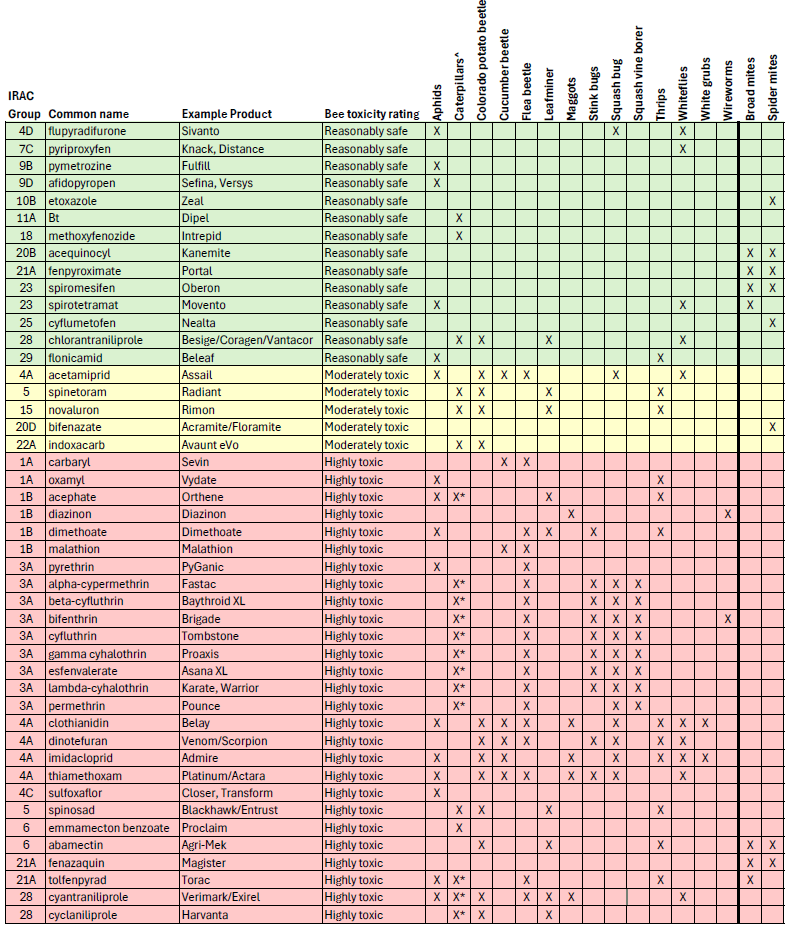
Green = “reasonably safe”; Yellow = “moderately toxic”, Red = “highly toxic”.
^ Caterpillar pests include European corn borer, corn earworm, fall armyworm, cabbage looper, imported cabbageworm, diamondback moth, beet armyworm, and cutworms.
* Not all caterpillar species are controlled equally by the products listed. Refer to Table 2-25 in the 2025 Southeast Vegetable Crops Handbook for more specific information regarding product efficacy.
Additional strategies for protecting pollinators in agricultural landscapes
Providing diverse habitats, including natural areas and wildflower plantings, is also crucial for supporting bee populations. These areas provide additional food, nest sides, and refuge areas from pesticide-treated fields. As a bonus, many other beneficial insects, including insect predators and parasitoids will also benefit from any measures taken to protect and promote wild bees in crop fields.
Sources Consulted:
Intermountain Fruit / Utah State University Extension. Pesticide Toxicity to Honeybees and Pollinators. Intermountain Tree Fruit Production Guide. https://intermountainfruit.org/pesticide-tables/toxicity-pollinators#:~:text=Protecting%20Pollinators%20and%20Beneficials%20from,are%20above%2052%C2%B0F.
Minnesota Department of Agriculture. Pesticides & Bee Toxicity. https://www.mda.state.mn.us/protecting/bmps/pollinators/beetoxicity
Southeast Vegetable Extension Workers. 2025. Southeastern U.S. 2025 Vegetable Crop Handbook. https://vegetables.tennessee.edu/wp-content/uploads/sites/167/2025/01/2025_SEVEG_final_online1.pdf
This article is featured in the Vegetable and Fruit News, Vol. 16, Issue 4.
Vegetable & Fruit News is a research-based publication for the commercial vegetable and fruit industry available electronically from April through October. Published by the University of Maryland Extension Agriculture and Food Systems team.
Subscribe