

FS-2025-0765 | April 2026
Rainwater Harvesting on Urban Farms: Adding Gutters to Collect Rainwater from a High Tunnel
By Emily M. H. Woerner, Neith Little, Donald Murphy, Richard Francis & Rachel Rosenberg Goldstein
Rainwater harvesting is the act of collecting and storing rainwater for later use (Kloss, 2008; EPA, 2024). Rainwater harvesting can reduce stormwater runoff, conserve drinking water, and provide more water for irrigation (Kloss, 2008; Watershed Stewards Academy, 2014). Urban farmers and gardeners could tap into the benefits of rainwater harvesting by installing systems on existing high tunnel structures (also known as “hoop houses”). High tunnels, which allow farmers to prolong the growing season and better protect their crops from the elements (Oklahoma State University Extension, 2017; USDA, n.d.), could capture thousands of gallons of water each year depending on the amount of rainfall. This publication will help urban farmers calculate the amount of water they could potentially harvest and estimate the cost of adding a rainwater harvesting system to their high tunnel, using a case study of a system installed on a farm in Baltimore, MD.
Collecting Rainwater from a High Tunnel
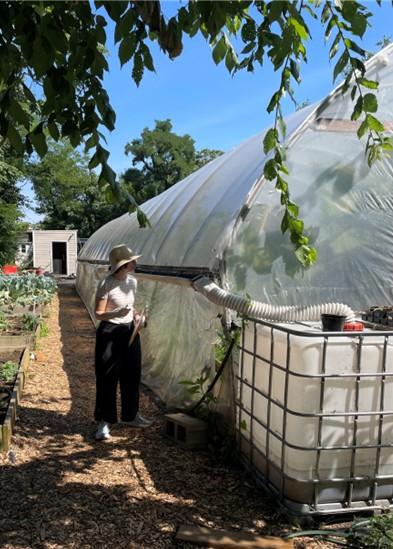
Rainwater can be collected from a high tunnel by installing gutters along the sides of the structure. Gutter brackets can be directly attached to the hip board supporting the sides of the high tunnel (Figure 1). Downspouts can be connected to rain barrels for collection and storage. Iowa State University Extension and Outreach documented this design in their 2012 publication “Rainwater Catchment from a High Tunnel for Irrigation Use” (Iowa State Extension, 2012).
Case Study: Rainwater Harvesting in Baltimore City
Plantation Park Heights Urban Farm used gutters to collect rainwater from their 30 ft x 72 ft high tunnel. Rainwater was stored in a 275-gallon intermediate bulk container (IBC) tote.
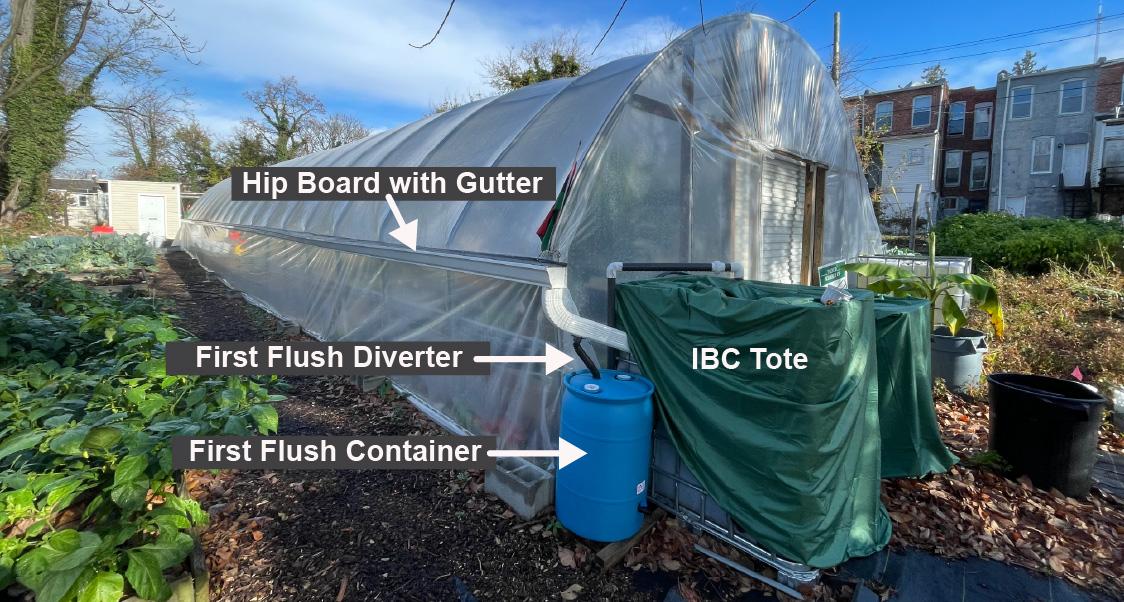
A new rainwater harvesting system (Figure 2) was installed at Plantation Park Heights Urban Farm as part of the Safe Rainwater Harvesting project (https://saferainwaterharvesting.org/) in the summer of 2024 to replace the pre-existing system. The new system included:
- New gutters - The high tunnel was professionally outfitted with aluminum gutters and downspouts.
- Quotes were obtained from three local gutter companies before selecting the company for the installation.
- It is recommended to attach the downspout as close as possible to the top of the tote (i.e. the opening at the top) to maximize the storage capacity of the tote.
- Gutter guards - Gutter guards (Figure 3) were installed to prevent leaves and other debris from collecting in the gutters and entering the collection tanks.
- First flush diverter system - A first flush diverter and first flush container (black tubing and 30-gallon blue plastic container shown in Figure 2) were installed along the downspout. A first flush diverter system collects the first volume of water to run off from the high tunnel. The first volume of water collected from a roof or other surface typically contains the most contaminants. Preventing this water from entering the collection tank can reduce contamination of the remaining rainwater (Watershed Stewards Academy, 2014). The water in the first flush container is either dumped after the rain event or can be used to irrigate non-food crops. A spigot is attached to the bottom of the container to allow for easy disposal.
- Note: The first flush diverter used in this system was part of a commercially available kit. However, there are other do-it-yourself options. One option is to build a diverter using PVC pipes and a ball valve.
- IBC totes - The new gutters were connected to 330-gallon IBC totes. Because the totes were clear plastic, green covers were placed over the totes to prevent algae growth.
- Alternatively, an opaque tote (black, stainless steel, etc.) that can block the sun can be used to prevent algae growth. Spray paint could be applied to the outside of a clear tank to block sunlight.
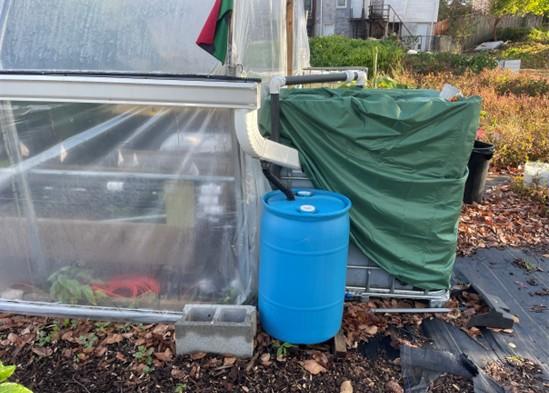
- Sump pump - A submersible sump pump was installed in the bottom of the IBC tote to pump water from the tote and into the high tunnel’s irrigation system (Figure 4). Note: Water can also be accessed through the valve at the bottom of the IBC tote.
Adding a Rainwater Harvesting System to Your High Tunnel
To successfully implement this design on an urban farm or garden, first consider the price of materials and labor.
Materials and Costs
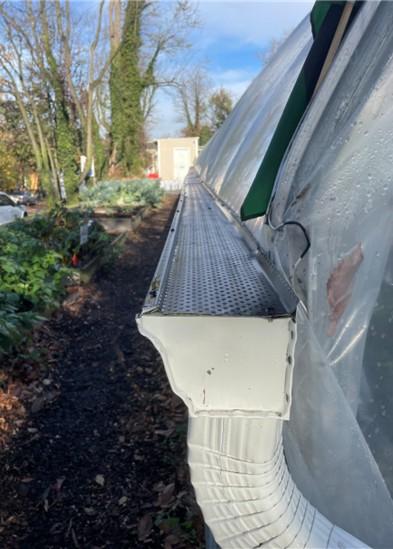
Table 1 presents a list of basic equipment, materials, and associated costs needed to install a rainwater harvesting system on a pre-existing high tunnel structure. If you do not have a high tunnel, please see the Funding Resources section for information on programs designed to assist urban farmers with financing high tunnels for their farms.
Table 1 includes the materials used with the Safe Rainwater Harvesting project, but there might be other similar materials and brands that could work for building other systems. Commercial products are mentioned in this publication solely for the purpose of providing specific information. Mention of a product does not constitute a guarantee or warranty of products. Reference to commercial products or trade names is made with the understanding that no discrimination is intended and no endorsement by University of Maryland Extension or the Safe Rainwater Harvesting project is implied.
New materials were purchased for the project to ensure the integrity of the research results. Purchase of new material is not necessary in practice on a farm. The following materials and associated costs were needed to install the new system at Plantation Park Heights Urban Farm:
| Materials and Services | Source | Cost | Notes |
|---|---|---|---|
| Gutters, gutter guards, and labor for installation | Local Baltimore gutter company | $2,232 | This includes gutters installed along BOTH sides of the high tunnel. |
| First flush diverter kit | Online retailer (ex. Earthminded, Rain Harvest Systems) | $40 per tank x 2 gutter systems = $80 | Kit includes one diverter hose and two spigots. |
| 30-gallon barrel | Online retailer (ex. Uline, Home Depot, Lowes) | $79 per tank x 2 gutter systems = $158 | Alternative: can often be found for free used from restaurants or car washes |
| 330-gallon IBC tote | Online retailer (ex. Uline, Home Depot) | $635 per tote x 2 gutter systems = $1,270 | Alternative: can often be purchased used at a lower cost from a local classifieds website (ex. Facebook Marketplace, Craigslist) |
| Green IBC tote cover | Online retailer (ex. Amazon, Uline) | $29 per tote x 2 totes = $58 | Alternative: opaque tarp |
| Sump pump (optional) | Online retailer (ex. Grainger, Pond Solutions) | $168 per tote x 2 totes = $336 | Alternative: water can be accessed directly from the valve at the bottom of the IBC tote. |
| - | - | Total $4,134 | - |
| Materials and Services | Source | Estimated Cost | Notes |
|---|---|---|---|
| Self-installed gutter and downspout | Home improvement store | Aluminum gutters ($13 per ft.) for a 96ft high tunnel (10 ft.): ~$130 Downspout and downspout outlet: $15 End caps (2 count): $6 Gutter connectors (6 count): $27 Gutter seam sealer (applied with caulk gun): $11 1/2” hex drive sheet metal screws (box of 100): $7 Gutter hangers installed every two feet ($2.50 per hanger): $120 Collecting rainwater from ONE side of high tunnel: $316 Collecting rainwater from BOTH sides of high tunnel: $632 | This includes gutters installed along BOTH sides of the high tunnel. Options are provided in this table for installing a system along one side of the high tunnel, but this will NOT capture the entire volume of water hitting the collection surface. Also note that the cost does not include tools needed for installation (tin snips, drill/driver, caulk gun, and seaming pliers) or a gutter guard. |
| Homemade first flush diverter | Home improvement store | Prices vary | A first flush diverter can be designed out of PVC and a float valve. |
| Used 30-gallon barrel | Online marketplaces | Prices vary ($0 - $50 per barrel) Collecting rainwater from ONE side of high tunnel: $0 - $50 Collecting rainwater from BOTH sides of high tunnel: $0 - $100 | Used containers can be acquired through online marketplaces. It is recommended that containers be rinsed prior to use. |
| Used 330-gallon IBC tote | Online marketplaces | $75-$100 per barrel Collecting rainwater from ONE side of high tunnel: $75- $100 per barrel Collecting rainwater from BOTH sides of high tunnel: $150 - $200 | Used containers can be acquired through online marketplaces. It is recommended that containers be rinsed prior to use. |
| IBC tote cover or opaque tarp | Online retailer | $10-30 per cover/tarp Collecting rainwater from ONE side of high tunnel: $10- 30 Collecting rainwater from BOTH sides of high tunnel: $20 - $60 | - |
| Total | - | Collecting rainwater from ONE side of high tunnel: ~$401-$496 Collecting rainwater from BOTH sides of high tunnel: ~$802-$992 | Does not include the prices for first flush diverters or sump pumps. |
While a new system similar to the one used for the Safe Rainwater Harvesting project may be cost prohibitive for some farms, alternatives do exist. Table 2 includes a rough estimate of a system designed with self-installed gutters and used containers for rainwater collection.
Rainwater Quality
It is important to note that the quality of harvested rainwater can be highly variable. The Rutgers New Jersey Agricultural Experiment Station recommends applying a treatment to harvested rainwater to reduce risk of exposure to microbial contaminants (Bakacs et al., 2013). The Rutgers scientists recommend treating harvested rainwater with a bleach solution (chlorine-based disinfection). More detailed information can be found here: https://njaes.rutgers.edu/fs1218/.
One alternative to bleach is peracetic acid. SaniDate® 12.0 is a commercially available peracetic acid that was approved by the EPA to treat pre-harvest water for human pathogens, such as Salmonella (U.S. Food and Drug Administration, 2024). Peracetic acid has the added benefit of not creating disinfection byproducts associated with chlorine disinfection (Dery et al., 2021).
Regardless of the treatment used, the Rutgers group also recommends using best practices when irrigating with rainwater. This includes 1) using drip irrigation or other irrigation methods that reduce contact between the water and produce, and 2) delaying harvesting after irrigation to allow for bacterial die-off to occur (Bakacs et al., 2013).
Estimating Rainwater Capture
To calculate the amount of rain that could be captured at your farm, you will need to know:
- Average rainfall per season in your area. Historical rainfall data can be accessed through the National Weather Service (https://www.weather.gov/wrh/climate). For detailed instruction on how to calculate average rainfall per season, please see the Appendix on p. 15. Use this value in place of ‘X’ in the formula.
- The “season” will depend on the months you are interested in capturing rainwater.
- The area (sq. ft.) from which you are collecting rainwater. In the simplest scenario, if you have gutters on both sides of a straight-walled high tunnel, this is calculated as the area of a rectangle formed by the high tunnels’ footprint as viewed from above (length x width). Use this value in place of ‘Y’ in the formula.
(X inches of rain/1 season) × (Y sq.ft./1 high tunnel) × (144 sq.in./1 sq.ft.) = Z cubic in.of rain/season/high tunnel
Z cubic in. x (1 gallon/231 cubic in.) = gallons of rain per season per high tunnel
Example calculation:
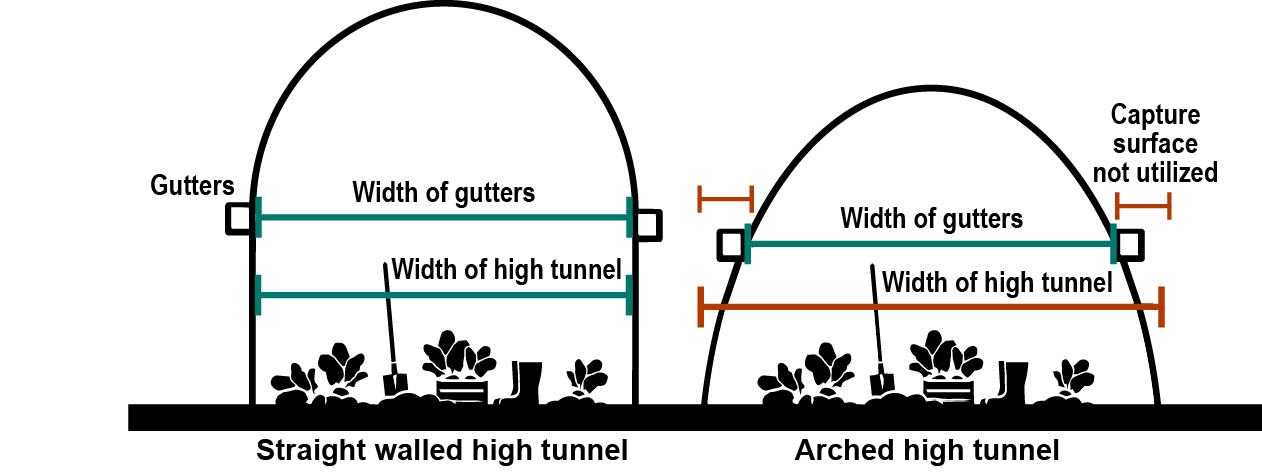
The case study involved collecting rainwater from a 30 ft (width) x 72 ft (length) high tunnel. The high tunnel had straight side walls, which allowed the entire footprint of the high tunnel to capture rainwater. This is not the case for all high tunnels. A high tunnel with arched sides, instead of straight, will lose some footprint for capturing rainwater due to the placement of the gutters along the hip boards (Figure 5). The footprint for collection should be calculated as the width between the gutters multiplied by the length of the high tunnel.
The collection area of the 30 x 72 ft high tunnel with straight side walls in the case study was 2,160 square feet. In the summer of 2024 (June to August), Baltimore received just over 3 inches of rain during the summer (NOAA NWS, 2025). To calculate the total rainwater capture possible during the summer of 2024:
(3 inches of rain/1 summer) x (2,160 sq.ft./ 1 high tunnel) x (144 sq. in./1 sq. ft.) = 933,120 cubic in. of rain /season/high tunnel
933,120 cubic in. x (1 gallon/ 231 cubic in. ≃ 4,039 gallons of rain per season per high tunnel
A farmer with a 30 ft x 72 ft high tunnel capturing water in Baltimore during the summer of 2024 could have captured approximately 4,039 gallons of rain. To put it another way, a 30 ft x 72 ft high tunnel can capture nearly 900 gallons of rainwater during a half-inch rainstorm (Iowa State Extension, 2012).
Funding Opportunities
The following sources may provide opportunities to help finance the installation of harvested rainwater systems on urban farms.
Nationwide funding sources:
- The Natural Resources Conservation Service (NRCS) may have funding available for rainwater harvesting projects. Speak with your NRCS representative or visit: https://www.nrcs.usda.gov/conservation-basics/conservation-by-state/maryland
The Environmental Quality Incentives Program (EQIP) provides financial assistance for farmers looking to install high tunnels. Visit: https://www.nrcs.usda.gov/programs-initiatives/environmental-quality-incentives-program
Please note: A farm must have a farm number assigned from the USDA Farm Service Agency (FSA) to access these programs. Both for-profit and nonprofit farms are eligible to receive a farm number. To find your local FSA office, please use the USDA Service Center locator tool: https://www.farmers.gov/working-with-us/service-center-locator
Maryland based funding sources:
- Maryland Department of Agriculture (MDA) offers Urban Agriculture Water & Power Grants. Visit: https://mda.maryland.gov/resource_conservation/Pages/Infrastructure-Grants.aspx for more information.
- United Way of Central Maryland’s Neighborhood Grants support resident-led projects that benefit the region’s communities. More details are available at https://uwcm.org/grants-fundingopportunities/neighborhood-grants/
Acknowledgments
This work is supported by the Agriculture and Food Research Initiative, project award no. 2023-68008- 39852 from the U.S. Department of Agriculture’s National Institute of Food and Agriculture. Any opinions, findings, conclusions, or recommendations expressed in this publication are those of the author(s) and should not be construed to represent any official USDA or U.S. Government determination or policy.
Additional Resources for Rainwater Harvesting
Consult the following resources for more information on rainwater harvesting:
The Iowa State Extension guide on collecting water from a high tunnel: https://shop.iastate.edu/extension/farm-environment/natural-resources-and-environment/sustainability/pm3017.html
Information on rainwater harvesting from a roof and maintaining a rainwater harvesting system from the Watershed Stewards Academy: https://extension.umd.edu/sites/extension.umd.edu/files/2021-03/FC-MGPub%20Rainwater%20Harvesting%20Rainscaping.pdf
The Department of Energy offers tools to help estimate monthly rainfall that could be captured: https://www.energy.gov/cmei/femp/articles/rainwater-harvesting-calculator
Pacific Northwest National Laboratory (PNNL) and Federal Energy Management Program (FEMP) developed an interactive GIS map for regulations and potential for rainwater harvesting: https://pnnl-gis.maps.arcgis.com/apps/dashboards/0a305382f87740ccb2296404d40d0cb0
References
Bakacs, M., Haberland, M., and Yergeau, S. (2013). Rain Barrels Part IV: Testing and Applying Harvested Water to Irrigate a Vegetable Garden. https://njaes.rutgers.edu/fs1218/
Dery, J. L., Choppakatla, V., Sughroue, J., and DerRock, C. (2021). Minimizing risks: Use of surface water in pre-harvest agricultural irrigation; Part III: Peroxyacetic acid (PAA) treatment methods. The University of Arizona Cooperative Extension. https://extension.arizona.edu/sites/extension.arizona.edu/files/pubs/az1884-2021.pdf
Environmental Protection Agency. (2024). Soak Up the Rain: Rain Barrels. https://www.epa.gov/soakuptherain/soak-rain-rain-barrels
Kloss, C. (2008). Managing wet weather with green infrastructure municipal handbook: Rainwater harvesting policies. Environmental Protection Agency. https://www.epa.gov/sites/default/files/2015-10/documents/gi_munichandbook_harvesting.pdf
Iowa State Extension. (2012). Rainwater Catchment from a High Tunnel for Irrigation Use. https://shop.iastate.edu/extension/farm-environment/natural-resources-and-environment/sustainability/pm3017.html
National Oceanic and Atmospheric Administration National Water Service. (2025). Baltimore MD Precipitation. https://www.weather.gov/media/lwx/climate/bwiprecip.pdf
Oklahoma State University Extension. (2017). High tunnels. https://extension.okstate.edu/fact-sheets/high-tunnels.html
U. S. Department of Agriculture (USDA) Natural Resources Conservation Service. (n.d.). High Tunnel Initiative. https://www.nrcs.usda.gov/programs-initiatives/eqip-high-tunnel-initiative
U.S. Food and Drug Administration. (2024, November 4). FDA and EPA Announce First Registered Pre-Harvest Agricultural Water Treatment. https://www.fda.gov/food/hfp-constituent-updates/fda-and-epa-announce-first-registered-pre-harvest-agricultural-water-treatment
Watershed Stewards Academy. (2014). Rainwater Harvesting. In Watershed Stewards Academy Rainscaping Manual (pp.65-77). Watershed Stewards Academy. https://aawsa.org/wsa-rainscaping-manual-2
Appendix
How to calculate average rainfall using historical rainfall data:
Step 1:
Identify your location, time frame, and season for which you are interested in calculating average rainfall. For this example, to calculate the average rainfall for the summer of 2024 (June-August) in Baltimore, MD.
Step 2
Access rainfall data through the National Weather Service (NWS).
- Go to the NWS website: https://www.weather.gov/wrh/climate
- Using the map of the US on the home page, click on the state corresponding to your location.
- For this example, select Maryland.
- You should see a blue box labeled “NOWData - NOAA Online Weather Data."
- Working in this blue box, complete selections for 1) Location, and 2) Product.
- Location: Baltimore
- Product: Monthly summarized data
- Note: Options (3) can be left as is.
- Click “Go” under 4) View.
- Using the generated table, record the precipitation (inches) for each month in the year you selected:
- June 2024: 1.4 inches
- July 2024: 1.41 inches
- August 2024: 6.22 inches
Step 3:
Calculate the average rainfall for these months:
Average=((Month 1 Precipitation + Month 2 Precipitation + Month 3 Precipitation +) )/(# of months)
Average rainfall in the summer of 2024 in Baltimore, MD = ((1.4 + 1.41 + 6.22) )/3=3.01
Please note: Precipitation can vary from year to year. Monthly precipitation from other years is available in the same dataset generated in Steps A through E.
EMILY M.H. WOERNER
NEITH LITTLE
nglittle@umd.edu
DONALD MURPHY
dmurphy@umd.edu
RICHARD FRANCIS
RACHEL ROSENBERG GOLDSTEIN
rerosenb@umd.edu
This publication, Rainwater Harvesting on Urban Farms: Adding Gutters to Collect Rainwater from a High Tunnel (FS-2025-0765), is a part of a collection produced by the University of Maryland Extension within the College of Agriculture and Natural Resources.
The information presented has met UME peer-review standards, including internal and external technical review. For help accessing this or any UME publication contact: itaccessibility@umd.edu
For more information on this and other topics, visit the University of Maryland Extension website at extension.umd.edu
University programs, activities, and facilities are available to all without regard to race, color, sex, gender identity or expression, sexual orientation, marital status, age, national origin, political affiliation, physical or mental disability, religion, protected veteran status, genetic information, personal appearance, or any other legally protected class.
When citing this publication, please use the suggested format:
Woerner, E., Little, N., Murphy, D., Francis, R., & Rosenburg Goldstein, R. (2026). Rainwater Harvesting on Urban Farms: Adding Gutters to Collect Rainwater from a High Tunnel (FS-2025-0765). University of Maryland Extension. go.umd.edu/FS-2025-0765.