

EBR-2024-0720 | July 2025
Reducing Crop Heat Stress in Urban Farms
By Qianwen Lu, UME Urban Ag Specialist, and Neith Little, UME Urban Ag Educator
What is heat stress?
Maryland’s average annual temperature has risen nearly 4°F (about 2°C) above the average between 1895-1915. The increased temperature has made heat stress incidents more common than in the past. Heat stress occurs when plants are exposed to excessive amounts of sunlight and heat (usually above 86°F) for an extended period. Heat stress is a particularly common problem for urban farmers, because the thermal mass of pavement and buildings increases both daytime and nighttime temperatures (the “urban heat island effect”). Additionally, urban growers frequently use high tunnels, which can increase crop heat stress during summer months.
The adverse effects of heat stress:
Heat stress can cause harmful impacts on plants. It can inhibit the development and growth of plant vegetative and reproductive tissues. It also reduces plant photosynthesis rate, nutrient uptake, and pollen production. Additionally, heat stress can cause sunscald on fruit, leading to flower and fruit drop, inducing plant wilting, and drying out shallow-rooted and young plants. Ozone pollution due to poor air quality can also combine with heat stress to damage plants. High nighttime temperatures can even cause the development of more male flowers than female flowers in zucchini and thus reduce productivity.
Symptoms of crops impacted by heat stress:
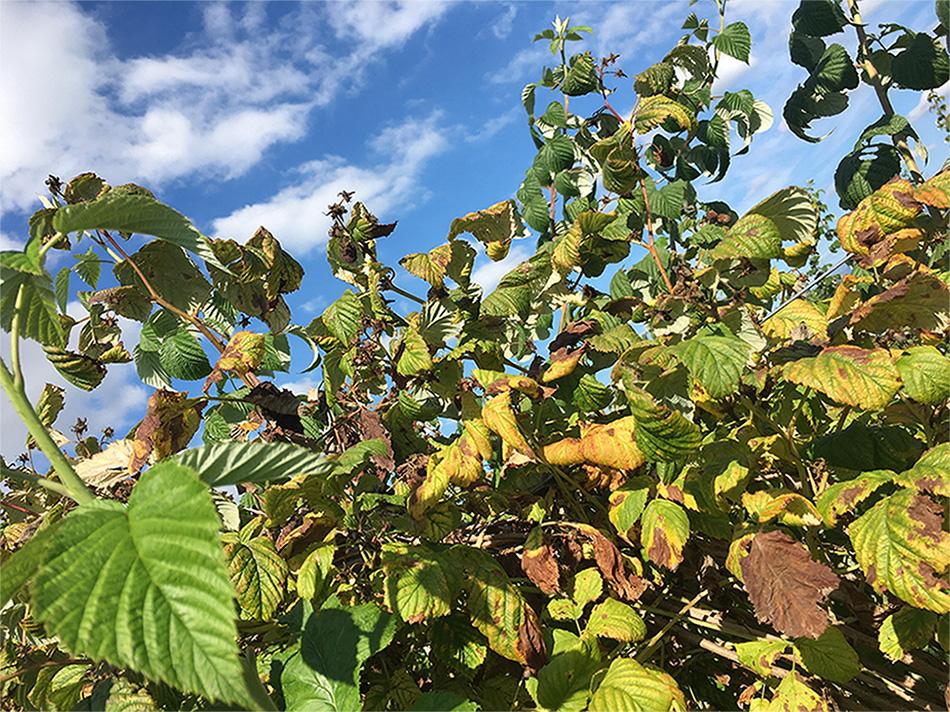
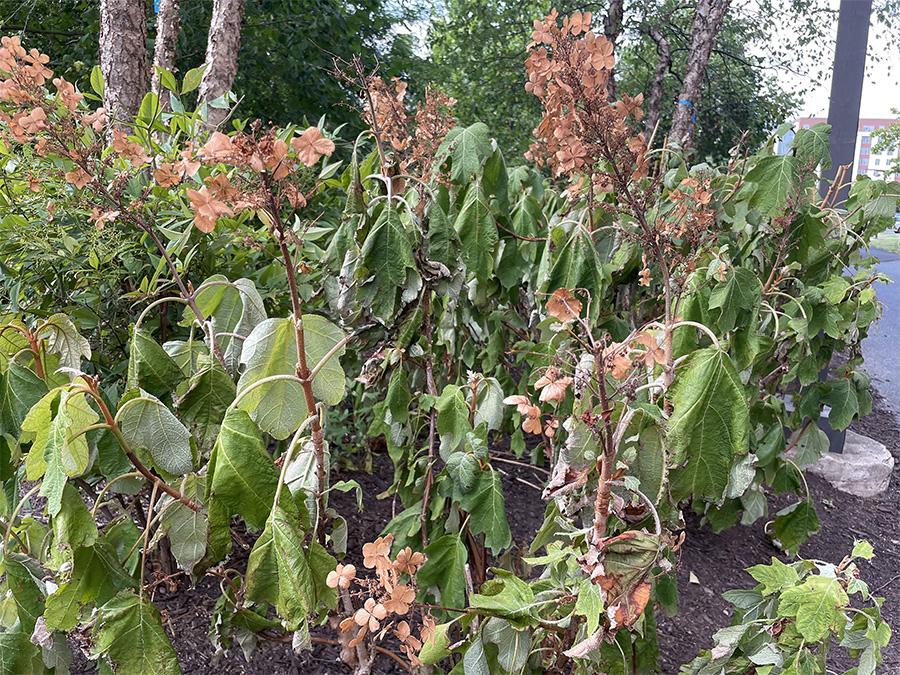
Symptoms of crops impacted by heat stress include but are not limited to leaf rolling and cupping, dry leaf edges in raspberry plant (Photo 1), bottle-necking, bolting (when a plant prematurely develops a flowering stalk), blossom end rot, flower abortion, hollow centers or cavities in fruit, sunscald, fruit zippering and scarring, and plant wilting in hydrangea (Photo 2). Specifically, cucumbers are prone to increased bitterness in high-heat conditions.
Tips to mitigate crop heat stress:
- Place shade cloth over crops.
- Turn on the irrigation system to keep plants cool.
- Add organic matter to the soil in advance of planting to increase the soil’s water-holding capacity.
- Plant using white or metalized plastic mulch to keep soil moisture level more uniform.
- Apply white particle films (clay- or lime-based) over the mulch to decrease soil temperatures.
- Avoid applying fertilizers and pesticides when temperatures are consistently above 80°F to avoid phytotoxicity.
- Avoid planting or transplanting young seedlings on hot days.
- Do not prune plants on hot days to avoid water loss.
- Choose varieties that are heat-tolerant and resistant to bolting.
- When building a high tunnel, choose a design with roll-up side vents that can be rolled up to a person’s height (5 ft). This increases cross-ventilation.
Implementing effective heat stress mitigation strategies can help maintain plant vitality in extreme weather. You can reduce heat-related damage and support healthy plant growth by providing adequate water, shade, and proper soil management to plants. With these proactive measures, your plants will be more resilient in challenging weather conditions.
For more information:
- Brust, J. 2020. Ozone damage to tomato and cucurbit plants. University of Delaware Cooperative Extension Weekly Crop Update. https://sites.udel.edu/weeklycropupdate/?p=15542.
- Ernest, E. 2024. Heat tolerant vegetable varieties. University of Delaware Cooperative Extension Weekly Crop Update. https://sites.udel.edu/weeklycropupdate/?p=14443.
- Ernest, E. 2024. Extending lettuce production into the summer. University of Delaware Cooperative Extension Weekly Crop Update. https://sites.udel.edu/weeklycropupdate/?p=24236.
- Lerner, R. No date. Cucumber bitter during hot, dry weather. Purdue University Indiana Yard and Garden – Purdue Consumer Horticulture. https://www.purdue.edu/hla/sites/yardandgarden/cucumbers-bitter-during-hot-dry-weather/.
- Sanchez, N. 2021. Heat wave in the garden: How to identify and prevent heat stress in plants. Oregon State Extension Service. https://extension.oregonstate.edu/gardening/flowers-shrubs-trees/heat-wave-garden-how-identify-prevent-heat-stress-plants.
- Schuh, M. 2023. Heatwave makes vegetables misbehave. University of Minnesota Extension. https://extension.umn.edu/yard-and-garden-news/heatwave-makes-vegetables-misbehave.
- Via, S. 2023. The Effects of Climate Change in Maryland. University of Maryland Extension. https://extension.umd.edu/resource/effects-climate-change-maryland/.
- Zobel, E. 2024. Heat Stress on Plants. University of Maryland Extension. https://blog.umd.edu/umefruitveg/2024/06/.
QIANWEN LU
qwenlu@umd.edu
NEITH LITTLE
nglittle@umd.edu
This publication, Reducing Crop Heat Stress in Urban Farms (EBR-2024-0720), is a part of a collection produced by the University of Maryland Extension within the College of Agriculture and Natural Resources.
The information presented has met UME peer-review standards, including internal and external technical review. For help accessing this or any UME publication contact: itaccessibility@umd.edu
For more information on this and other topics, visit the University of Maryland Extension website at extension.umd.edu
University programs, activities, and facilities are available to all without regard to race, color, sex, gender identity or expression, sexual orientation, marital status, age, national origin, political affiliation, physical or mental disability, religion, protected veteran status, genetic information, personal appearance, or any other legally protected class.
When citing this publication, please use the suggested format:
Lu, Q., & Little, N. (2025). Reducing Crop Heat Stress in Urban Farms (EBR-2024-0720). University of Maryland Extension. go.umd.edu/EBR-2024-0720.