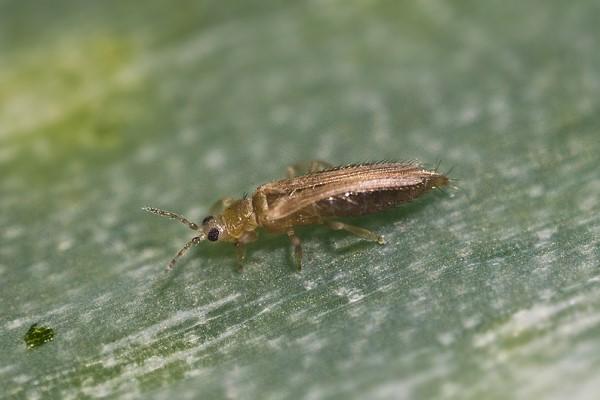
Magnified view of an adult thrips with a black body and white-banded wings.

Magnified view of an adult thrips. Photo: Matt Bertone, NC State University

Updated: September 4, 2025

Key points about thrips

  • Thrips are small insects (2mm or less) shaped like a grain of rice, usually yellow, brownish, or black in color. Adults have wings, but they are not easily visible without magnification.
  • Most thrips feed on indoor and outdoor plants using rasping mouthparts to break plant cells open and consume their contents. A wide variety of plant species can be damaged by thrips. A few thrips species are predators of plant-feeding thrips and other small insects and mites.
  • Plant damage from thrips feeding ranges from mild to severe, and there is a risk they could transmit a plant virus. Thrips can be hard to get rid of since they reproduce rapidly, use a wide range of host plants, and readily become resistant to insecticides.
  • Thrips is both a singular and plural term (as with deer).

Identifying thrips

  • Thrips are small insects with a slender, rice-like shape (tapered at both ends), about 1/16 of an inch long (1-2 mm). Their legs and antennae are relatively short, but are easy to see with magnification.
  • Only adults can have wings, which are slightly longer than the body. Often clear or banded (striped), the narrow, fringed wings are hard to see without magnification, and are held flat over their backs at rest. Some thrips species have wingless adults.
  • Juvenile thrips (called nymphs or larvae) look like adults, but are wingless and often near-white or yellow. Adults tend to be yellow, brownish, or glossy black, depending on the species.
  • Thrips move around by walking, but can also jump. Adults are able to fly, typically catching wind currents and dispersing far distances. They are not noticeable when airborne due to their small size.
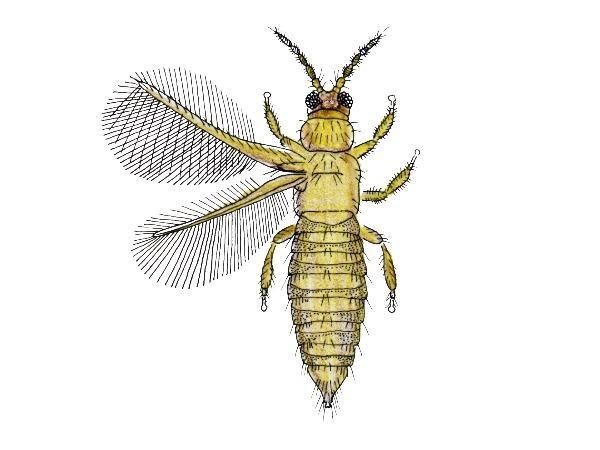
Drawing of an adult thrips body structure (with only the left pair of wings shown).
Adult Western flower thrips, showing one of the two pairs of wings.
Illustration: John Davidson, UMD Department of Entomology

Examples of thrips

Single adult flower thrips
Flower thrips (adult)
Photo: Bruce Watt, University of Maine, Bugwood.org
Single adult impatiens thrips, magnified.
Impatiens/Poinsettia thrips (adult female)
Photo: Manfred R. Ulitzka
Single adult Cuban laurel thrips, magnified.
Cuban laurel thrips (adult)
Photo: Jennifer Carr, University of Florida, Bugwood.org
Single adult onion/tobacco thrips, magnified.
Onion thrips (adult)
Photo: Manfred R. Ulitzka
Single adult banded thrips, magnified.
Banded thrips (adult)
Photo: Whitney Cranshaw, Colorado State University, Bugwood.org
Large group of greenhouse thrips, nymphs and adult.
Greenhouse thrips (nymphs and adult)
Photo: David Cappaert, Bugwood.org
Single Western flower thrips nymph, magnified.
Western flower thrips (nymph)
Photo: Whitney Cranshaw, Colorado State University, Bugwood.org
Single adult pepper thrips, magnified.
Pepper thrips (adult female)
Photo: Manfred R. Ulitzka

Thrips look-alikes

Several other small insects or arthropods might be confused with thrips based on their body shape and size.

Springtails

Appearance: Elongate springtails have a similar body shape, though don’t taper at each end as much as thrips do. Springtails are wingless, usually slightly larger, with antennae that tend to be thicker and longer than thrips antennae.

Behavior: Springtails prefer damp environments and tend to stay in soil, and would rarely be found on leaves or flowers. They can jump, but cannot fly, and tend to run around. Found indoors and outdoors, they are rarely noticed outdoors.


Photo: Joseph Berger, Bugwood.org

Booklice (Psocids)

Appearance: Pale in color, but not as slender-bodied as thrips, nor as tapered at each end.

Behavior: Prefers humid environments when found indoors, but rarely seen, and unlikely to be on leaves or flowers. Booklice cannot jump or fly.

Despite their name, they are also not true lice, do not bite, and are not parasitic like true lice (such as head lice).


Photo: Matt Bertone, NC State University
 

Armored scale

Appearance: Juvenile males tend to be rice-shaped and covered in white or brown wax. (Females tend to be rounder or teardrop-shaped and are not as similar to thrips. Adult males are basically undetectable.) Scale antennae and legs are functionally absent and will not be visible.

Behavior: Once they mature beyond the crawler stage, armored scale juveniles cannot walk, jump, or fly. They will not move when prodded, unlike thrips that tend to run into a crevice to hide (or jump away) if disturbed.


Photo: Chris Evans, University of Illinois, Bugwood.org

Minute pirate bugs

Appearance: Nymphs are pale yellow to reddish, and adults are black with clear and golden wing patches. They are not as narrow-bodied as thrips, and they are larger overall.

Behavior: Generally fast-moving, these bugs cannot jump like thrips can. Minute pirate bugs prey on thrips and other small pests.


Photo: Matt Bertone, NC State University

Whiteflies

Appearance: Adults look like tiny white-winged flies. Thrips wings are much less noticeable. Whitefly nymphs are very flat, yellowish-white ovals.

Behavior: Whitefly nymphs don’t move, except for minimal crawling right after hatching; they essentially adhere to the leaf. Thrips, in comparison, are much more active.


Photo: Whitney Cranshaw, Colorado State University, Bugwood.org

Life cycle and behavior

Feeding

  • With asymmetrical mouthparts, plant-feeding thrips puncture plant tissue with a single elongated “jaw” (mandible) and suck up the leaking cell contents with a straw-like stylet. Thrips mostly feed on leaves and flowers (budded or open).
  • The pale flecking resulting from injured and emptied plant cells causes damage known as stippling or streaking. When rows of stippling or streaking run together, they can look like pale or silvery streaks.
  • Damage on outdoor plants resembles stippling caused by sap-sucking insects like leafhoppers and fleahoppers. Both indoors and outdoors, damage can also resemble stippling caused by spider mites.

Reproduction

  • Female thrips can mate, but they are also capable of parthenogenesis, a form of asexual reproduction where an embryo develops from an egg without fertilization. This is one reason why thrips populations can rise rapidly. Most (if not all) adult thrips infesting a plant will be female.
  • Adult females insert eggs into cuts made in plant tissue. They may lay between a couple dozen and a couple hundred eggs per female.
  • Juveniles mature fairly quickly in warm conditions, and pupate on leaves, in the soil, or in leaf litter.
  • In cool temperatures (around 60℉), egg-to-adult development may take about a month. In warm temperatures (around 85℉), this can shorten to 2 weeks or less. Adults may live for about a month or more, depending on the temperature.
  • Multiple generations are produced over the course of a year, and adults can overlap with juveniles.
  • The overwintering life stage outdoors can be adults, pupae, or eggs, depending on species. Overwintering occurs in protected places like within soil, plant foliage, plant debris, or under bark. Some species die out in winter and are repopulated by individuals migrating north the following spring.

Host plants

Several species of thrips occur in Maryland, and some (especially those in greenhouses) can be found worldwide. In general, they can feed on a wide variety of outdoor and indoor plant species, though some thrips species are more host-specific. Examples include privet thrips that feed on privet (Ligustrum, which are invasive shrubs) and pear thrips which feed on sugar maple (Acer saccharum), pear, apple, and several other fruit trees.

Commonly-affected indoor plants include species in the African violet family (gesneriads), spiderwort family (such as Tradescantia), aroid family (Alocasia, Philodendron, Anthurium, and others), orchids, Peperomia, poinsettia (Euphorbia pulcherrima), Ficus, palms, miniature roses, and herbs.

Some species and/or life stages of thrips only feed on pollen and nectar and do not damage leaves or blooms. Others feed on flower parts but may leave foliage alone.

Looking for thrips

Signs and symptoms help to diagnose the presence of thrips. Signs are direct evidence of the organism, and include visible insects themselves or their byproducts and residues. For example, thrips produce noticeable frass (excrement/droppings). Symptoms are unusual changes in plant growth or appearance and indirect evidence of plant harm.

Signs of a thrips population

Plant parts to inspect

Common feeding areas include young leaves, leaf margins, and along the main vein. Thrips can also infest flower buds, and tuck into other nooks and crannies (like where leaf stalks join the main stem).

Photo: M. Talabac, UME

Frass

Frass will be visible as small, dark, tar-like spots glued to the plant, especially near feeding damage.

Photo: David Cappaert, Bugwood.org

Congregations

Thrips that eat pollen and/or nectar can congregate in blooms.

Photo: Ask Extension

Plant symptoms

Low thrips numbers usually do not cause prominent feeding damage. However, thrips can transmit (vector) plant viruses if they feed on an infected plant before moving to a healthy plant. Symptoms of an infection will depend on the type of virus transmitted and the host plant involved.

Abundant thrips can cause deformed or discolored leaves, bud blast (death of unopened flower buds), bleached-looking petal streaks, and reduced growth and vigor overall. Thrips can affect a variety of annuals, perennials, vegetables, shrubs, trees, vines, or indoor tropicals.

Deformed growth

Young leaves that are still expanding when thrips are feeding can become permanently stunted, crinkled, or curled.

Example: Cuban laurel thrips damage on weeping fig (Ficus benjamina) leaves. The affected leaf tissues are also turning yellow-bronze.

Photo: Scot Nelson

Leaf stippling

Feeding damage (stippling) will be paler than healthy tissue. Injured tissues turn silvery or may yellow and then bronze (turn brownish) and dry out.

Example: Onion thrips damage on an onion leaf.

Photo: Scot Nelson

Leaf stippling

Heavy stippling will coalesce into patches of pale, thin, silvery leaf tissue. On thicker leaves, scarred areas may look sunken or pitted. Frass deposits tend to be abundant around heavy damage.

Example: Western flower thrips damage to a bean leaf (underside view), with speckles of frass.

Photo: Whitney Cranshaw, Colorado State University, Bugwood.org

Petal stippling

Stippling results in loss of color in flower petals.

Example: Sweetpea bloom with flower thrips damage.

Photo: Whitney Cranshaw, Colorado State University, Bugwood.org

Fruit scarring

Patches of rough-textured scarring or darkened speckling on the skin can occur on vegetables.

Example: Pepper with significant thrips damage.

Photo: J. Traunfeld, HGIC

Thrips management tactics

Monitor plants for pests to prevent outbreaks. Thrips are best controlled promptly when found. When taking action, only use pesticides as a last resort, and the lowest-toxicity option first.

Discourage thrips

  • Outdoors, encourage predators and parasitoids (natural enemies) by increasing plant species and structural diversity (layers like trees, shrubs, groundcovers) in your landscape. Ensure that your landscape has sources of nectar through all growing seasons, since many predators and parasitoids feed on nectar. These natural enemies are also sensitive to pesticides. Limit pesticide use to protect this natural source of sustainable pest management.
  • Avoid over-fertilizing plants, especially with nitrogen. Excess nitrogen promotes rapid, tender growth which is often more attractive to thrips and other insect pests. Research has shown that high nitrogen levels in plant tissue can increase susceptibility to pest attacks.
  • Minimize plant stress by watering when needed and by not growing vulnerable plants in locations subjected to reflected heat or reduced air circulation. Crowded plantings can also be more vulnerable to thrips outbreaks and may help thrips to spread more quickly.
  • Remove weeds from garden areas so they do not harbor thrips or viruses that thrips can transmit.

Reduce thrips abundance

The most sustainable way to intervene is guided by the principles of Integrated Pest Management (IPM). Chemicals (pesticides) are only considered as a last resort when other methods fail. Indoor or outdoor plants heavily infested with thrips are best removed and discarded, as it is simpler and generally cheaper than attempting treatment.

Cultural

Potted plants: Avoid using a potting mix with a high proportion of organic matter (like compost), which may favor thrips (as well as fungus gnats).

Indoor plants: High humidity may discourage most thrips species (as well as spider mites).

Outdoor plants: Avoid shearing shrubs, which creates a dense layer of foliage and lots of new growth that supports pest outbreaks with more food sources and places to hide.

Mechanical

Thrips are fast-moving and not easy to squish. However, you can remove some thrips (especially juveniles that have softer bodies) from the plant by rubbing them with your fingers, or knock them off with a strong jet of plain water from a garden hose or sink. Trim off disfigured leaves or infested flowers with thrips tucked inside.

After removing infested vegetable plants, lightly till the soil to kill or bury any thrips pupae left behind. If possible, replant with less susceptible crops.

Indoors, repotting plants might remove pupae in the soil, but it will not impact thrips living elsewhere on the plant. (To repot, remove all of the old potting mix and replace it with fresh mix.)

Strong water spray from a garden hose rinsing pests off the bottom of leaves.
A strong spray of plain water from a garden hose can knock insect pests off of leaves. Be sure to spray both sides of the leaves.
Photo: C. Carignan

Biological

You do not need to purchase predators to eat thrips on outdoor plants. Releasing lab-raised insects might introduce diseases or undesirable genes into the local population of natural enemies. Additionally, when released, many will disperse and leave the garden. Instead, you can attract and maintain local natural enemies through conservation practices like reducing pesticide use and incorporating a diversity of flowering plants.

Naturally occurring key predators of thrips are listed further below.

Although beneficial insect supply companies sell lab-raised predators and parasitoids for release in greenhouses, these beneficials might not be suitable for conditions in the average home, where the humidity level is lower. Natural enemies are often sold in bulk for pest suppression in conservatories; mail-ordering such perishable items can be expensive. Thrips can be managed on indoor plants using other control methods.

If you experiment with using purchased beneficials in an enclosed space that maintains adequate humidity (like a terrarium, grow tent, or glass cabinet), you will need to periodically repeat those releases to restock the population. Natural enemy options for thrips include minute pirate bugs (Orius species), predatory mites (Amblyseius cucumeris), and parasitic nematodes (Steinernema feltiae).

Adult minute pirate bug on a plant stem next to dead scale insects.
Adult minute pirate bug.
Photo: S. Klick, UME

Chemical

Insecticides can kill thrips on contact, or poison the thrips once the chemicals are ingested with plant sap.

  • Contact insecticides are the simplest and most immediately effective option. Sprays must contact the thrips directly in order to work, and thrips tucked underneath deformed leaves or wedged into plant crevices can be difficult to treat. Repeat applications will be necessary since missed thrips can reproduce quickly.

    Low-toxicity products include horticultural oil and insecticidal soap.
     
  • Systemic insecticides are absorbed into the plant sap or tissues from foliage or root applications. This category of insecticide may risk harming pollinators visiting flowers if a plant blooms soon after treatment. How long a systemic chemical remains in the plant’s tissues can vary and is not always known. Some systemic ingredients (the neonicotinoid group of chemicals) are restricted in Maryland for outdoor use only by certified pesticide applicators.

Pollinators and Pesticides

Active ingredients that fall between contact and systemic activity include spinosad and azadirachtin. Pesticide formulations of the beneficial insect-killing fungi Beauveria bassiana or Metarhizium anisopliae are also available.

Always read and follow all label directions. Make sure the product is labeled for use on the type of plant you are treating (such as vegetables) and for the environment where it is growing (such as home gardens, or inside the home). Do not combine sprays or use alternative ingredients, such as home remedies like household soap or detergent.

Thrips natural enemies

Several insects and mites will consume thrips, and beneficial fungi can also infect them. Become familiar with the appearance of different life stages of these insect and mite beneficials so they are not harmed by thrips removal efforts.

Ladybug larva on a leaf
Ladybugs (larvae and adults)
Photo: Matt Bertone, NC State University
Minute pirate bug on a leaf
Minute pirate bugs (nymphs and adults)
Photo: Matt Bertone, NC State University
Lacewing larva on a leaf
Lacewings (larvae)
Photo: Matt Bertone, NC State University
Magnified view of a predatory mite walking through leaf hairs
Predatory mites (larvae, nymphs, and adults)
Photo: UMD Entomology Department
Dustywing insect on a leaf
Dustywings (larvae and adults)
Photo: Whitney Cranshaw, Colorado State University, Bugwood.org

Additional resources

Thrips | Virginia Cooperative Extension

Thrips | University of California Integrated Pest Management Program

Life and Death in a Cone Flower: Minute Pirate Bugs, Orius spp., and their prey, flower thrips, Frankliniella spp. | Bug of the Week Blog

References

Davidson, John A., & Michael J. Raupp. (2014). Managing Insects and Mites on Woody Plants: an IPM Approach, Third Edition. Tree Care Industry Association.

Dreistadt, Steve H. et. al. (2004). Pests of Landscape Trees and Shrubs: An Integrated Pest Management Guide, Second Edition. University of California Statewide Integrated Pest Management Program.

Gill, Stanton, & Sanderson, J. (1998). Ball Identification Guide to Greenhouse Pests and Beneficials. Ball Publishing.

Gill, Stanton et. al. (2002). Total Crop Management for Greenhouse Production. Maryland Cooperative Extension.

Steiner, M.Y., and D.P. Elliott. (1987). Biological Pest Management for Interior Plantscapes, Second Edition. Alberta Environmental Centre.

Author: Miri Talabac, Horticulture Coordinator, HGIC, July 2025. Reviewed by Madeline Potter, Faculty Specialist/Entomology & Integrated Pest Management, University of Maryland Extension, July 2025.


Still have a question? Contact us at Ask Extension.