Performance of Dairy Heifers on Pasture Relative to TMR-fed Counterparts
Over the past several years, a study was completed at the Central Maryland Research and Education Center Clarksville Dairy farm to investigate the effects of improved grazing management on pregnant dairy heifer performance. The objectives were to determine the effect of improved grazing management on heifer growth characteristics, along with its economic feasibility relative to a conventional management system. Heifers were also followed through their first lactation to investigate potential carry-over effects on first lactation performance.
Focal point
Study utilized pregnant Holstein heifers assigned to one of 2 treatments:
Control: continuous pasture + TMR
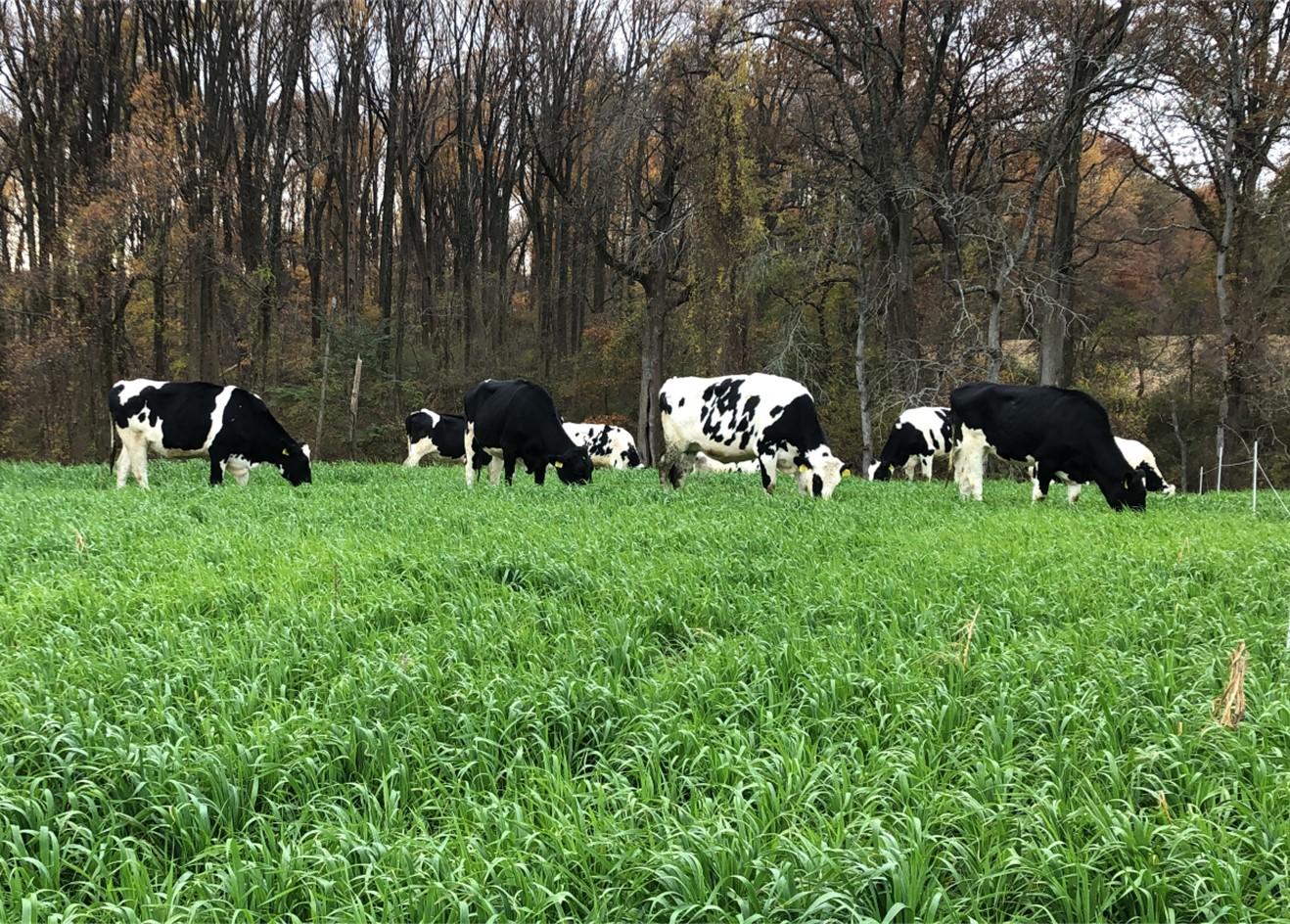
Grazing: rotational grazing of annuals & perennials
Initial and final body weight and hip height was similar
Both groups achieved 85% of mature weight at calving
While initial body condition was similar, final body condition was slightly reduced for grazing heifers
Methods
Pregnant Holstein dairy heifers (n=166; 2021-2023) from the University of Maryland Dairy were utilized for this study. Heifers were enrolled in the study on a rolling basis, with heifers added following pregnancy confirmation and removed approximately 3 weeks prior to calving. Upon enrollment, heifers were randomly assigned to one of two treatments groups: control (CON) or grazing (ROT). Heifer groups varied in size throughout the study period (ranging from 15 to 22 per group) but were kept consistent between treatments at any given time.
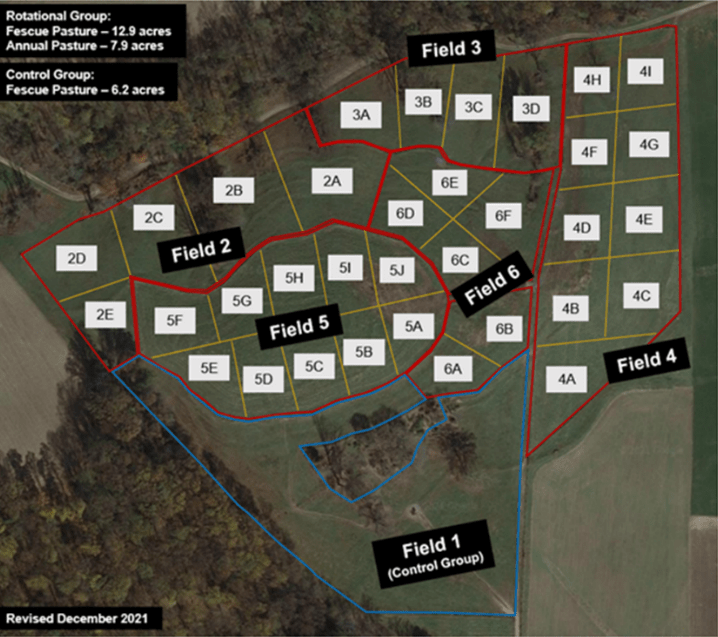
Heifers in the CON group received a total mixed ration (TMR) once per day and had access to one continuously managed 6-acre perennial pasture consisting of mostly tall fescue. Heifers in the ROT group were rotationally grazed across 21 acres of both perennial and annual pastures subdivided into approximately 0.6-acre paddocks; heifers were rotated to a new paddock every 1-3 days, depending on forage availability. Perennial pastures within the rotational grazing system were similar to the control pasture and consisted of mostly tall fescue. Annual pastures within the rotational grazing system were established on a seasonal, rotating basis using cool-season annuals (triticale-oat-annual ryegrass-crimson clover mixture) followed by warm-season annuals (sudangrass-cowpea mixture). Heifers in the ROT group also received a daily ground corn/mineral mix at a rate of 1 pound per head per day to ensure appropriate mineral intake and meet dietary requirements. An overview of the pasture layout and sizing for both groups is shown in Figure 1.
Figure 1. Pasture map depicting grazing areas for the control (blue) and grazing (red) treatment groups, as well as paddock subdivisions for the grazing group (yellow). Annual pastures were located in fields 5 & 6.
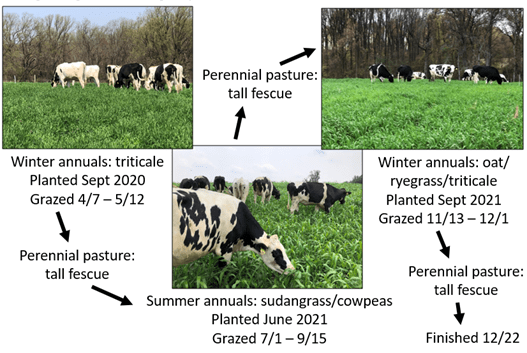
Figure 2. Timeline of seasonal grazing rotation across forages for heifers in the grazing treatment group in 2021.
The study ran annually from around the beginning of April through the end of December. Throughout the growing season, heifers in the ROT group alternated between annual and perennial pastures based on forage availability and growth; actual dates spent grazing the different forage types varied from year to year, but as an example the grazing dates for 2021 are shown in Figure 2. Throughout the study, both groups of heifers were measured every two weeks to determine bodyweight (BW), body condition score (BCS), hip height (HH), and average daily gains (ADG). Forage samples were collected every two weeks to determine forage yield and nutritive value; for each treatment group, samples were collected from the paddock immediately prior to grazing.
Results
A full analysis of the results for this study is in progress, but some preliminary findings are included here. On average, heifers were enrolled in the study for 144 days and there was no difference between treatment groups. The average nutrient composition for the TMR fed to the CON heifers and the pastures grazed by both CON and ROT heifers is shown in Table 1.
Table 1. Nutrient profile of forages and TMR for control and grazing treatment groups
Control Treatment (CON)
Rotational Grazing Treatment (ROT)
Nutrient, %DM
Fescue
TMR
Fescue
Sundangrass
Triticale
DM
24.3
42.8
24.9
18.7
18.8
NDF
49.6
40.9
50.2
49.6
42.6
CP
20.4
14.1
19.1
22.3
22.3
TDN
65.7
65.4
66.5
68.8
71.6
Starch
2.1
15.1
2.0
3.3
2.9
Sugar
9.7
4.8
10.0
6.7
13.2
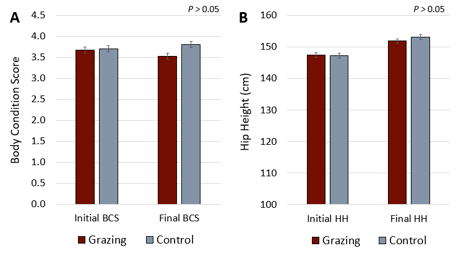
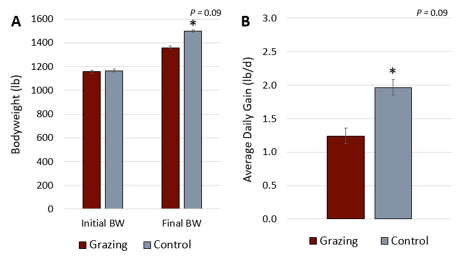
Initial bodyweight, body condition score, and hip height were similar between treatment groups, with heifers averaging 1161 lbs BW and 3.7 BCS when they started grazing (Figures 3-4). Final body condition score and hip height were not statistically different between the two treatment groups (P > 0.05; Figure 3). However, average daily gain and final bodyweight tended to be lower for the ROT heifers compared to the CON heifers (P = 0.09; Figure 4). Final bodyweight and average daily gain for the ROT heifers was 1359 lbs and 1.3 lb/d, respectively, while final bodyweight and average daily gain for the CON heifers was 1499 lbs and 1.9 lb/d, respectively.
Figure 3. Initial and final body condition score (A) and hip height (B) for heifers in the control and grazing treatment groups.Figure 4. Initial and final bodyweight (A) and average daily gain (B) for heifers in the control and grazing treatment groups.
Although these results indicate a slightly slower growth rate for ROT heifers, heifer body condition was still good and was comparable to their CON counterparts. Final bodyweights for the ROT heifers were still acceptable and they achieved or exceeded 85% of mature bodyweight at first calving. Performance of heifers from both treatment groups were tracked as heifers went through their first lactation; additional data analysis moving forward will explore possible carry-over effects of these management systems on first lactation milk production, health, and reproductive performance.
Interestingly, heifers in both groups initially lost weight following their enrollment in the study, suggesting that both groups required an adaptation period to adjust to their new environment. Prior to study enrollment, all heifers were group-housed in a barn and fed a TMR once daily. Following study enrollment, CON heifers required an average of 23 days to regain their starting bodyweight while ROT heifers required an average of 35 days. The longer adaptation period for the ROT heifers is not surprising given that they experienced a more dramatic change in housing and diet compared to the CON heifers. This highlights the importance of adaptation when making housing or feeding changes for heifers.
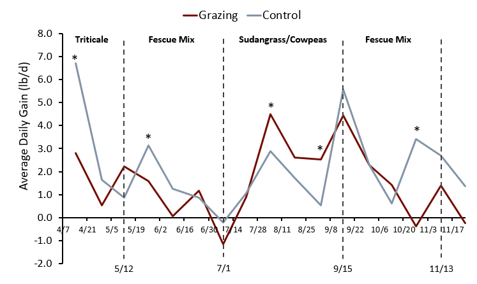
Heifer average daily gains varied considerably across weigh periods; an example of this variability in daily bodyweight gains for both groups of heifers is demonstrated in Figure 5 (data from 2021 grazing season). Variability in daily gains was likely due to a number of factors, including heifer adaptation, heifers entering/leaving the study, changes in forage type and forage quality over time (especially for the ROT group), and varying weather conditions throughout the grazing season. The ROT heifers appeared to perform substantially better while grazing the warm-season annual mixture (sudangrass/cowpeas) during the heat of the summer, which might be expected given the nutrient profile of this pasture (shown in Table 1).
Figure 5. Heifer average daily gain across weigh periods during the 2021 grazing season for heifers in the control and grazing treatment groups. Vertical dashed lines indicate when changes in pasture type occurred for the grazing treatment group. Asterisks indicate statistically significant differences.
Take Home & Conclusions
A detailed economic analysis comparing expenses between these systems is forthcoming. Although these results indicate a slightly slower growth rate for ROT heifers, final body weights and body condition scores of these heifers were still acceptable and they achieved or exceeded 85% of mature bodyweight at first calving. Overall, these results demonstrate that bred heifers managed in an improved grazing system can achieve satisfactory growth relative to TMR-fed counterparts. Because the replacement heifer program is typically the second or third greatest expense on the dairy and feed often exceeds 50% of those costs, increasing utilization of pasture may be an economical choice for some producers to reduce costs on their farm without compromising performance.
Producers looking to improve grazing systems on their farm should begin by exploring simple management changes including the implementation (or increased intensity) of rotational grazing practices, ensuring proper soil fertility, and increasing forage diversity within the pasture. Incorporation of annual forages into the grazing system may also help improve animal performance by offsetting the reduced summer growth (i.e. summer slump) in perennial pastures and mitigating the palatability and forage intake issues associated with endophyte-infected tall fescue pastures during the summer.
Future Plans
Moving forward, a comprehensive analysis comparing the economics behind heifer performance within each of these systems will be completed, along with an evaluation of potential carry-over effects on heifer first lactation performance. Future studies will continue to explore how improvements in pasture management affect heifer performance and the economic viability of the heifer program.
Acknowledgements
We are grateful for the assistance provided by the staff at the Clarksville Dairy Farm in support of this study. This study was partially funded by the Maryland Agricultural Experiment Station Competitive Grants Program and by a Northeast SARE Research and Education Grant.
Interested in more forage-related resources and information?