Adult Pea Aphid with two juveniles on a flower petal.

Pea aphid adult and juveniles. Photo: Joseph Berger, Bugwood.org

Updated: October 20, 2025

Key points about aphids

  • Aphids are small pear-shaped insects that can vary in color. Some individuals may have wings.
  • Aphids are very common insects, and can be found on a wide range of plants. They are usually discovered in large numbers since they can reproduce quickly.
  • Aphids feed on plant sap using their straw-like mouthparts. Plant damage from aphid feeding tends to be minimal, though there is a risk they could transmit a plant virus.
  • Many predatory insects and songbirds eat aphids and help to lower their populations naturally. When necessary, aphids can usually be managed with sustainable, chemical-free tactics such as strong water sprays and physically squishing or brushing off the insects.

Identifying aphids

  • Aphids are small, soft-bodied insects with a pear-like or teardrop shape, about ⅛ to 1/16 of an inch long (2-4mm). Their legs and antennae are long and slender.
  • Aphid adults sometimes have transparent wings, which will be much longer than their body.
  • Cornicles are a key feature of aphids, and they are usually prominent. They look like a pair of tailpipes on their rear (abdomen), sometimes darker than the body color.
  • Aphids are often green, but their body color can vary, and may be yellow, rosy-pink, red, blue-black, or dark gray. The bodies of woolly aphids are covered in fluffy white wax.
Drawing of multiple aphids clustered on a plant stem. A magnified circle highlights two adult aphids for comparison, one winged and one wingless.
Winged and wingless aphids in the same colony.
Illustration: John Davidson, UMD Department of Entomology
Drawing of an aphid that includes notable features like straw-like mouthparts and upright cornicles on the rear end.
Body structure of a wingless aphid, showing the straw-like mouthparts tucked under the head (on the left), and upright cornicles on the abdomen (on the right).
Illustration: Eugene Wood, UMD Department of Entomology

Examples of distinctive aphids

Some aphid species are easier to identify based on their unique appearance and their association with a particular host plant. Below are a few examples of some of the unique-looking aphids found in Maryland gardens and landscapes.

Oleander aphid

Scientific name: Aphis nerii

General appearance: bright orange-yellow, with black legs and cornicles

Host plants: primarily members of the dogbane family (Apocynaceae), both hardy and tropical, including milkweeds (Asclepias species), oleander (Nerium oleander), and Hoya species

Photo: D. Clement, UME

Beech blight aphid

Scientific name: Grylloprociphilus imbricator

General appearance: powdery grayish color with a reddish-brown abdomen, with a prominent tuft of fluffy-looking white wax attached to the end of the abdomen, as large as (or larger than) the body of the aphid itself

Host plants: primarily American beech (Fagus grandifolia), and potentially also on the roots of baldcypress (Taxodium distichum)

A type of woolly aphid, beech blight aphids form large colonies that can cover a foot or more of a beech branch, clustering on both the twig and the undersides of the surrounding leaves. When disturbed, they will vigorously wiggle their abdomens, with the dance-like movements earning them the common nickname "boogie-woogie aphids."

Learn more about this species in Ohio State University's article "Beech Blight Aphids Got Talent."

Photo: M. Talabac, HGIC

Witchhazel cone gall aphid

Scientific name: Hormaphis hamamelidis and Hormaphis cornu

General appearance: galls (plant tissue deformities) are cone-shaped, emerging from the upper surface of the leaf; galls may be green or reddish; the aphids themselves are very small and hidden inside of the gall

Host plants: common witchhazel (Hamamelis virginiana); also river birch (Betula nigra) for Hormaphis cornu

The similarly-named spiny witchhazel gall aphid, a different species, forms galls among the witchhazel flower buds, not on the leaves.

Photo: M. Talabac, UME

Brown ambrosia / goldenglow aphid

Scientific name: Uroleucon species

General appearance: reddish or dark reddish-brown, with dark cornicles and long legs and antennae

Host plants: primarily members of the daisy family (Asteraceae), including black-eyed Susan (Rudbeckia), cup plant (Silphium), coneflower (Echinacea), sunflower (Helianthus), and goldenrod (Solidago, Euthamia, and Oligoneuron species)

To discourage predators, a colony of these aphids will jerk their bodies from side to side when disturbed. Learn more in the Bug of the Week blog article "Cup plant feeds brown ambrosia aphid, Uroleucon ambrosiae, which in turn provides dinner for lynx spiders, lady beetles, long-legged flies, flower flies, and green lacewings."

Photo: M. Talabac, HGIC

Giant conifer aphid

Scientific name: Cinara species

General appearance: large for an aphid (up to a quarter-inch), long-legged and dark in color

Host plants: conifers, including pines (Pinus), junipers (Juniperus), spruces (Picea), and firs (Abies); each aphid species in this group uses a particular host plant genus or species

People may encounter this aphid indoors if live or fresh-cut conifers are used for holiday decorations. If the aphids wander off the plant in that situation, avoid stains by not squishing them.

Learn more about a common species in the Ohio State University article "Late-Season White Pine Aphids."

Photo: white pine aphid (Cinara strobi) by Joe Boggs, Ohio State University Extension

Purple-spotted lily aphid

Scientific name: Macrosiphum lilii

General appearance: yellow, with a prominent reddish-purple blotch, long antennae, and long black cornicles

Host plants: primarily lilies (Lilium species)

Photo: M. Talabac, HGIC

Aphid look-alikes

A few insects that live in groups or masses and have a similar appearance to woolly or winged adult aphids. Examine the insects for distinguishing features to separate them:

  • Look-alike insects will not have cornicles, though occasionally aphid cornicles are hard to see because they are reduced in size or hidden by fluffy wax. A hand lens may be helpful.
  • Wings on adult aphids are usually clear (or mostly clear), and the antennae are often body length or longer.

Adelgids

Adelgids feed on conifers (needled evergreens) like spruce and hemlock. They can look white and woolly, and might be confused for woolly aphids.

There are two primary species in Maryland: Hemlock Woolly Adelgid and Cooley Spruce Gall Adelgid.

Photo: Steven Katovich, Bugwood.org

Barklice

Barklice (psocids) are winged as adults, and often are larger than aphids. They possess chewing mouthparts, not the straw-like mouthparts of aphids.

Barklice can congregate on bark on outdoor plants to feed on lichen, pollen, fungi, and decaying material. They do not harm plants.

Photo: Jessica Louque, Smithers Viscient, Bugwood.org

Mealybugs

Mealybugs resemble woolly aphids due to their white, waxy coating. However, the wax on mealybugs is more like a powdery coating, and is not fluffy or uniformly tufted like that of woolly aphids.

Aphids have prominent legs and antennae; mealybugs do not. Adult female mealybugs do not have wings. (The gnat-like adult male mealybugs do, but they are tiny and rarely seen.)

Mealybugs are more common on indoor plants than outdoor plants. Root-feeding mealybugs and root-feeding aphids can be difficult to tell apart.

Photo: Whitney Cranshaw, Colorado State University, Bugwood.org

Whiteflies

Whitefly adults resemble winged aphid adults in body shape. However, whiteflies are often smaller than aphids, and whitefly wings will be powdery white instead of transparent as they are with aphids. The antennae are also usually shorter in whiteflies than in aphids.

Photo: Whitney Cranshaw, Colorado State University, Bugwood.org

Life cycle and behavior

Feeding

  • A straw-like mouthpart, called a proboscis, contains needle-like stylets that are used to tap into the phloem (plant vessels that transport sap around the plant). Aphids can feed from phloem tissue in leaves (often from the underside of the leaf), flowers, stems, branches or trunks, and more rarely, roots.
  • Some aphid species use more than one plant species as hosts, and may alternate between two different plant species at different times of year. Examples include:
    • witchhazel cone gall aphid: witchhazel and river birch
    • woolly apple aphid: apple and elm (among other species)
    • woolly elm aphid: elm and serviceberry
    • woolly alder aphid: alder and silver maple
  • Some root-feeding aphids (Pemphigus species) live on the leaves of one host plant (trees) in fall and spring, and move to the roots of a secondary host (annuals and perennials) in summer.
  • A few aphid species create leaf galls. Galls are abnormal tissue swellings in a plant.
    • Since they feed inside of a gall that forms around them, the aphids are not directly visible.
    • The host plant and gall’s appearance help to identify the aphid responsible. One example is the witchhazel cone gall aphid.
    • Leaf galls typically only cause aesthetic damage and do not significantly harm the health of the plant.
  • A byproduct of aphid feeding is the excretion of a sugary liquid waste called honeydew. Honeydew can drip down on any surface underneath aphids, including plant material, sidewalks, cars, and outdoor furniture.
Drawing of an aphid inserting its mouthparts into the phloem vessels inside a leaf, viewed in cross-section from the side.
Aphid proboscis and stylets reaching phloem in a leaf cross-section.
Illustration: John Davidson, UMD Department of Entomology

Reproduction

  • Adult females can either lay eggs or give birth to live young, depending on the aphid species and the time of year (daylength). They are also capable of parthenogenesis, a form of asexual reproduction where an embryo develops from an egg without fertilization. This is one reason why aphid populations can rise rapidly. Some female aphids can produce as many as twelve juveniles per day.
  • Multiple generations are produced over the course of a year, and adults can be present with juveniles of different ages. Juvenile aphids (nymphs) look like wingless adults, only smaller.
  • Eggs are usually the overwintering life stage outdoors. Most aphid eggs are too small to be noticeable and are laid on bark, though the white pine aphid has more prominent glossy black eggs laid end-to-end along a pine needle. Some aphids may overwinter as adults on weeds or in other sheltered places.

Host plants

Over sixty recorded aphid species occur in Maryland. Due to this diversity, aphids can be found on a wide variety of outdoor plant species. They can also occur on indoor plants like orchids, gardenias, citrus, succulents, and patio tropicals like hibiscus that are overwintered indoors.

Vegetables that appeal to aphids include: beans, beets, broccoli, Brussels sprouts, cabbage, cantaloupes, cauliflower, collards, cucumbers, eggplant, kale, peppers, potatoes, pumpkins, radishes, spinach, squash, tomatoes, turnips, and watermelons.

Looking for aphids

Signs and symptoms help to diagnose an aphid presence. Signs are direct evidence of the organism, and include visible insects themselves or their byproducts and residues. Symptoms are unusual changes in plant growth or appearance and indirect evidence of plant harm.

Signs of an aphid population

Living in groups

Living in groups makes aphids easier to detect. Common feeding locations include young leaves and flower buds. Groups of woolly aphids are typically found around trunk wounds or crevices on young branches.

Photo example: rose aphids clustered on a rose bud

Photo: Whitney Cranshaw, Colorado State University, Bugwood.org

White shed skins

Exuviae are the shed skins from insects molting as they mature. The white exuviae of aphids often stick to the plant near where the group is feeding, and might be easier to see than aphids blending in with the leaves or tucked underneath curled leaves. A hand lens or magnifying glass may be needed.

Photo example: shed aphid skins sticking to an eggplant leaf

Photo: J. Traunfeld, HGIC

Honeydew and sooty mold

Honeydew is the excreted sugary waste of sap-sucking insects. The clear liquid can coat leaves or nearby surfaces, making them glossy and sticky. Black sooty mold fungus may grow on honeydew deposits, and might be more noticeable.

Photo example: shiny honeydew residue on a tulip poplar (Liriodendron tulipifera) leaf

Photo: HGIC

Honeydew and Sooty Mold

Ants

Ants will often tend aphids like a herd of livestock, wandering over the colony and protecting them from predators. In return, the ants benefit from consuming sugary honeydew.

Numerous ants roaming over plant stems or around the base of a plant may indicate the presence of aphids.

Photo: Matt Bertone, NC State University

Plant symptoms associated with aphids

Low aphid numbers usually result in minimal plant damage. Abundant aphids may cause leaf deformities or yellowing, and reduced plant growth and vigor on vegetables, perennials, shrubs, trees, vines, or indoor plants. Aphid feeding may stunt or kill seedlings, small plants, or annuals.

Leaf distortion

Young leaves that are still expanding when aphids are feeding can become permanently deformed: stunted, crinkled, or curled.

Heavy honeydew deposits can also cause emerging leaves to stick together, potentially tearing or kinking as they unfurl. This is more of an issue with indoor plants, since the residue is not rinsed off by rain.

Photo: HGIC

Leaf discoloration

Patchy yellowing can occur on the upper leaf surface if groups of aphids are feeding underneath. This yellowing can sometimes look like individual tiny yellow dots (stippling) on a leaf’s upper surface, or a blotchy patch of yellow.

Photo example: beech aphid feeding symptom on American Beech (Fagus grandifolia); this can be confused with beech leaf disease, which causes dark banding when the leaf is backlit

Photo: M. Talabac, HGIC

Viral transmission

Aphids can potentially transmit (vector) plant viruses if they feed on an infected plant before moving to a healthy plant. Symptoms of infection will depend on the type of virus transmitted and the host plant involved. Virus symptoms can include mosaic (marbled or mottled yellowing), ringspots (yellow rings or wavy lines), and the stunting of leaves or the whole plant.

Photo example: pokeweed mosaic virus on pokeweed (Phytolacca americana)

Photo: M. Talabac, HGIC

Aphid management tactics

Aphid outbreaks do not always require intervention, and nature usually suppresses them effectively outdoors. Leaves with aphid galls typically do not require removal or management. Indoors, monitor plants for pests so you can take quick actions to prevent outbreaks, as aphids can be fairly easy to remove physically. When taking action, only use pesticides as a last resort, and try the lowest-toxicity option first.

Discourage aphids

  • Support predators and parasitoids (natural enemies) by increasing plant species and structural diversity (layers like trees, shrubs, groundcovers) in your landscape. Ensure that your landscape has sources of nectar through all growing seasons, since many predators and parasitoids feed on nectar and pollen. These natural enemies are also sensitive to pesticides. Limit pesticide use to protect this natural source of sustainable pest management.
  • Avoid over-fertilizing plants, especially with nitrogen. Excess nitrogen promotes rapid, tender growth which is often more attractive to aphids and other insect pests. Research has shown that high nitrogen levels in plant tissue can increase susceptibility to pest attacks. (Explore more about the Impacts of Fertilizers on Insect Pests.)
  • Minimize plant stress by watering when needed and not growing vulnerable plants in locations subjected to reflected heat or reduced air circulation. Crowded plantings may also be more vulnerable to aphid outbreaks and may help aphids to spread more quickly.
  • Remove weeds from garden areas so they do not harbor aphids or diseases that aphids can transmit.
  • Apply row cover around seedlings and vegetable transplants to reduce aphid and other pest damage. Remove the cover when the plant begins to flower to allow for pollination. (Not all vegetable plants will need to be pollinated.)

Reduce aphid abundance

The most sustainable way to intervene is guided by the principles of Integrated Pest Management (IPM). Chemicals (pesticides) are only considered as a last resort when other methods fail.

Mechanical control

Aphids are soft-bodied, slow-moving, and easy to squish. Rub them off the plant with your fingers, or knock them off with a strong jet of plain water from a garden hose. Trim off curled leaves with aphids still underneath.

Knock ants off of a plant where they are tending aphids by shaking the plant or hosing-off the plant with plain water, which allows you to remove and manage the aphids more easily. Since root-feeding aphids often need to be tended by ants in order to survive, in those situations, ant management may be needed.

For infestations of root-feeding aphids on vegetables, remove and discard the affected plants. Lightly till the soil prior to replanting to kill or bury any aphids left behind, and replant with less susceptible crops.

Strong water spray from a garden hose rinsing pests off the bottom of leaves.
A strong spray of plain water from a garden hose can knock insect pests off of leaves. Be sure to spray both sides of the leaves. Photo: C. Carignan

Biological control

You do not need to purchase predators like ladybugs or lacewings to eat aphids that are on outdoor plants. Releasing lab-raised insects might introduce diseases or undesirable genes into the local population of natural enemies. Additionally, when released, many will disperse and leave the garden. Instead, you can attract and maintain local natural enemies through conservation practices like reducing pesticide use and incorporating a diversity of flowering plants.

While beneficial insect supply companies sell lab-raised predators and parasitoids, they are not practical for indoor use at home. (They are often sold in bulk for greenhouses and conservatories, may require higher humidity than typical homes provide, and the shipping of such a perishable item may be expensive.) Aphids on indoor plants can be managed with other control methods.

Group of pale-colored dead aphid mummies on a leaf. Some mummies have holes in their abdomen.
Several aphid mummies, some with emergence holes, on a corn leaf.
Photo: M. Potter, UME

Aphid “mummies,” which are hollowed-out dead aphids, indicate that tiny parasitic wasps were active and parasitized those individuals. Mummies are distinguished from live aphids by looking bloated and brown or cream-colored. Inside the aphid mummy is a developing parasitic wasp. Once the wasp emerges, there will be a round exit hole in the aphid mummy’s abdomen. Aphid mummies are a good sign, indicating there are biological control services present. Look for aphid mummies in an aphid population before you decide to intervene.

Dead aphid mummy, tan in color and with a round hole in its abdomen, among live green aphids on a leaf.
An aphid mummy with an emergence hole, a sign of parasitoid activity.
Photo: Whitney Cranshaw, Colorado State University, Bugwood.org

Chemical control

Aphid feeding rarely requires pesticides, even low-risk materials like insecticidal soap or horticultural oil. In general, insecticides can either kill aphids on contact or poison the aphids once the chemicals are ingested with plant sap.

Contact insecticides are the simplest and most immediately effective option.

  • Sprays must contact the aphids directly in order to work.
  • Aphids tucked underneath deformed leaves can be difficult to treat, and aphids inside galls will not be affected.
  • Repeat applications may be necessary since missed aphids can reproduce quickly.
  • Avoid applying contact insecticides on or near plants in bloom, as these applications could harm pollinators.
  • Low-toxicity insecticides include horticultural oil and insecticidal soap (these types of pesticides may go by a variety of brand or trade names).

Systemic insecticides are absorbed into the plant sap from foliage or root applications.

  • This category of insecticide may risk harming pollinators visiting flowers if a plant blooms soon after treatment.
  • How long a systemic chemical remains in the plant’s tissues can vary and is not always known.
  • Some systemic ingredients (the neonicotinoid group of chemicals) are restricted in Maryland for outdoor use only by certified pesticide applicators. Examples of neonicotinoid active ingredients include imidacloprid and dinotefuran.

Pollinators and Pesticides

Always read and follow all label directions, and make sure the product is labeled for use on the type of plant you are treating (such as vegetables) and the environment it is growing in (home landscapes or inside the home). Do not combine sprays or use alternative ingredients (home remedies like household soap or detergent).

Aphid natural enemies

Several species of insects, spiders, and birds will eat aphids. Become familiar with the appearance of different life stages of beneficial insects so they are not harmed by aphid removal efforts.

Ladybug larva on a leaf
Ladybugs (larvae and adults)
Photo: Matt Bertone, NC State University
Two gray caterpillars sitting among a colony of white woolly aphids on a twig.
Harvester caterpillars
Photo: Joe Boggs, Ohio State University
Parasitoid wasp laying an egg in an aphid. The wasp and the aphid are about the same size.
Parasitic wasps
Photo: Melissa Schreiner, Colorado State University, Bugwood.org
Legless green and brown-marked larva of a flower fly on a leaf.
Flower flies (larvae)
Photo: M. Talabac, HGIC
Metallic green fly perched on a leaf, eating another insect.
Long-legged flies (adults)
Photo: Matt Bertone, NC State University
Small brown spider sitting on a leaf, eating a red aphid.
Spiders
Photo: Mike Raupp, UME
Lacewing larva on a leaf
Lacewings (larvae)
Photo: Matt Bertone, NC State University
Golden-orange and black-marked beetle visiting a yellow daisy-type flower.
Soldier beetles (adults)
Photo: M. Talabac, HGIC
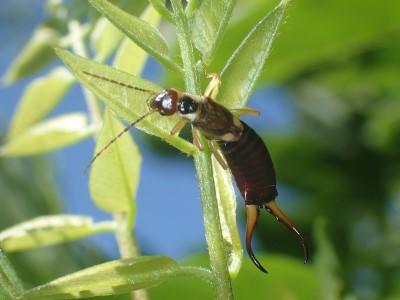
Earwig exploring a plant stem.
Earwigs (nymphs and adults)
Photo: Whitney Cranshaw, Colorado State University, Bugwood.org

Aphids and Natural Pest Control on Coral Honeysuckle

Author: Miri Talabac, HGIC Horticulture Coordinator, October 2025.
Reviewed by Madeline Potter, UME Faculty Specialist/Entomology & Integrated Pest Management, October 2025.


Still have a question? Contact us at Ask Extension.