

Many home landscapes have some moss growing on the ground, even in sunny exposures. Generally, moss thrives in semi-shady sites with abundant moisture. These under-appreciated and under-utilized plants are able to thrive in compacted, low-fertility, poorly-drained soil, and can be quite attractive as a groundcover. There are many different species of moss, with an array of shades of green and leaf textures, and many are very carefree to grow.
What is moss?
There are over 15,000 species of mosses found all over the world wherever there is moisture. They are part of a subdivision of non-flowering plants known as Bryophytes. Unlike other green plants, moss has no true vascular system: they do not have leaf veins or true roots, and instead absorb and translocate what they need directly from cell to cell by osmosis. Root-like structures called rhizoids help to anchor moss to the ground, tree bark, stone, and other surfaces. Instead of true leaves they have needles and scales of various sizes, shapes, and colors.
Moss life cycle
The moss life cycle is quite different from that of "higher" (flowering) plants. Mosses reproduce by spores - sexual reproductive cells that develop from the centers of leaf rosettes at the tips of the shoots. Water transfers the male cells to fertilize the female reproductive cells (eggs), which after fertilization become spore-bearing capsules. When mature, the capsules release their dust-like contents onto moist soil, logs, or rocks, and produce new moss plants.
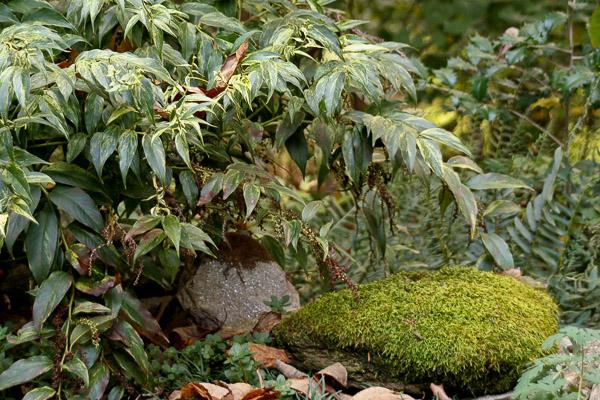
What are some of the common types of moss in the home landscape?
- Sheet Moss (Hypnum): typically grows flat on rocks, logs, and soil; it can be easily peeled back in a blanket-like layer or sheet
- Rock Cap Moss (Dicranum): common; forms cushion-like clumps on the ground
- Hair Cap Moss (Polytrichum): clump-forming; often found growing directly on the soil
- Cushion Moss (Leucobynum): clump-forming; grows directly on the soil
- Sphagnum Moss (Sphagnum): There are about 50 species in North America. Sphagnum mosses are the largest of the mosses and come in a range of colors, including green, reddish-orange, and golden-yellow. They are usually found in very wet areas, such as streams, lakes or pond edges, or marshland. Over many years it grows into and fills up the body of water creating a bog, with the deeper decomposing layers forming peat. The peat moss is so acidic that it is sterile, and was used during the Civil War as a wound dressing. Ancient peat bogs in Ireland that are now dry land are routinely harvested for making peat logs to burn in fireplaces and stoves. Sphagnum peat moss is harvested, shredded, baled, and sold to gardeners to improve soil structure or use as a primary ingredient in container potting mix.
How can you control unwanted moss in your lawn?
Moss is not responsible for lawn decline; instead, it takes advantage of areas where the grass is thinning-out due to unfavorable conditions. Moss growth tends to be associated with consistent moisture, shade, low soil fertility, and acidic soil. However, mosses are a diverse group, and not all species require those conditions. (Use laboratory soil testing, not the presence of moss by itself, to assess the soil to determine if adjustments like lime applications are needed.)
Moss is a valuable groundcover alternative to turfgrass in areas where moss naturally appears on its own. If moss must be removed, it is easy to dislodge since moss does not possess true roots.
- A sturdy rake should successfully pull moss off of the soil. If that does not work, certain herbicides are labeled for the control of moss; active ingredient options include iron sulfate and potassium salts of fatty acids. Follow product label directions for use.
- Apply the recommended amount of fertilizer and lime (according to a soil test), and improve drainage or resist compaction by adding organic matter. Sow grass seed onto any cleared areas and water daily, keeping the top layer of soil moist but not saturated until the grass has germinated and begun to establish.