
Snap It or Scrap It: Putting Plant ID Apps to the Test
Amanda Grev, Pasture & Forage Specialist, University of Maryland Extension
Have you ever questioned what type of plant you are looking at in your pasture or hayfield? Accurate plant species identification is essential for making management decisions in hay and pasture systems, but plant identification can sometimes be challenging. These days the easiest thing to do is usually pull out your phone and ask it. In fact, a wide variety of mobile phone apps are available and offer users the potential to quickly and easily identify plant species. But how accurate are these apps anyway? And are they able to detect and correctly identify common plant species under real-world field conditions?
To help answer this question, we set out to put these apps to the test. The goal for this project was to test the accuracy of nine popular mobile phone apps at identifying common plant species found in forage systems. There are hundreds of plant species that could be tested and compared, but target plant species for this project included common broadleaf and grass species located in pastures and hayfields across the region. So far, 30 different plant species (27 broadleaf and 3 grass species) have been tested. Tested species up to this point include: broadleaf dock, broadleaf plantain, buckhorn plantain, buttercup, Canada thistle, cocklebur, common mallow, common milkweed, common ragweed, curly dock, field mustard, field pennycress, fleabane, giant foxtail, hairy bittercress, hemp dogbane, henbit, horsenettle, johnsongrass, lambsquarter, marestail, Pennsylvania smartweed, perilla mint, pokeweed, purple deadnettle, redroot pigweed, spiny amaranth, velvetleaf, yellow foxtail, and yellow woodsorrel.
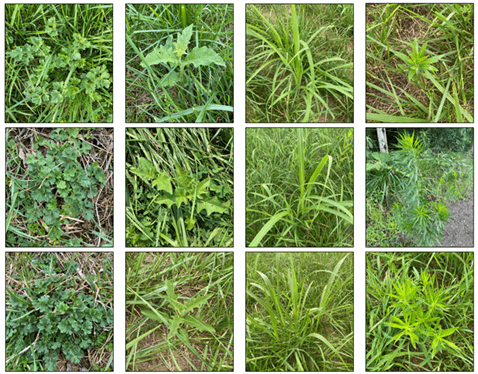
All plants were photographed using a cell phone camera, and all photos were taken on farms in Maryland during the growing season under normal field conditions. For each plant species, three unique images were selected (Figure 1). Because stage of maturity will likely affect the accuracy of the apps at identifying plant species, images depicting whole plants in a vegetative state (no flowers, seedheads, etc.) were used for this test.
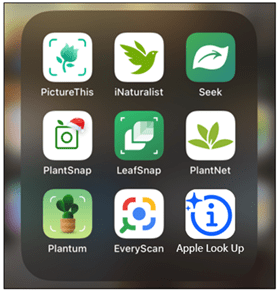
Each image (n=90) was individually run through nine different automated plant ID apps, including: PictureThis, iNaturalist, Seek by iNaturalist, PlantSnap, LeafSnap, PlantNet, Plantum, Google Lens, and Apple Visual Look Up (Figure 2). For each individual image, app performance was scored using the following scale: 4 = top suggestion correct; 3 = second suggestion correct; 2 = third suggestion correct; 1 = genus correctly identified but not species; and 0 = correct identification not provided.
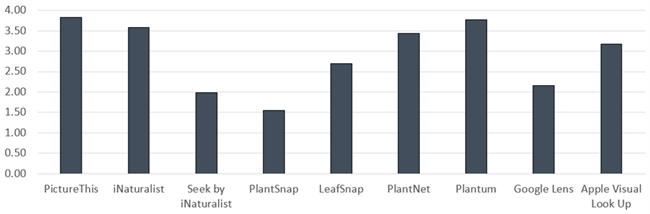
Across all nine apps, 61% of the tested images were identified correctly on the first suggestion and 74% were identified correctly within the first three suggestions. There was a lot of variability in individual app performance. The average score for each of the tested apps (4 = top suggestion correct; 0 = correct identification not provided) is shown in Figure 3. Of the nine tested apps, PictureThis was the most accurate, identifying 94% of tested images correctly on the first suggestion. Plantum was second, identifying 89% of images correctly on the first suggestion, followed by iNaturalist (79%) and PlantNet (66%). PlantSnap was the least accurate app, identifying only 26% of images correctly on the first suggestion. Overall, while the apps are not perfect, it appears that phone-based plant ID apps can be a useful tool for those wanting rapid identification of plant species in hay and pasture systems. Using these apps in conjunction with other tools (books, web searches, consulting with Extension educators or other professionals) should help provide some answers when looking to identify plant species in our hay and pasture systems. Moving forward, future testing for this project will include additional plant species (particularly more desirable grasses, legumes, and forbs), along with additional photos representing a broader range of plant growth stages.
This article appears in November 2025, Volume 16, Issue 8 of the Agronomy News.