
Tank Mix Options for Postemerge & Residual Weed Control in Soybean
Kurt Vollmer, Weed Management Specialist, University of Maryland Extension
In 2025, studies were conducted to explore the effectiveness of mixing different herbicides for controlling weeds in herbicide-tolerant (E3) soybean. Studies focused on two main factors: applying the herbicides at different times and using a combination of products that have both foliar and residual activity.
Using a mix of herbicides with different sites-of-action can help control a wider range of weed species. It’s a more reliable strategy than simply rotating herbicides year after year. By targeting multiple biological processes, the likelihood of a weed developing resistance to one specific herbicide is greatly reduced. However, it’s important to remember that some herbicides are great for immediate weed control, but herbicides with residual activity are often needed to ensure weeds don’t come back later in the season.
The study was conducted at the Wye Research and Education Center, as well as a grower’s field in Cordova, MD. Treatments evaluated both conventional and organic herbicides to see how well mixing different products worked when applied to emerged weeds (Table 1). Conventional treatments included Reflex and Enlist One, either alone or mixed together or with Dual Magnum. Organic treatments included Axxe and Homeplate, either on their own or in combination. A non-chemical method, flame-weeding, was also included.
| Treatment(s) a | Rate | Timing b |
|---|---|---|
| Reflex | 1.5 pt | EPOST or MPOST |
| Enlist One | 2 pt | EPOST or MPOST |
| Reflex + Enlist One | 1.5 pt + 2 pt | EPOST or MPOST |
| Reflex + Dual | 1.5 pt + 1.5 pt | EPOST or MPOST |
| Enlist One + Dual Magnum | 2 pt + 1.5 pt | EPOST or MPOST |
| Reflex + Enlist + Dual Magnum | 1.5 pt + 2 pt + 1.5 pt | EPOST or MPOST |
| Axxe | 13% v/v | EPOST or MPOST |
| Homeplate | 6% v/v | EPOST or MPOST |
| Axxe + Homeplate | 13% v/v + 6% v/v | EPOST or MPOST |
| Flame-weeding | N/A | EPOST or MPOST |
a Treatments containing Reflex, Enlist One, or Dual Magnum included Scanner at 0.25% v/v. Treatments containing Axxe or Homeplate included Oroboost at 0.25% v/v.
b Treatments were applied early-postemergence (EPOST) when weeds were approximately 3 inches tall or mid-postemergence (MPOST) one week later at the Wye site. Only one postemergence application occurred at the Cordova site.
Wye Results
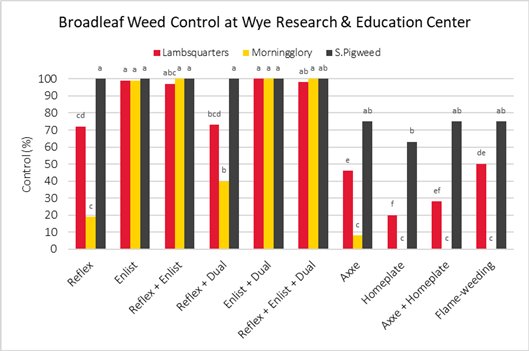
The timing of spraying did not change how well weeds were controlled 34 days after early postemergence applications. This is probably because the two spray dates were only a week apart. Overall, herbicide programs that included Enlist gave better control of lambsquarters, morningglory, and smooth pigweed than the other treatments (Figure 1).
Even though they are not labeled for grass control, the conventional herbicides still controlled 85% to 92% of grasses like large crabgrass, giant foxtail, and fall panicum. The organic herbicides controlled 62% to 68% of these grasses.

Axxe, Axxe + Homeplate, and flame-weeding sometimes worked as well as conventional herbicides, but their results were inconsistent. In some plots they gave complete weed control, and in others they gave none (Figure 2). Organic herbicides kill weeds by burning the plant tissue, and they don’t work as well on bigger, more mature plants. Even though the goal was to spray when weeds were only 3 inches tall, some larger weeds were present, which likely made the organic herbicides less effective.
Cordova Results

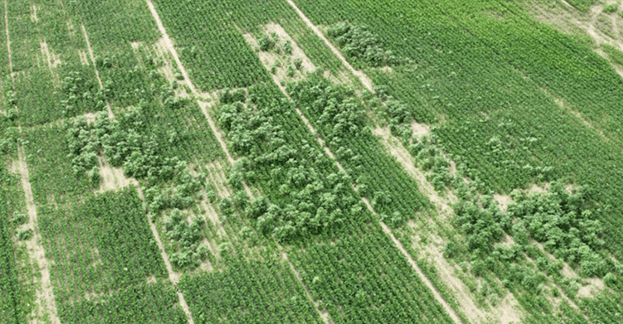
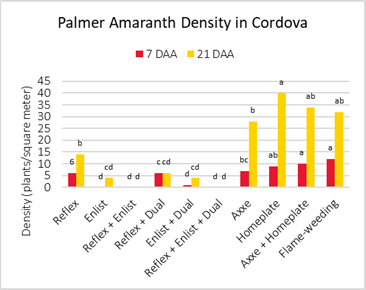
Palmer amaranth was the main weed at the Cordova location (Figure 3). Seven days after applications (DAA), the Reflex + Enlist treatments gave the best control followed by Enlist alone and Enlist + Dual (Figure 4).
Similar results were observed 21 DAA. Treatments containing Reflex and Enlist controlled 99–100% of the Palmer amaranth. In fact, almost no Palmer plants were found in these plots at either rating date. The number of plants in the Reflex + Dual treatment also did not change between rating dates (Figure 5).
Mixing herbicides that work in different ways is an important step to slow down weed resistance and get better weed control. It may cost more at first, but it can save money and trouble later. Using Reflex together with Enlist gave very good control of Palmer amaranth. Reflex and Dual Magnum also leave a soil “barrier” that keeps new weeds from sprouting. Even one Palmer amaranth plant that survives can quickly become hard to manage. Spray programs that stop weeds now and keep new ones from coming up later can save money and give better control than having to make several passes using only one type of herbicide each time.
Acknowledgements: We would like to acknowledge the Maryland Soybean board for funding this research; summer interns, Elise Lankford and Shelby Gustafson; as well as the Agronomy crew at the Wye REC, and our on farm cooperator.
This article appears in November 2025, Volume 16, Issue 8 of the Agronomy News.