
Updated: September 8, 2026
Measuring, Modeling, and Managing Soil Organic Carbon in Maryland Agriculture (EB-2026-0828)
This publication explains how Maryland farmers can measure and model soil organic carbon, use COMET-Farm to compare management scenarios, and apply soil-health information to conservation decisions. Authors: Gurpal S. Toor and Suzanne Dorsey; Title: Measuring, Modeling, and Managing Soil Organic Carbon in Maryland Agriculture (EB-2026-0828).
Updated: August 3, 2026
Soil Fertility Management-Converting Among Soil Test Analyses Frequently Used in Maryland (SFM-4)
Authors:
Frank J Cole
- Joshua M. McGrath
- Gurpal Toor
- Brian Kalmbach
- Paul Shipley
- David Ruppert
SFM-4 outlines conversions of soil test results from various regional soil test laboratories to Maryland's 'Fertility Index Value' (FIV) scale, upon which soil fertility recommendations for agricultural production are based. Authors: Frank J. Cole, Joshua McGrath, Gurpal Toor, Brian Kalmbach, Paul Shipley, and David Ruppert; Soil Fertility Management-Converting Among Soil Test Analyses Frequently Used in Maryland (SFM-4).
Updated: August 3, 2026
Soil Sampling for Optimizing Agricultural Production in Maryland (FS-1184)
Soil samples provide information about the soil fertility status of a field, which is used to generate nutrient and lime recommendations and develop a farm's nutrient management plan. This factsheet outlines proper soil sampling techniques (how, when, why) to optimize crop production, minimize environmental degradation, and maximize farm profitability. Authors: Brian Kalmbach and Dr. Gurpal Toor; Title: Soil Sampling for Optimizing Agricultural Production in Maryland (FS-1184)
Updated: July 28, 2026
Cultivating Conservation for Maryland and Delaware’s Historically Underserved Farmers (EM-2025-0752)
Authors:
Sarah Hirsh
- Shannon Dill
- Caroline Kuchta
- Neith Little
- Kelly Nichols
- Margaret Todd
This guidebook aims to increase knowledge of conservation practices and resources available to help farmers and land managers plan for and incorporate conservation onto their land. The guidebook discusses how conservation can fit into whole farm planning, conservation plans, the Web Soil Survey resource, an overview of agencies and conservation programs, and Natural Resource Conservation Service program eligibility and contract requirements. Authors: Sarah Hirsh, Shannon Dill, Caroline Kuchta, Neith Little, Kelly Nichols, and Margaret Todd; Title: Cultivating Conservation for Maryland and Delaware’s Historically Underserved Farmers (EM-2025-0752).
Updated: August 22, 2025
Soil Health (FS-2025-0754)
Authors:
Sarah Hirsh
Soil health is the status of soil in terms of its ability to function and sustain life. It involves physical, chemical, and biological factors that are all interrelated. Soil organisms are critical for building good soil structure, ensuring air and water movements through the soil, decomposing organic materials, and cycling nutrients. A soil with good physical structure and with sufficient nutrient cycling will encourage increased numbers and diversity of soil organisms. When we manage soil with practices that minimize disturbance, maximize soil cover, maximize biodiversity, and maximize the presence of living roots, we can increase soil health, increasing the sustainability and profitability of agriculture. Author: Sarah Hirsh; Title: Soil Health (FS-2025-0754).
Updated: January 20, 2023
Assessing the Extent of Soil Loss from Nursery Tree Root Ball Excavation (EB-442)
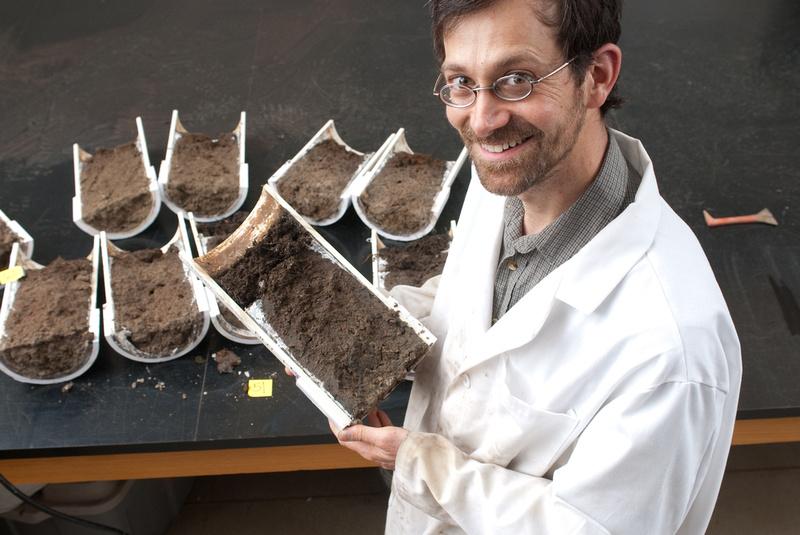
A soil quality management issue unique to tree nurseries is the removal of soil off site with sale of the ornamental trees and shrubs, which are harvested with a balled and burlapped (B & B) root ball. The amount of soil removed with B & B harvest and sale has been estimated as much as 5 cm per year. One piece of evidence that has been used to estimate soil loss during B & B tree harvest is the volume of the holes left behind. However, the soil balls wrapped for B & B removal are generally densely permeated with tree roots, leading some to assume that much or most of the ball removed consist of roots rather than soil. There is a dearth of published data on this soil removal or published methods that will allow for reliable calculation of soil being removed from individual enterprises.The main conclusion from this study is that a balled and burlapped (B & B) root ball consists almost entirely (99%) of soil and that the tree roots take up only a negligible portion of the mass and volume. Our results show that in fact the volume of the hole left behind is a reasonable estimate of the volume of soil removed. Authors: Ray Weil, Margaret Guthrie, Chuck Schuster, and Stanton Gill; Title: Assessing the Extent of Soil Loss from Nursery Tree Root Ball Excavation (EB-442)
Updated: January 19, 2021
Good Agricultural Practices (GAPs): Irrigation Water Treatment for High E. coli Levels
Authors:
Donna Pahl
What should you do if your water test results show that levels of generic E. coli exceed the maximum recommended amount? Before investing in a system to clean and sanitize your irrigation water, do a visual survey of your water sources to investigate what is causing the elevated microbial counts. Below are several strategies to consider.